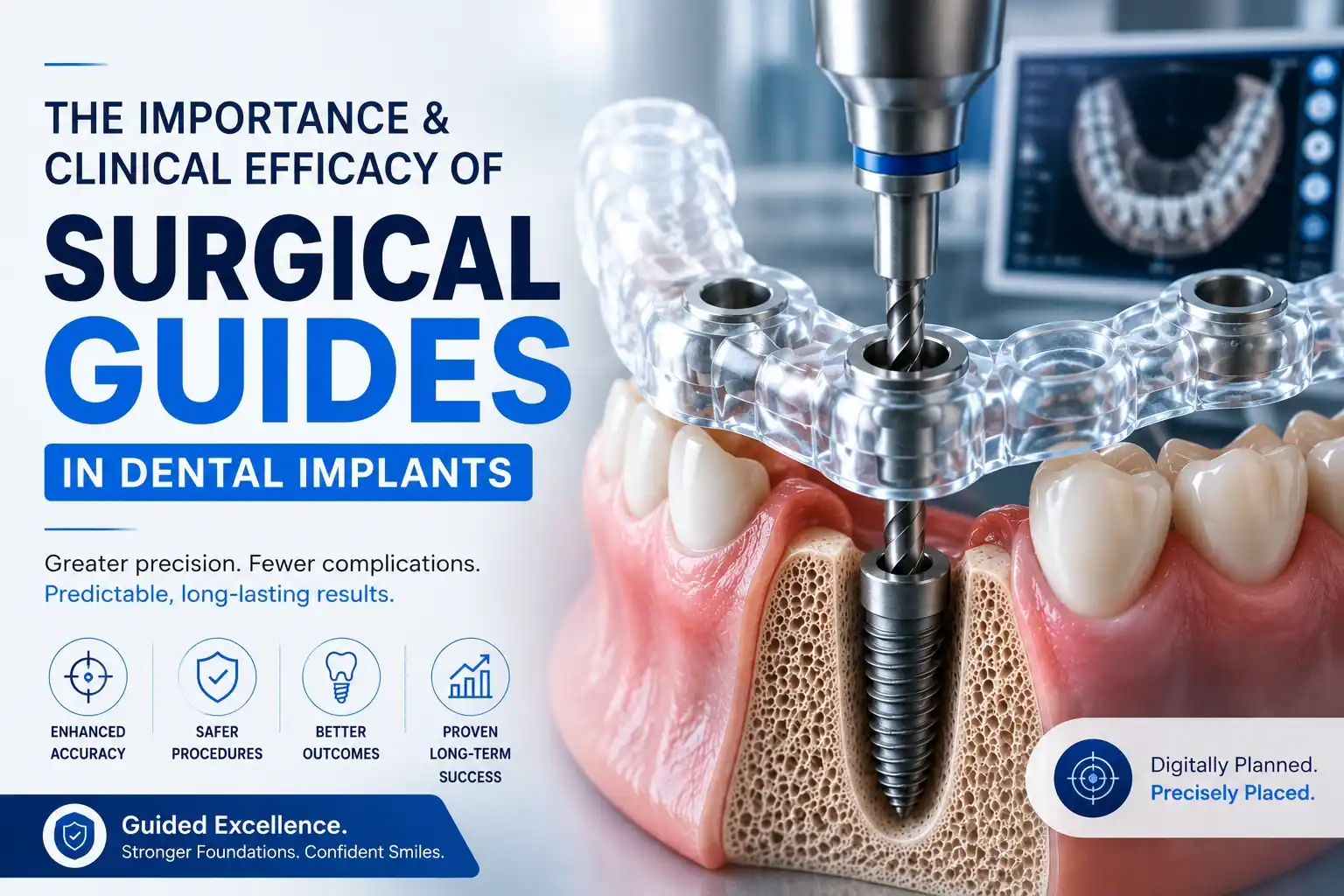

Dental implant surgery has undergone a fundamental shift over the past decade. What was once a procedure driven largely by surgeon skill and tactile judgment has become a digitally planned, mechanically guided process capable of delivering millimeter-level precision in every case.
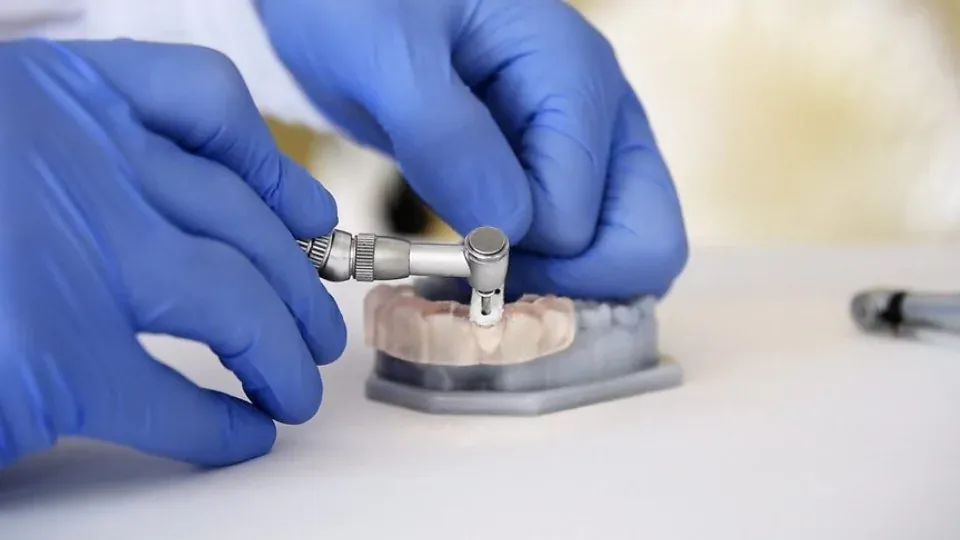
At the center of this shift is the surgical guide, a custom-fabricated device that translates a digital implant plan into physical surgical reality. This article examines why surgical guides are clinically important, what the evidence says about their efficacy, and what that means for dentists, implantologists, and the patients they serve.
Why Precision Matters in Implant Dentistry
Dental implants occupy a fixed position in three-dimensional space once osseointegrated, they cannot be repositioned. This irreversibility means that placement precision at surgery determines the quality of every clinical outcome that follows: crown esthetics, tissue health, bite function, and long-term implant survival.
The consequence of imprecision is immediate and lasting. An implant placed 1.5mm buccally produces a compromised emergence profile. An implant placed 2mm too deep creates a peri-implant tissue management problem. An angulation deviation of 10 degrees may require a prosthetic workaround that compromises the final restoration.
Surgical guides exist precisely to prevent these deviations. By mechanically constraining the drill to the approved plan, guides eliminate the variability that makes freehand implant placement a risk-dependent skill. Learn how our implant surgical guides eliminate this variability in every case.
The Clinical Evidence for Surgical Guide Efficacy
Accuracy: What the Research Shows
The most thoroughly studied benefit of surgical guides is positional accuracy specifically, how close the placed implant is to the virtually planned position. Research consistently demonstrates that guided surgery outperforms freehand by a factor of 2 to 4:
- Guided surgery: achieves apex deviation of 0.5 to 1.0mm mean (literature consensus across multiple studies)
- Freehand surgery: achieves apex deviation of 2.0 to 3.5mm mean, with high individual variability
- Angular deviation with guides: 2 to 5 degrees mean
- Angular deviation freehand: 5 to 12 degrees mean
A landmark meta-analysis by Tahmaseb et al. (2014) reviewed 46 studies involving over 1,700 implants. The pooled analysis found mean apex deviation of 0.65mm with guided surgery confirming that the accuracy benefit is consistent across settings, surgeons, and case types.
Schneider et al. (2009) conducted a large multi-center study examining over 800 implants across 10 clinical centers. Guided surgery achieved a mean deviation of 0.5mm versus 2.8mm for historical freehand controls. Operative time was reduced by an average of 16 minutes per implant. Complication rates were 0.2% guided versus 5.2% freehand.
Long-Term Implant Survival
The accuracy advantage of guided surgery translates directly into long-term survival outcomes. Well-positioned implants that support properly designed restorations demonstrate better bone maintenance, lower complication rates, and longer functional lifespans.
Clinical follow-up studies report 5-year implant survival of 98 to 99% for guided placements compared to 94 to 97% for freehand. Marchetti et al. (2016) followed 120 guided implants for 5 years and reported a 98.3% survival rate with mean marginal bone loss under 1mm outcomes consistent with the highest standards in implant literature.
Complication Prevention: The Safety Case for Guides
Nerve Injury Prevention
Inferior alveolar nerve paresthesia is one of the most serious complications in mandibular implant surgery. The mechanism is simple: when the surgeon misjudges depth and the drill or implant contacts the nerve canal, temporary or permanent sensory disturbance results.
Freehand surgery achieves depth accuracy of plus or minus 2 to 3mm a margin that creates real risk when the planned implant is in proximity to the canal. Guided surgery limits depth to a pre-calculated stop, maintaining a minimum 1.5 to 2.0mm safety margin regardless of bone resistance or operator fatigue.
Clinical evidence shows nerve paresthesia rates below 0.2% with guided surgery compared to 0.4 to 1.2% with freehand, a 4 to 6 times reduction in this serious complication.
Sinus Perforation Prevention
In the maxillary posterior, freehand depth miscalculation risks sinus perforation, a complication that ranges from minor (antibiotics-managed sinusitis) to serious (chronic sinus infection, implant removal, revision surgery). Guided surgery eliminates this risk through the same depth control mechanism. Our dental surgical guide design process verifies sinus floor clearance on every posterior maxillary case before fabrication.
Guided sinus perforation rates are under 0.5% compared to 2 to 5% for freehand a 4 to 10 times reduction.
Prosthetic Outcomes: Where Guided Surgery Delivers Visible Results
The esthetic and prosthetic benefits of guided surgery are most visible in the anterior zone. Crown esthetics, gingival symmetry, and emergence profiles all depend on implant position. When position is prosthetically driven and mechanically delivered, restorative outcomes are predictable.
Studies report first-time prosthesis fit rates of 90 to 95% with guided placements, compared to 70 to 75% for freehand. The practical impact is significant: fewer intraoperative adjustments, fewer remake fees, and higher patient satisfaction scores.
At Guided Excellence, every guide is designed using a prosthetic-driven approach; the restoration drives the implant position, not the other way around. This philosophy is embedded in our surgical guide design workflow.
Efficiency: The Time Savings Argument
The accuracy and safety benefits of surgical guides are supported by a practical efficiency case. Guided surgery consistently reduces operative time by 15 to 30 minutes per implant by eliminating the iterative positioning, re-drilling, and depth verification steps inherent to freehand technique.
For multi-implant cases, the time saving compound: a 4-implant guided case typically completes 60 to 90 minutes faster than its freehand equivalent. This reduces anesthetic exposure, patient fatigue, and operative complexity benefits that are especially significant for medically compromised patients.
Clinical Indications: When Guides Are Essential vs. Optional
The clinical importance of surgical guides scales with case complexity. In straightforward posterior single-tooth cases with generous bone, guides provide efficiency and accuracy improvements but outcomes are not critically at risk without them.
In the following scenarios, guides transition from beneficial to essential:
- Esthetic zone implants (maxillary anterior): position determines crown esthetics completely
- Proximity to the inferior alveolar nerve or maxillary sinus: depth control is a patient safety requirement
- Immediate implant placement: the extraction socket creates a path that may conflict with prosthetic ideal
- Multiple adjacent implants: inter-implant spacing and parallelism require coordinated mechanical control
- Full arch restorations: cumulative positional accuracy is impossible to achieve reliably freehand
If you are planning any of these case types, the clinical and safety evidence strongly supports using a surgical guide. Submit your case and let our team design a guide that meets the precision requirements of your specific clinical scenario.
Why Every Dentist Placing Implants Should Use Surgical Guides
The cumulative case for surgical guides is straightforward: they make every outcome better than the freehand alternative. Accuracy improves by 2 to 4 times. Serious complications decrease by 4 to 10 times. Operative time decreases by 15 to 30 minutes per implant. Prosthetic fit improves significantly. Long-term survival improves meaningfully.
No other single change in implant technique delivers comparable improvements across all of these dimensions simultaneously. The clinical evidence is consistent, extensive, and unambiguous.
At Guided Excellence, Dr. Zareh Baghoomian personally reviews complex cases before fabrication begins, ensuring that every guide reflects sound clinical judgment in addition to technical precision. Our flat-rate pricing for surgical guides makes this standard of care accessible without compromising your practice economics.