
When a surgical guide arrives at your practice, it has already passed a series of accuracy validation tests. Or it should have. The difference between a guide lab that systematically validates accuracy before delivery and one that ships guides without rigorous verification is measured in clinical outcomes, guides that seat perfectly and deliver planned positions versus guides that rock, bind, or produce unexpected implant placements.
This article explains what accuracy validation looks like in a rigorous dental lab setting, the specific tests that confirm a guide performs as designed, and what questions to ask to evaluate whether your guide supplier validates accuracy or assumes it.
Why Pre-Delivery Validation Cannot Be Skipped
A surgical guide is a single-use medical instrument that must perform correctly on its first, and only, clinical use. There is no adjustment at the chair. There is no second chance if the guide seats improperly or delivers drills off the planned trajectory. By the time accuracy problems become apparent, the patient is in the chair, anesthetized, and relying on the guide to perform as designed.
Pre-delivery validation is the process that catches accuracy problems before they reach the surgical field. Each validation step addresses a specific category of potential error, dimensional deviation, sleeve alignment, seating surface inaccuracy, sterilization stability, that could compromise clinical performance.
Validation Step 1: Digital Design Verification
Accuracy validation begins before a single layer of resin is cured. The guide design is reviewed against the approved virtual plan to confirm that all sleeve positions, angulations, and depth stops match the planning data exactly. Dimensional measurements in the design software confirm that sleeve inner diameters, wall thicknesses, and inter-sleeve distances fall within specification.
At Guided Excellence, this design review is performed before fabrication for every case, and for complex cases it includes clinical review by Dr. Baghoomian to verify that the technical design reflects sound clinical intent. This design verification step is part of our standard surgical guide manufacturing process.
Validation Step 2: Post-Print Dimensional Measurement
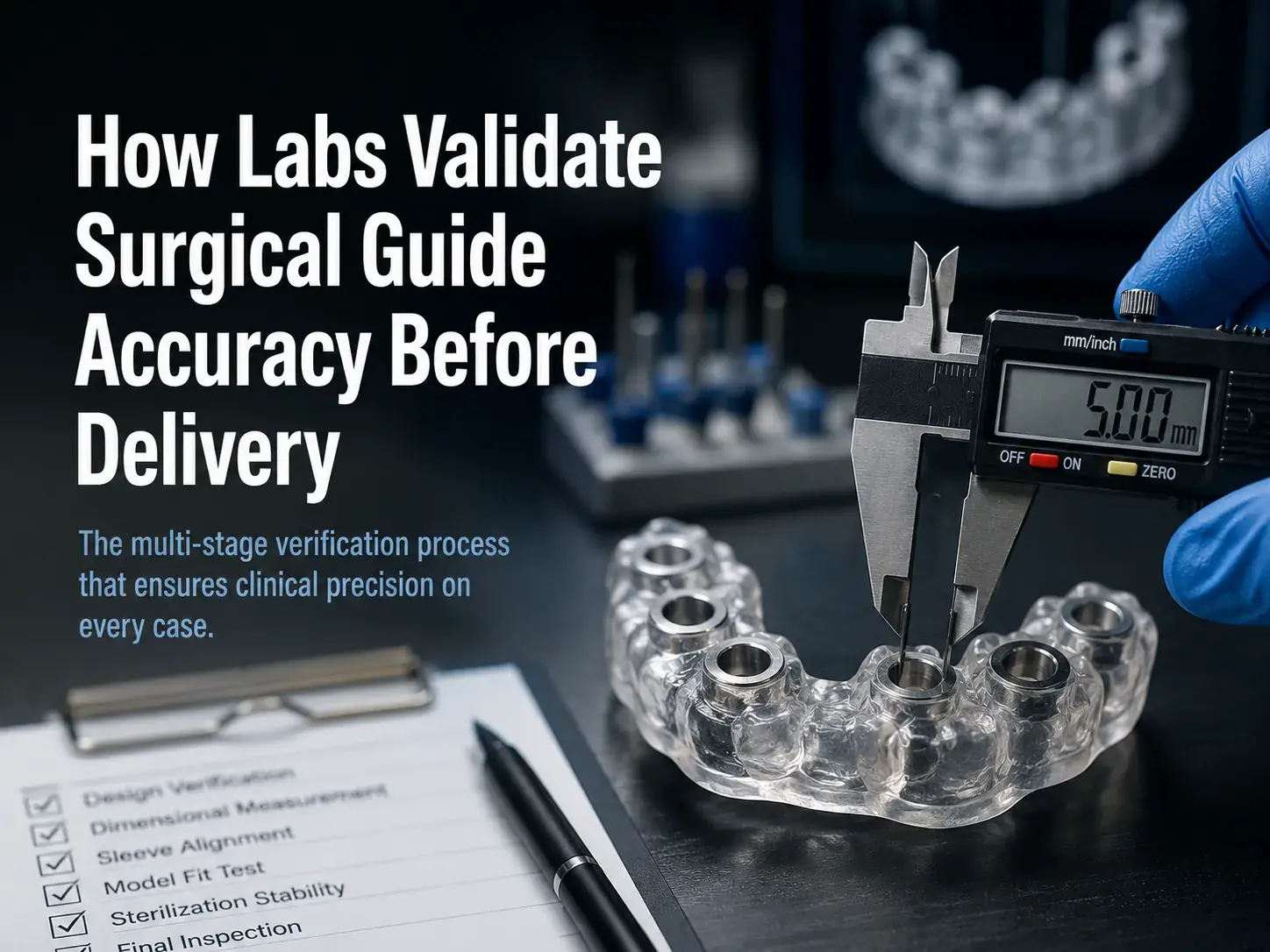
After 3D printing, washing, and post-curing, the physical guide is measured against the approved design specification. The critical measurements include:
- Drill sleeve inner diameters, measured individually with precision bore gauges to plus or minus 0.05mm tolerance
- Sleeve angulations, verified with digital angle gauges for guides with angled posterior sleeves
- Overall guide span dimensions, confirmed against design values using calibrated calipers
- Wall thickness at structural load points, verified to confirm adequate rigidity
These measurements are not estimated or sampled, they are performed on every sleeve in every guide. Any sleeve outside tolerance triggers either targeted replacement or complete reprinting depending on the nature of the deviation. Guides with out-of-tolerance dimensions are never released to shipment.
Measurement records are maintained for each case. Practices that require dimensional documentation for their patient files can request these records.
Validation Step 3: Sleeve Alignment Verification
Dimensional accuracy of the sleeve inner diameter is necessary but not sufficient. The sleeve must also be aligned correctly within the guide body, coaxial with the drill channel with no tilt or rotational offset. A sleeve with a correct inner diameter but a 2-degree installation tilt will direct the drill off the planned axis as reliably as an incorrectly sized sleeve.
Sleeve alignment is verified using optical inspection and angular measurement after each sleeve is press-fit into the guide body. Any sleeve showing measurable tilt is removed and reinserted. Retention of each sleeve is also tested, sleeves that can be rotated or displaced under finger pressure indicate inadequate press-fit and must be replaced.
Validation Step 4: The Model Fit Test
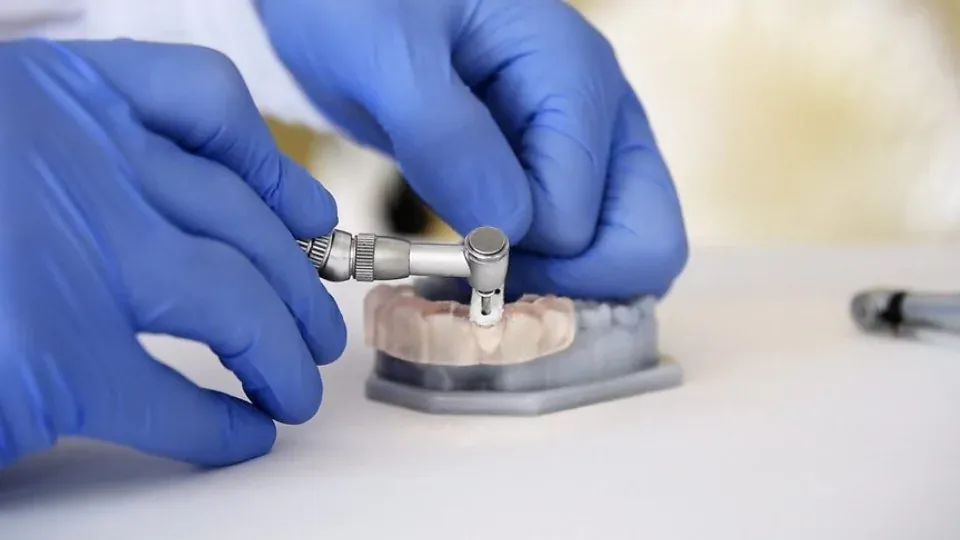
The model fit test is the most clinically relevant validation step and the one that most directly predicts guide performance in surgery. The completed guide is seated on the patient's three-dimensional model, a replica of the anatomy the guide was designed to contact. This test reveals the accuracy of the seating surface as an integrated whole, rather than individual dimensional measurements.
A guide that passes the model fit test demonstrates:
- Complete contact between guide seating surface and model with no visible gaps from any angle
- Zero rocking or movement under firm bilateral finger pressure applied from any direction
- Correct alignment of inspection windows with planned surgical landmarks
- Proper engagement of all retention features without requiring force to seat or remove
At Guided Excellence, this test is performed on every single guide before shipment, not on a sample basis and not only for complex cases. A guide that fails this test is not shipped regardless of timeline pressure. This is the most important quality commitment in our implant surgical guide manufacturing process.
Validation Step 5: Sterilization Stability Testing
A guide that is dimensionally accurate before sterilization but warps during autoclave processing will not deliver accurate results in surgery. Sterilization stability is validated by measuring critical dimensions before and after autoclave sterilization.
Acceptable dimensional change under sterilization: plus or minus 0.2mm. Guides that show dimensional change above this threshold indicate a material quality or cure completion problem. These guides are scrapped, the root cause is identified, and the resin batch or post-cure protocol is corrected before additional guides are produced.
Every guide also includes chemical indicator strips in the sterilization packaging that provide visible confirmation to the receiving clinician that sterilization temperature and time conditions were met.
Validation Step 6: Final Pre-Shipment Inspection
Before packaging, the completed guide undergoes a final visual and physical inspection:
- No damage from handling during production (scratches, chips, cracks)
- All sleeves present, correctly positioned, and showing no rotation
- Inspection windows and retention features intact
- Sterilization indicator strips included in packaging
- Patient label accurate with correct identifier and sterilization date
- Protective packaging adequate for shipping without risk of guide damage
What to Ask Your Lab About Accuracy Validation
The following questions separate labs with genuine validation processes from those that rely on assumptions:
- Do you measure every sleeve inner diameter in every guide, or do you rely on supplier specifications?
- Do you perform a model fit test on every guide, or only on complex cases?
- Can you provide dimensional measurement records for my cases?
- What is your process when a guide fails any validation step?
- Do you perform sterilization stability testing on your resin materials?
Labs that answer all five questions with specific, documented processes are labs that validate accuracy. Labs that provide vague reassurances about quality are labs that assume it. Submit your first case to Guided Excellence and experience validation-backed accuracy on every guide.