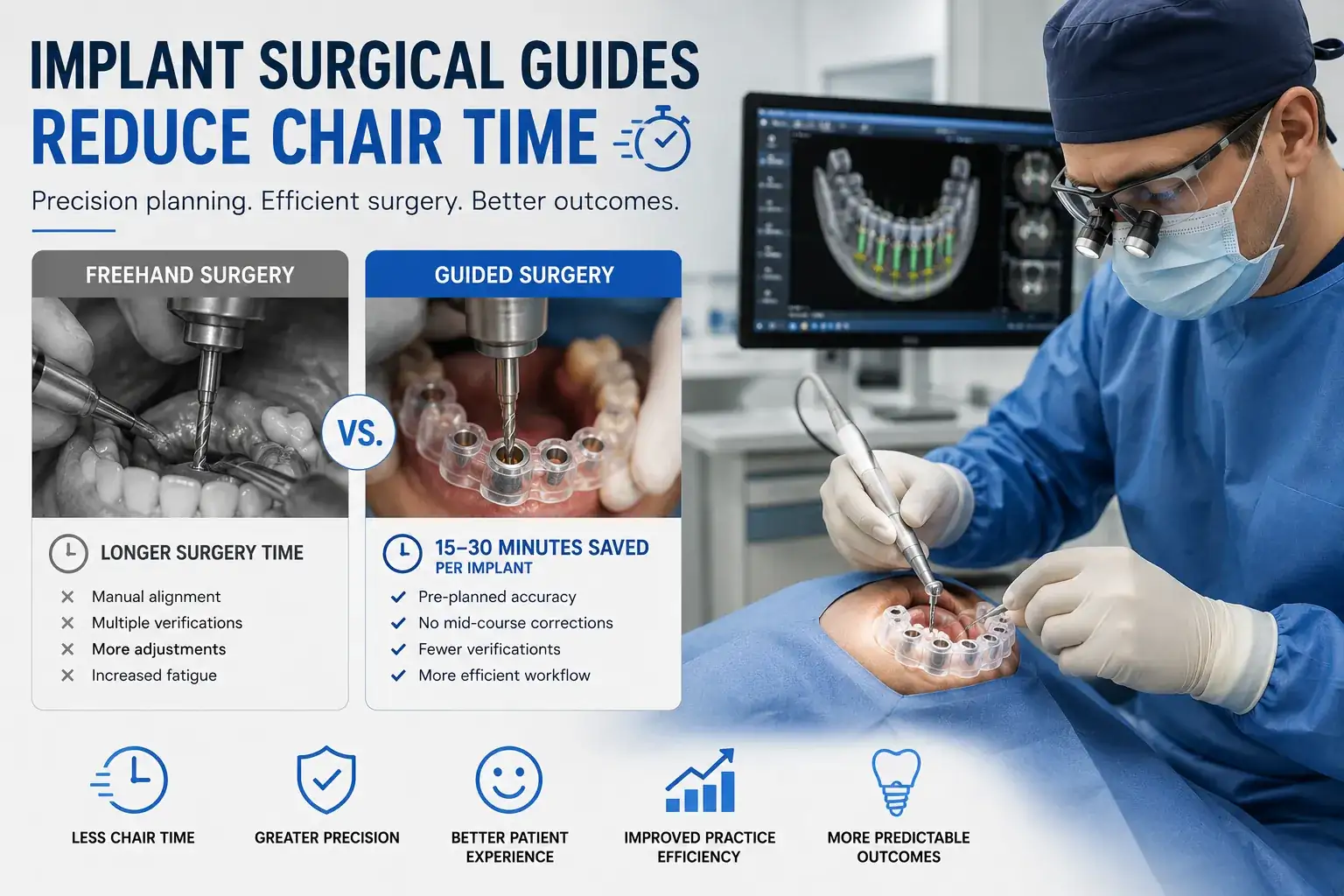

Operative time in implant surgery has a direct effect on patient safety, practice economics, and clinical quality. Longer surgeries expose patients to extended anesthetic effects, increase fatigue-related precision loss, and represent a significant cost in surgeon and staff time. For patients, every extra minute in the chair is additional discomfort, stress, and recovery burden.
Surgical guides consistently reduce operative time by 15 to 30 minutes per implant compared to freehand surgery. For multi-implant cases and full arch restorations, these savings compound into hour-long reductions in surgical duration. This article explains specifically where those time savings come from and what they mean for your practice.
Why Freehand Surgery Takes as Long as It Does
To understand where guide-driven time savings come from, it helps to understand what makes freehand implant surgery time-consuming. The answer is not drilling, the actual drilling process takes only minutes. The time cost in freehand surgery comes from the decision-making and verification steps that surround the drilling.
Initial drill alignment in freehand surgery requires the surgeon to determine, using tactile feedback and visual estimation, the correct entry point, angle, and depth for each implant. This estimation process typically takes 3 to 7 minutes per implant, including positioning, repositioning, and visual confirmation against adjacent anatomical references.
Progressive correction during the drill sequence adds additional time. As each successive drill follows the same path, the surgeon monitors for deviation and makes corrections, pausing, re-angulating, re-inserting. Any deviation in the initial pilot drill path compounds through the sequence and may require abandoning the preparation and re-drilling at a corrected position.
Depth verification at each drill size is another time consumer. Without mechanical depth stops, the surgeon verifies depth by withdrawing the drill, using a depth gauge or periapical radiograph, and confirming before advancing to the next drill. This process adds 1 to 3 minutes per drill per implant.
Where Surgical Guides Eliminate Time
Elimination of Initial Positioning Time
A surgical guide eliminates the initial drill positioning process entirely. The surgeon seats the guide, verifies it is fully seated (1 to 2 minutes), and inserts the first drill into the sleeve. The sleeve defines the entry point, angle, and direction. There is no estimation, no repositioning, no assessment of whether the angle looks right. Time saved: 3 to 7 minutes per implant.
Elimination of Mid-Sequence Corrections
Once the guide is seated, every drill in the sequence follows the same mechanically-constrained path. There are no corrections to make, the guide prevents deviation rather than requiring the surgeon to detect and correct it. The drill sequence proceeds without pauses for assessment. Time saved: 2 to 5 minutes per implant. See how our custom implant surgical guides eliminate this variability.
Elimination of Depth Verification Steps
Depth-limiting sleeves stop each drill at the pre-calculated depth. The surgeon feels the mechanical stop and moves to the next drill without measuring, probing, or radiographic verification between drills. For a standard 4 or 5-drill sequence, this eliminates 4 to 10 minutes of depth verification per implant.
Flapless Surgery: Multiplied Time Savings
Surgical guides enable flapless surgery in cases where bone anatomy and implant position are well-defined from CBCT. Flapless surgery eliminates incision (3 to 5 minutes), flap elevation (5 to 10 minutes), suturing (5 to 10 minutes), and the associated bleeding management. For single-implant cases, flapless guided surgery reduces the total surgical procedure to 15 to 25 minutes versus 45 to 60 minutes for open-flap freehand surgery.
Measured Time Savings: What Research Shows
Clinical research consistently confirms guide-driven time savings. Schneider et al. (2009) measured operative time in 800+ guided implant cases and compared to historical freehand data, finding mean operative time of 22 minutes per implant with guided surgery versus 38 minutes freehand, a 16-minute reduction per implant representing a 42% decrease.
For multi-implant cases, the savings per case are more substantial. A 4-implant guided case saves 60 to 80 minutes versus freehand. A full arch 6-implant guided case saves 90 to 120 minutes. These are not marginal improvements, they represent fundamental changes in what can be accomplished in a single session.
The Financial Value of Chair Time Savings
Chair time has a real financial cost, not just in overhead, but in lost opportunity. Consider a practice where the total cost of running a surgery session is $5 to $8 per minute including surgeon time, staff time, and facility overhead. At $6 per minute, a 20-minute saving per implant is worth $120 per case. For 50 guided implant cases per year, annual time savings total $6,000 in direct cost reduction. Our flat-rate surgical guide pricing starts at $150 per guide, the time savings alone deliver a strong return on investment.
Scheduling efficiency is a related benefit. When guided single-implant cases reliably complete in 25 to 35 minutes versus 50 to 60 minutes freehand, the practice can potentially schedule an additional implant case per surgery day. The revenue impact of one additional implant case per week, at typical implant case fees, far exceeds the weekly cost of guides.
Patient Benefits of Reduced Chair Time
The chair time reduction benefits patients directly, not just practices. Shorter surgeries mean less total local anesthetic exposure and faster return of normal sensation. There is less cumulative surgical trauma to tissues, reducing post-operative swelling, bruising, and discomfort. Recovery is typically faster and more comfortable after a 25-minute guided flapless surgery than after a 55-minute freehand surgery.
For patients with medical conditions that make extended surgery higher risk, cardiovascular disease, bleeding disorders, anxiety, or compromised healing capacity, the surgical time reduction has genuine clinical safety value. A 30-minute reduction in operative time is not trivial for a patient with a compromised medical history.
Time Savings in Complex Cases
The time saving advantage of surgical guides is largest in the case types where freehand surgery is most complex. Multiple adjacent implants, full arch restorations, immediate implant placement, and esthetic zone cases all involve higher cognitive demand and more careful positioning in freehand surgery, and therefore produce larger time savings with guides.
Full arch guided surgery represents the most dramatic demonstration of this principle. A guided All-on-4 case typically completes in 60 to 90 minutes of active surgical time. A comparable freehand All-on-4 case commonly takes 2.5 to 4 hours. The 90 to 150 minute difference represents an enormous reduction in patient stress, anesthetic exposure, and operative risk, particularly given that full arch cases typically involve more extensive anatomy manipulation.