
Every surgical guide is a product of collaboration. The surgeon communicates clinical intent, what needs to be achieved, where, and at what depth. The lab communicates technical design, how it will be achieved and whether it is anatomically feasible. When this communication works well, guides arrive matching clinical requirements precisely. When it breaks down, assumptions fill gaps, and guides reflect what the lab guessed rather than what the surgeon needed.
What is less commonly discussed is how the guided surgery workflow itself, the shared digital model, the design review process, and the structured case form, actively improves the quality of dentist-lab communication compared to the analogue workflows that preceded it.
The Traditional Communication Gap
Before digital implant workflows, dentist-lab communication in implant cases relied on physical impressions, written prescriptions, and phone calls. The information transfer was incomplete by nature: the lab could not visualize the patient's anatomy directly, and the dentist could not see the guide design before it was fabricated.
Both parties worked from different, partial views of the same clinical situation. Labs made design assumptions where instructions were vague. Dentists received guides that sometimes reflected these assumptions rather than their clinical intent, not from negligence, but from the structural limitations of the communication channel.
The Shared Digital Model: A New Communication Language
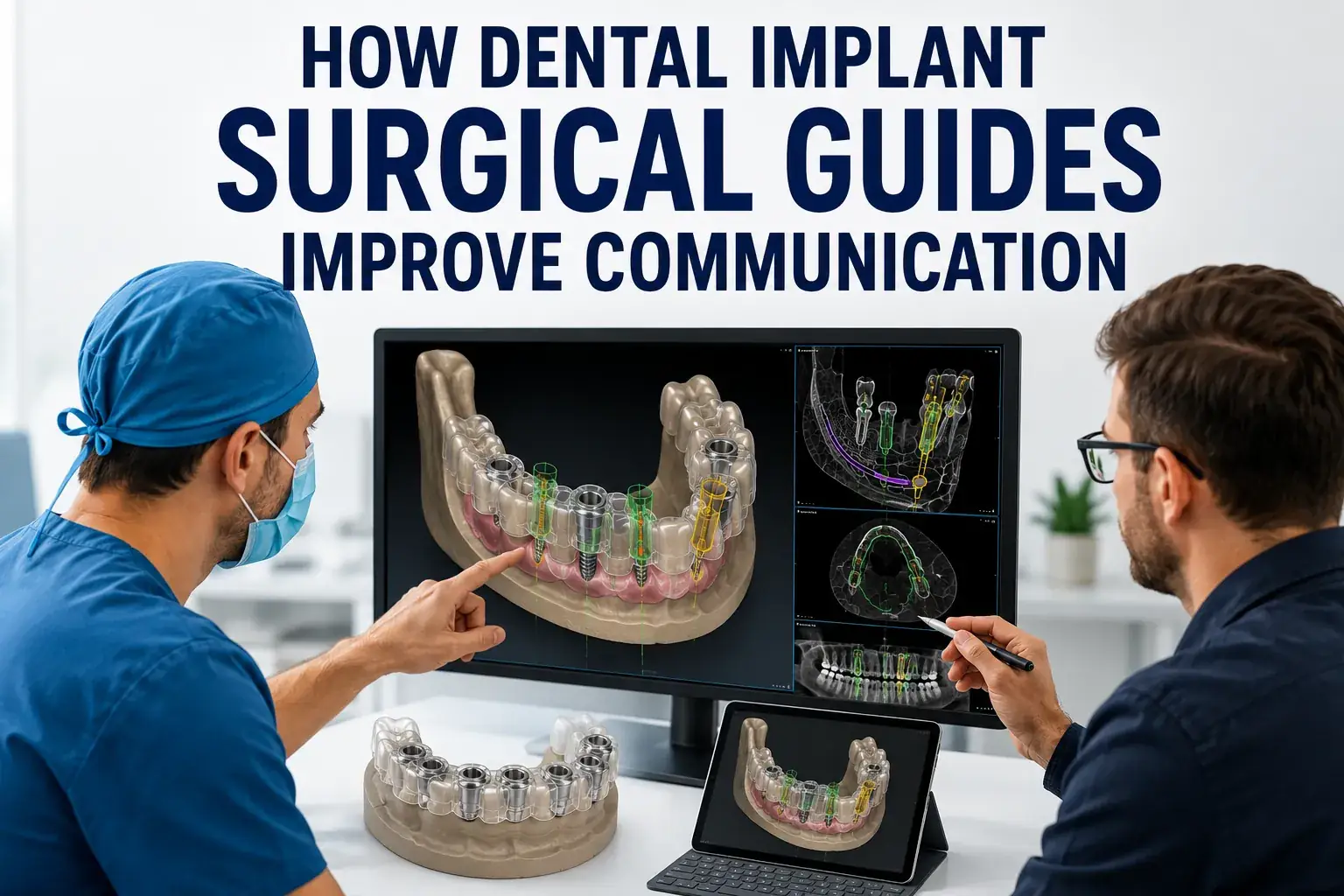
The most significant communication improvement that guided surgery workflows introduce is a shared three-dimensional model. When a case is set up in planning software, both the lab and the dentist can view, navigate, and discuss the same digital representation of the patient's anatomy.
This shared model makes clinical communication specific and visual in ways that verbal or written descriptions cannot achieve:
- "The sleeve looks too buccal" means something specific in a shared three-dimensional model, both parties can measure the deviation and discuss the correction
- "The inspection window placement blocks access for my flap" can be shown in the model, not just described
- "I'm concerned about the posterior sleeve angulation relative to the sinus" can be verified by measuring clearance in the model together
This is the foundation of how our dental surgical guide design team communicates with clinicians on complex cases, both parties working from the same digital reference, not separate partial views of an analogue situation.
Design Review: Communication Before Fabrication
The design review step, where the lab shares a visualization of the proposed guide design before fabrication begins, is the most direct application of shared-model communication. When a clinician reviews the guide design and can respond with specific feedback referenced to what they see, the communication quality achieves something impossible in analogue workflows: bilateral verification that the technical design matches clinical intent.
Common design review exchanges that improve guide quality:
- Surgeon: "The access for this posterior sleeve is too deep, my patient has limited mouth opening." Lab: "Understood, we can lower the guide body height by 3mm and adjust the sleeve entry angle. Does this visualization work?"
- Surgeon: "I want the inspection window positioned more buccally so I can visualize the ridge during drilling." Lab: "Moved, confirm the new position in the updated visualization."
- Surgeon: "I'm planning a flapless approach, do the retention pins require flap access?" Lab: "The current design uses pins at positions X and Y. For flapless, we can switch to a tissue-punch approach, confirm?"
These exchanges resolve design issues before materials are committed. The alternative, discovering these issues when the fabricated guide arrives, creates delays, additional fabrication costs, and in some cases surgery rescheduling.
The Case Information Form as Communication Protocol
The case information form is itself a structured communication tool. Treating it as a professional clinical brief, not a bureaucratic form, dramatically improves the quality of the design the lab produces. Each field in our guided case submission form corresponds to a specific design decision. Implant system specification determines sleeve geometry. Immediate loading indication changes retention and rigidity requirements. Surgical approach (flapless vs flap) affects guide body height and access design.
Labs that receive complete, specific case forms produce guides that match clinical intent on first delivery. Labs that receive vague or incomplete forms produce guides that match their assumptions, which sometimes align with clinical intent and sometimes do not.
Post-Surgery Communication: Closing the Loop
Communication between dentist and lab should not end when the guide ships. Post-surgery feedback is the information that enables continuous improvement in the collaboration. Effective post-surgery communication covers:
- Guide seating: did it seat passively on first placement? Was any adjustment needed?
- Drilling: did all drills move freely through the sleeves? Were there any sleeve fit concerns?
- Outcome: does the post-operative radiograph show implant position as planned?
- Prosthetics: did the provisional or healing abutment seat without adjustment?
Labs that receive this feedback can identify systematic issues, a sleeve design tendency that consistently requires surgeon compensation, an inspection window placement that surgeons routinely find inadequate, a retention feature that requires adjustment in certain anatomical contexts, and correct them before they repeat across future cases.
At Guided Excellence, we actively request post-surgery feedback. It is how we improve. Share your observations through our case submission and support portal.
Communication in Complex Cases: Where It Matters Most
For straightforward single-tooth cases, the communication requirements are modest, a complete case form and standard design review are sufficient. For complex cases, rich communication is a clinical quality factor.
Full arch restorations benefit from a pre-submission consultation to discuss prosthetic requirements, bone reduction coordination, and same-day loading logistics. Esthetic zone cases benefit from sharing the planned restoration design, the guide should be designed around the crown, not around bone availability alone. Immediate implant cases benefit from discussing the planned flapless versus open approach and its implications for guide retention.
Dr. Baghoomian at Guided Excellence is available for pre-case consultation on complex submissions. This direct clinical dialogue between the referring surgeon and the lab's clinical director ensures that complex cases are designed with full context. Learn more at our implant surgical guide lab.