
Patient safety is the foundational obligation in implant dentistry. Every clinical decision, from treatment planning through surgical execution, is ultimately evaluated against its impact on patient safety and the predictability of outcomes. The research answer on guided implant surgery is unambiguous: guided surgery significantly improves patient safety compared to freehand techniques and makes clinical outcomes substantially more predictable.
This article examines the specific mechanisms by which guided surgery protects patients, presents the evidence base for these safety improvements, and explains what improved predictability means for patients, practitioners, and practice economics.
Safety Mechanism 1: Preventing Nerve Injury
Inferior alveolar nerve injury is the most serious complication in mandibular implant surgery. Nerve damage causes temporary or permanent numbness, tingling, or pain affecting the lower lip, chin, teeth, and gum tissue on the affected side. Even temporary paresthesia lasting weeks to months causes significant patient distress and functional impairment. Permanent paresthesia is a life-altering injury with profound quality-of-life consequences and significant medicolegal implications.
The mechanism of nerve injury in freehand surgery is straightforward: the surgeon misjudges depth, and the drill or implant contacts or compresses the nerve canal. Freehand depth accuracy of plus or minus 2 to 3mm creates a real probability of this contact when bone height above the canal is limited, which is extremely common in the posterior mandible.
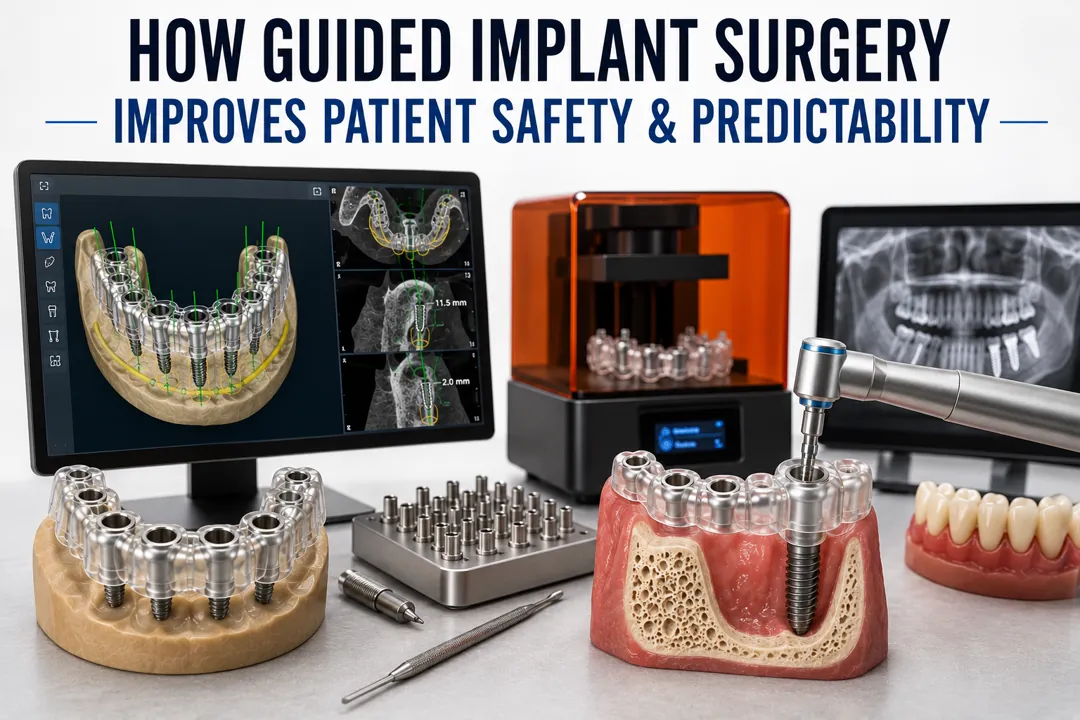
Surgical guides prevent nerve injury through a different mechanism: mechanical depth control. The depth-limiting sleeve in every guide is calculated to stop each drill at the depth that maintains minimum 1.5 to 2.0mm clearance above the nerve canal, calculated from the specific patient's CBCT anatomy at the exact planned implant location. This calculation is done individually for every case at Guided Excellence. Every implant surgical guide we produce includes this safety calculation as a standard design element.
Clinical evidence: nerve paresthesia rates with guided surgery are below 0.2% compared to 0.4 to 1.2% with freehand surgery, a 4 to 6 times reduction in this serious complication. Across a practice placing 50 mandibular implants per year, this translates to preventing 1 to 3 nerve injury events annually.
Safety Mechanism 2: Preventing Sinus Perforation
In the maxillary posterior, the equivalent safety risk is sinus floor perforation. When bone height between the alveolar crest and the sinus floor is limited, 8 to 12mm, which is common in the posterior maxilla, freehand depth miscalculation creates a meaningful probability of drill or implant penetration into the sinus cavity.
Sinus perforation consequences range from minor (post-operative sinusitis managed with antibiotics) to significant (chronic sinusitis, implant removal, sinus lift revision, and extended treatment). Even minor sinus perforations generate patient anxiety, additional appointments, and in some cases compromise the implant outcome.
Guided surgery prevents sinus perforation through the same depth control mechanism that prevents nerve injury. Guided sinus perforation rates are under 0.5% compared to 2 to 5% for freehand surgery, a 4 to 10 times reduction.
Safety Mechanism 3: Preventing Adjacent Root Damage
Adjacent root damage during implant drilling, ranging from minor root surface contact to root perforation, risks tooth devitalisation, root resorption, and potentially tooth loss. In tight inter-root spaces where planned implants are adjacent to vital teeth, freehand angular accuracy of plus or minus 5 to 10 degrees creates a meaningful risk of drill deviation toward adjacent roots. Guided surgery constrains the drill angulation to the planned path, maintaining root clearance throughout the full drilling depth. Our custom dental surgical guide design verifies adjacent root proximity measurements on every case before fabrication.
Guided adjacent root damage rates are under 0.1% compared to 0.3 to 1.0% for freehand surgery, a 3 to 10 times reduction.
Safety Mechanism 4: Reducing Operative Time
Operative time is itself a patient safety variable. Extended surgery increases total local anaesthetic exposure and the physiological recovery burden, cumulative fatigue in the surgeon and assistant, risk of complications associated with prolonged tissue retraction and manipulation, and surgical stress for medically compromised patients.
Guided surgery consistently reduces operative time by 15 to 30 minutes per implant by eliminating the positioning, correction, and depth verification steps inherent to freehand surgery. For full arch cases, time savings of 60 to 120 minutes represent clinically meaningful reductions in anaesthetic exposure and physiological stress, benefits that are especially significant for patients with cardiovascular conditions, bleeding disorders, or diabetes.
Predictability Mechanism 1: Consistent Implant Position
Freehand implant outcomes are variable, the actual implant position depends on surgeon experience, case difficulty, anatomy, and day-to-day factors that no clinician fully controls. Guided surgery delivers implant positions within 0.5 to 1.0mm of the virtual plan consistently, across surgeons, case types, and anatomical variations.
This positional consistency makes downstream outcomes predictable:
- The crown designed for the planned position fits the implant placed at that position
- The emergence profile develops as planned, not as adapted to a different position
- The prosthetic appointment is efficient, adjustments are minimal because the prosthesis matches the implant
- Patient expectations match the outcome, because the outcome was shown to the patient before surgery
Predictability Mechanism 2: Prosthetic Success Rates
The downstream prosthetic benefit of guided surgery is measurable and significant. First-time prosthesis fit rates, the prosthesis seating correctly without chairside modification at the delivery appointment, are 90 to 95% with guided placements compared to 70 to 75% with freehand placements.
This 15 to 25 percentage point improvement in first-time fit rates translates directly into clinical efficiency and patient experience quality. Patients whose restorations seat correctly at the first delivery appointment have a qualitatively different experience than patients whose deliveries require extended adjustment, remakes, or problem-solving conversations.
Predictability Mechanism 3: Long-Term Implant Survival
Well-positioned implants that support properly designed restorations experience more favourable biomechanical loading, better marginal bone maintenance, and more consistent long-term survival than implants in compromised positions supporting adapted restorations.
The clinical data supports this: guided implants show 5-year survival rates of 98 to 99% compared to 94 to 97% for freehand placements. While multiple factors influence long-term survival, initial positioning quality is among the most controllable and most consistently documented predictors of long-term outcome.
Communicating Safety to Patients
The safety and predictability improvements from guided surgery are communicable to patients in terms they find meaningful and compelling. Effective patient communication about guided surgery:
- "We design a custom guide from your specific CT scan that controls exactly where the implant is placed, not an estimate, but the precise planned position"
- "The guide keeps the drill a safe distance from the nerve at all times, that safety margin is calculated from your imaging"
- "Because we plan the implant position first and then design the crown to match, the restoration fits correctly from day one"
These statements are accurate and verifiable. Patients who understand them make better-informed decisions, have more realistic expectations, and experience higher satisfaction when outcomes match what was communicated.
At Guided Excellence, Dr. Baghoomian's clinical review of complex cases and our comprehensive quality control process ensure that the safety and predictability benefits described in this article are delivered on every guide we fabricate. Submit your case, see our transparent flat-rate pricing, and experience what patient-safety-focused guided surgery delivers.