Types of Surgical Guides for Dental Implants
Surgical guides are not one-size-fits-all. The right guide depends on how many teeth remain, how much bone is available, and how much of the drilling you want to control. This hub breaks down every type of surgical guide — by support surface (tooth-, tissue-, bone-borne) and by level of guidance — so you can match the guide to the case and jump straight to the service you need.
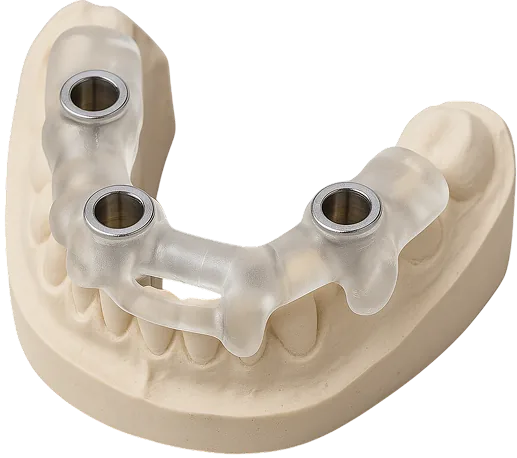
At a Glance
Surgical Guide Types Compared
Use this table to compare the main guide types, then read the detail below or jump to the matching service page.
| Guide type | Also called | Best for | Stability / support |
|---|---|---|---|
| Tooth-supported | Tooth-borne | Partially edentulous arches with healthy adjacent teeth | Highest — seats on existing teeth |
| Tissue-supported | Mucosa-borne | Fully edentulous arches, flapless protocols | Moderate — seats on soft tissue, pin-stabilized |
| Bone-supported | Bone-borne | Edentulous and complex cases, flap reflected | High — seats directly on bone |
| Hybrid | Combination | Limited or uneven support across the arch | Variable — combines two surfaces |
| Stackable | Stacked / full-arch | All-on-4, All-on-6 and full-arch cases | High — indexed layers on fixation pins |
Guides also differ by level of guidance: a pilot guide directs only the first drill, while a fully guided template controls the entire osteotomy.
Two Ways to Classify
How Surgical Guides Are Classified
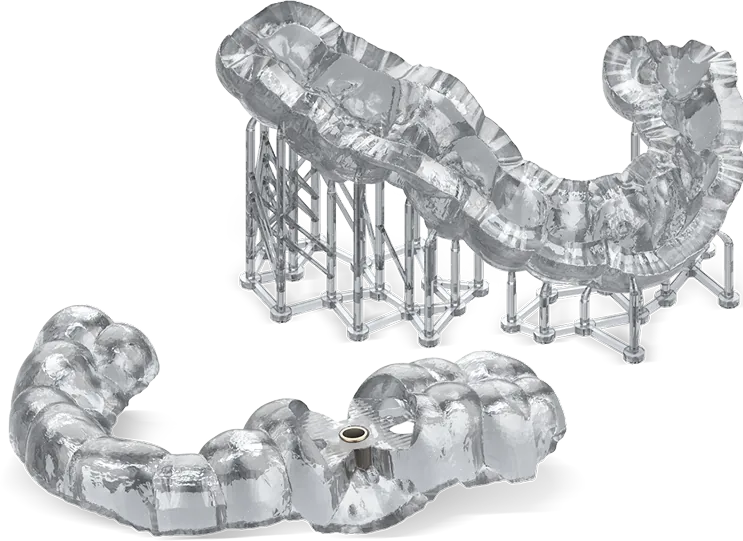
By Support Surface
What the guide rests on during surgery — tooth, tissue (mucosa), bone, or a hybrid of two. This determines stability and whether a flap is needed.
By Level of Guidance
How much of the drilling sequence the guide controls — from a pilot guide that directs only the first drill, to a fully guided template that controls the entire osteotomy.
Every Type Explained
The Surgical Guide Types We Design
Each guide type below links to the related service so you can go straight from the right type to ordering.
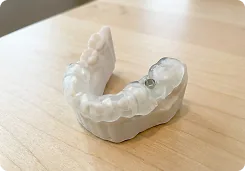
Tooth-Supported Guides
Seats directly on the patient's remaining teeth, giving the most stable, repeatable reference. Best for single-tooth and short-span cases with healthy adjacent teeth.
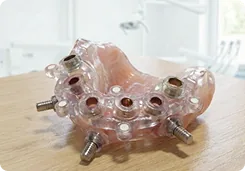
Tissue-Supported Guides
Rests on soft tissue when teeth are missing, often with fixation pins for flapless, minimally invasive placement. Requires accurate impressions and CBCT data.
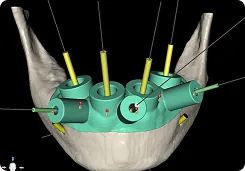
Bone-Supported Guides
Seats directly on the jawbone after a flap is reflected, giving a rigid reference for complex placements where teeth and tissue can't provide stability.
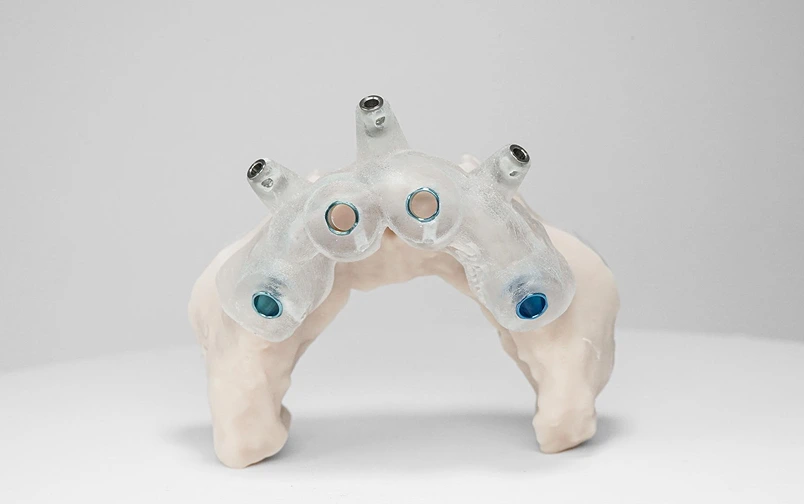
Hybrid Guides
Combine two support surfaces — for example tooth and tissue — to balance stability and access when no single surface is sufficient on its own.
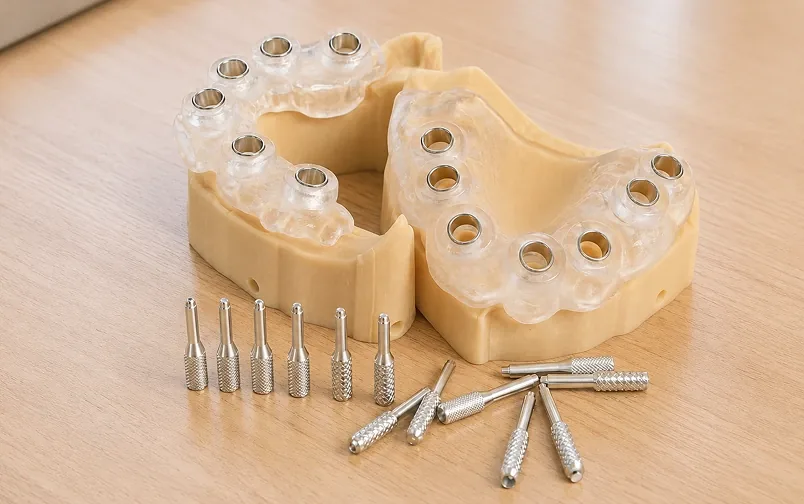
Pilot vs Fully Guided
A pilot drill guide controls only the initial osteotomy and leaves the rest freehand. A fully guided template controls the entire drilling sequence and placement for maximum accuracy. We produce both.
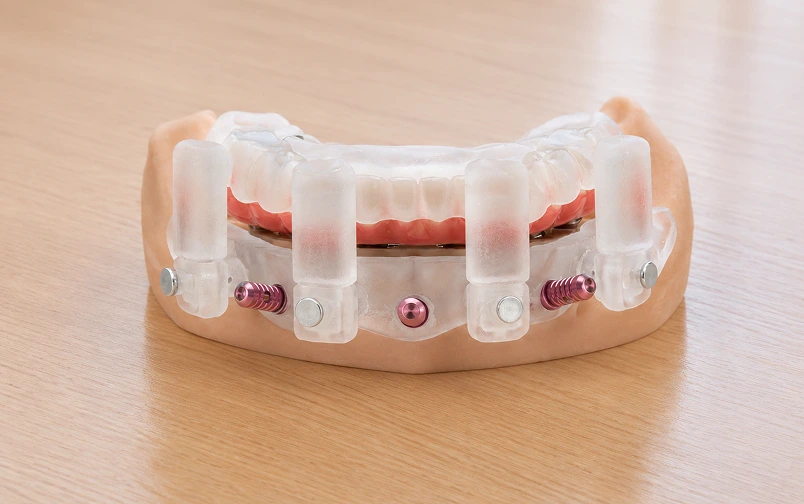
Stackable Guides
For All-on-4, All-on-6 and other full-arch cases, indexed layers for bone reduction, drilling, and verification all reference the same fixation pins, keeping the arch aligned at every step.
Decision Helper
Which Surgical Guide Type Is Right for Your Case?
Match the clinical scenario on the left to the recommended guide type on the right.
Explore Our Surgical Guides
Go Straight to the Right Service
Ready to order, or want detail on a specific service? Use the cards below to jump to the right page.
Implant Surgical Guides
The overview of our guides for single and multi-implant placement.
View overview →Dental Surgical Guide Design
Custom, patient-specific guide design and digital implant planning.
See design service →3D Printed Surgical Guides
High-precision, medical-grade 3D printed guides ready for surgery.
Learn more →All-on-X & Full-Arch Guides
Stackable, indexed guides for All-on-4, All-on-6 and full-arch cases.
Explore full-arch →Implant Surgical Guide Lab
The lab and workflow behind every guide we produce and ship.
Visit the lab →Transparent Pricing
Flat-rate, per-guide pricing with no per-implant surprises.
See pricing →Same Workflow, Every Type
How to Order Your Surgical Guide
Whatever the guide type, the process is identical — three steps from scan to delivery.
Upload Your Case
Submit your CBCT and intraoral or model scan through our digital implant planning process.
Approve the Plan
Dr. Zareh Baghoomian plans and reviews the case; you approve before anything is printed.
Receive in 3–5 Days
We 3D print your guide and ship it to your practice within 3 to 5 business days.
Answers
Frequently Asked Questions
Tooth-supported (tooth-borne), tissue-supported (mucosa-borne), bone-supported (bone-borne), and hybrid guides. They are also classified as pilot or fully guided based on how much of the drilling they control.
A tooth-borne guide seats on existing teeth for a stable reference; a bone-borne guide seats directly on the jawbone after a flap is reflected, typically for edentulous or complex cases.
Stackable guides, which index bone reduction, drilling, and verification to the same fixation pins so the whole arch stays aligned.
Yes. We produce both pilot drill guides and fully guided templates for every support type.
No. We design and 3D print the surgical guide only. Your surgical team performs the placement using the guide.
Not Sure Which Guide Type You Need?
Send your CBCT and scan through our digital workflow and we'll recommend the right type — then design and 3D print it, reviewed by Dr. Zareh Baghoomian.