Pilot vs Fully Guided Surgical Guides
Surgical guides differ not only by what they rest on, but by how much of the drilling they control. A pilot surgical guide directs only the first (pilot) drill and leaves the remaining osteotomy freehand, while a fully guided surgical guide controls the entire drilling sequence and the implant placement for maximum accuracy. Choosing between them depends on case complexity, your protocol, and how much control you want. We make the guide; your team performs the placement.
Overview
What Is the Difference Between Pilot and Fully Guided Guides?
The difference is the level of guidance. A pilot guide controls only the starting point and trajectory of the first drill, then the surgeon completes the osteotomy and places the implant freehand. A fully guided template controls every drill in the sequence and the implant insertion, so the placement matches the digital plan exactly.
Both are planned from the same CBCT and scan data; they differ in how prescriptive the surgery is. See where they fit among all guide types on our surgical guide types hub, or browse all surgical guides for dental implants.
Guidance Type 1
What Is a Pilot Surgical Guide?
A pilot surgical guide directs only the initial pilot drill to the planned entry point and angle. After that first osteotomy, the surgeon widens the site and places the implant by hand, using clinical judgment.
Pilot guides are simpler, give the surgeon more freedom during surgery, and suit straightforward single-implant cases where an experienced clinician wants a controlled starting point rather than full prescription.
Guidance Type 2
What Is a Fully Guided Surgical Guide?
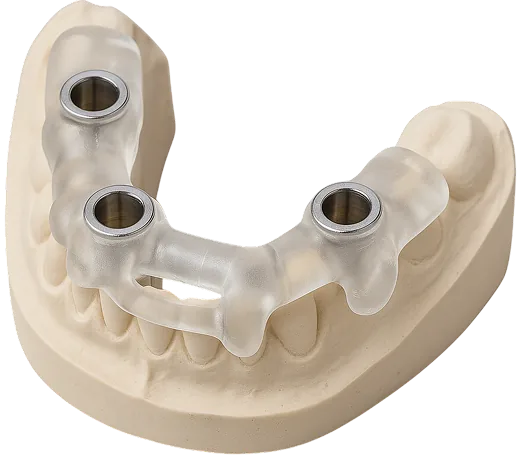
A fully guided surgical guide controls the entire drilling sequence and the implant placement through a series of precisely sized sleeves and drill keys. The implant ends up exactly where it was planned: position, angle, and depth.
Fully guided templates deliver the highest accuracy and are the standard for complex, multi-implant, and Full Arch cases. They also support flapless and immediate-load protocols when paired with the right support type.
At a Glance
Pilot vs Fully Guided: Side-by-Side Comparison
How the two levels of guidance compare.
| Feature | Pilot surgical guide | Fully guided surgical guide |
|---|---|---|
| Controls | Only the first (pilot) drill | The full drilling sequence and implant placement |
| Accuracy | Good for the entry trajectory | Highest, end to end |
| Remaining steps | Completed freehand | Guided |
| Best for | Simpler single-implant cases | Complex, multi-implant, Full Arch |
| Intra-op flexibility | More | Most prescriptive |
Decision Guide
When to Choose Each
Both options start from the same CBCT and scan data; the difference is how much of the surgery the guide prescribes.
Choose a Pilot Guide when…
- The case is straightforward and the anatomy allows flexibility
- The surgeon prefers freehand control after the initial drill
- A controlled starting point is needed, not full prescription
- Single-implant placement with an experienced clinician
Best for: simpler cases · experienced surgeons · intra-op flexibility
Choose a Fully Guided Template when…
- The case is complex or involves multiple implants
- Maximum precision is required from start to finish
- Flapless or immediate-load protocols are planned
- Full Arch or All-on-X placement requires every step aligned to one plan
Best for: complex cases · multi-implant · Full Arch · maximum accuracy
For Full Arch cases, a fully guided, stackable approach is usually best. See our All-on-X and Full Arch surgical guides.
Fully Guided Advantage
Advantages of Fully Guided Surgical Guides
- Maximum accuracyEvery drill and the implant follow the plan, reducing deviation from start to finish.
- Predictable, restoratively driven resultsImplant position supports the final restoration, not freehand estimation.
- Supports advanced protocolsWorks with flapless surgery and immediate-load workflows when paired with the right support type.
- Confidence on complex casesFull control where freehand risk is highest: multi-implant, Full Arch, and narrow-clearance sites.
Simple Workflow
How to Order Your Guide
- Upload your caseSend the CBCT (DICOM) and intraoral or model scan (STL) through our digital implant planning process, and tell us whether you want a pilot or fully guided design.
- Review and approveDr. Baghoomian plans the case and sends the digital plan for your approval.
- Print and shipWe produce the guide in our implant surgical guide lab and ship it in 3 to 5 business days.
Why Guided Excellence
Dentist-Reviewed, Fully Digital, Medical-Grade
Whether you choose a pilot or fully guided design, every guide is personally reviewed by Dr. Zareh Baghoomian, designed through a fully digital workflow, and produced with medical-grade 3D printing. We focus only on the guide, so you keep full control of the surgery, with patient-specific design, transparent flat-rate pricing, and fast turnaround. See our dental surgical guide design and 3D printed surgical guides for the technology behind every guide.
In Short
Key Takeaways
- A pilot guide controls only the first drill; a fully guided template controls the entire drilling and implant placement.
- Fully guided is the most accurate and is preferred for complex, multi-implant, and Full Arch cases.
- Pilot guides offer more intra-operative flexibility for simpler cases.
- Guided Excellence designs and prints both types; your team performs the implant placement.
Answers
Frequently Asked Questions
Compare the Family
Related Guide Types
Explore guide types by support surface, or head back to the hub.
Tooth Supported
Seats on existing teeth, the most accurate guide type for partially edentulous cases.
Learn more → Mucosa-borneTissue Supported
Rests on soft tissue with fixation pins, for fully edentulous, flapless cases.
Learn more → Stacked / Full ArchStackable Full Arch
Indexed layers for All-on-4, All-on-6 and Full Arch cases, fully guided by design.
Learn more → HubAll Guide Types
Compare every type and find the right guide for your case.
Back to hub →Ready to Start?
Submit your implant case, review transparent surgical guide pricing, or contact our surgical guide team. Your guide ships in 3 to 5 business days.
Mobile Contact Section

© 2026 Guided Excellence. All rights reserved.
 Designed & Developed by The Gud Agency