Tissue-Supported Surgical Guides
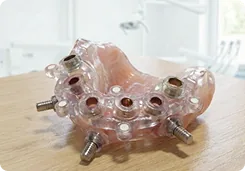
A tissue-supported surgical guide is a custom, 3D-printed template that rests on the soft tissue (gingiva) to control the position, angle, and depth of dental implant placement when no teeth are present. Also called a mucosa-borne or mucosa-supported guide, it is the standard choice for fully edentulous arches and flapless, minimally invasive surgery — held in place with fixation pins for stability. We make the guide; your team performs the placement.
Overview
What Is a Tissue-Supported Surgical Guide?
A tissue-supported surgical guide is a patient-specific drilling template that seats on the soft tissue when a patient has no teeth in the arch. It is planned from the patient's CBCT scan and a scan of the arch, then 3D printed with precise drill sleeves.
Because soft tissue is not rigid, the guide is stabilized with fixation pins so it cannot shift during surgery. Clinicians also call it a mucosa-borne guide. It is one of the three main support types alongside tooth-borne and bone-borne guides.
See the full comparison on our surgical guide types hub or browse all surgical guides for dental implants.
Step by Step
How a Tissue-Supported Surgical Guide Works
- Digital planningThe case is planned digitally from the CBCT and a scan of the edentulous arch (often using a dual-scan or denture-based protocol), positioning each implant against bone and the planned restoration.
- Design & 3D printingThe guide is designed to rest on the mucosa with channels for fixation pins, then 3D printed in medical-grade material with precision drill sleeves.
- Guided surgeryAt surgery, the guide is seated on the tissue and locked in place with anchor pins, then directs the drilling sequence at the planned angle and depth — usually without raising a flap.
- Pin stabilizationPin stabilization and accurate scan data are what make tissue-supported placement predictable, since the guide does not have teeth to hold it.
Indications
When to Use a Tissue-Supported Guide
Tissue-supported guides are the standard solution for fully edentulous arches where no teeth remain to support the guide — giving guided accuracy for flapless, minimally invasive implant surgery.
They are not ideal when teeth are present (use a tooth-supported guide instead) or when maximum rigidity is needed for a complex case (consider a bone-supported guide). Compare all options on our surgical guide types hub.
- Best forFully edentulous arches where no teeth remain to support the guide.
- Ideal protocolFlapless, minimally invasive surgery that can reduce trauma and speed recovery.
- RequiresFixation pins for stability and accurate CBCT and arch scan data.
- Not ideal whenTeeth are present (tooth-supported) or maximum rigidity is needed for complex cases (bone-supported).
At a Glance
Tissue- vs Tooth- vs Bone-Supported Guides
How the three support types compare at a glance.
| Feature | Tooth-supported (tooth-borne) | Tissue-supported (mucosa-borne) | Bone-supported (bone-borne) |
|---|---|---|---|
| Rests on | Existing teeth | Soft tissue (gingiva) | Jawbone |
| Best for | Partially edentulous | Fully edentulous, flapless | Edentulous / complex |
| Accuracy | Highest | Moderate | High |
| Flap required | Usually no | No | Yes |
| Stabilized by | Teeth | Fixation pins | Direct bone contact |
Why It Works for Edentulous Cases
Advantages of Tissue-Supported Surgical Guides
- Minimally invasiveDesigned for flapless placement, which can reduce post-operative trauma and recovery time.
- Works without teethProvides guided accuracy for fully edentulous arches where tooth support is not possible.
- Pin-stabilizedAnchor pins lock the guide in one position so it does not move during drilling.
- Restoratively drivenImplant position follows the planned prosthesis, supporting predictable final results.
- Patient comfortLess invasive surgery can mean a more comfortable experience and faster healing.
Simple Workflow
How to Order Your Tissue-Supported Guide
- Upload your caseSend the CBCT (DICOM) and your arch scan (STL) through our digital implant planning process. We will confirm whether a dual-scan protocol is needed.
- Review and approveDr. Baghoomian plans the implant positions and pin placement, then schedules a virtual Zoom meeting to review the plan and make any necessary changes in real time.
- Print and shipWe produce the guide in our implant surgical guide lab and ship it in 3 to 5 business days.
Why Guided Excellence
Dentist-Reviewed, Fully Digital, Medical-Grade
Every tissue-supported surgical guide is personally reviewed by Dr. Zareh Baghoomian, designed through a fully digital workflow, and produced with medical-grade 3D printing. We focus only on the guide, so you keep full control of the surgery — with patient-specific design, transparent flat-rate pricing, and fast turnaround. See our dental surgical guide design and 3D printed surgical guides for the technology behind every guide.
In Short
Key Takeaways
- A tissue-supported (mucosa-borne) surgical guide rests on soft tissue and is used when no teeth are present.
- It is the standard for fully edentulous, flapless surgery and is stabilized with fixation pins.
- Accuracy is moderate and depends on pin stabilization and good CBCT and arch scan data.
- Guided Excellence designs and prints the guide; your team performs the implant placement.
Answers
Frequently Asked Questions
A tissue-supported surgical guide, also called a mucosa-borne guide, is a custom 3D-printed template that rests on the soft tissue to guide implant placement when no teeth are present. It is held in place with fixation pins.
Use a mucosa-borne guide for fully edentulous arches and flapless, minimally invasive implant surgery.
It is stabilized with fixation (anchor) pins placed through the guide into the bone, which lock it in one position during drilling.
It is slightly less accurate because soft tissue is not rigid, but pin stabilization and accurate CBCT and arch scans make it predictable for edentulous cases.
We need a CBCT scan in DICOM format and an intraoral, denture, or model scan in STL format. A dual-scan protocol may be used for fully edentulous arches.
No. Guided Excellence designs and 3D prints the surgical guide only. Your surgical team performs the implant placement using the guide.
Compare the Family
Related Guide Types
Not the right fit? Explore the other support types, or head back to the hub.
Tooth-Supported
Seats on existing teeth — the most accurate guide type for partially edentulous cases.
Learn more →Bone-borneBone-Supported
Seats on the jawbone after a flap — for edentulous and complex cases.
Compare guide types →Stacked / full-archStackable
Indexed layers for All-on-4, All-on-6 and full-arch cases.
Learn more →HubAll Guide Types
Compare every type and find the right guide for your case.
Back to hub →Ready to Start?
Submit your implant case, review transparent surgical guide pricing, or contact our surgical guide team — your tissue-supported guide ships in 3 to 5 business days.