Tooth-Supported Surgical Guides
A tooth-supported surgical guide is a custom, 3D-printed template that rests on the patient's existing teeth to control the exact position, angle, and depth of implant placement. Because natural teeth give a stable, repeatable reference, tooth-supported (tooth-borne) guides are the most accurate type of surgical guide — ideal for partially edentulous cases. We make the guide; your team performs the placement.
Overview
What Is a Tooth-Supported Surgical Guide?
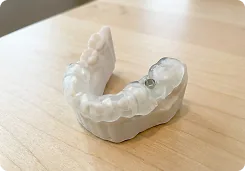
A tooth-supported surgical guide is a patient-specific drilling template that seats directly onto remaining natural teeth during dental implant surgery. It is built by aligning the planned implant positions — taken from the patient's CBCT scan and an intraoral or model scan — to the existing dentition.
During surgery the guide clicks onto the teeth in one position only and directs each drill through metal sleeves, so the implant is placed exactly as planned. Clinicians also call this a tooth-borne guide.
Explore the full range on our surgical guide types hub or see all surgical guides for dental implants.
Step by Step
How a Tooth-Supported Surgical Guide Works
- Digital planningThe case is planned from the CBCT and intraoral or model scan, positioning each implant against bone, nerve, and the planned restoration.
- Design & 3D printingThe guide is designed to seat on the existing teeth with a single, unambiguous fit, then 3D printed in medical-grade material with precision drill sleeves.
- Guided surgeryAt surgery the guide snaps onto the teeth and directs the drilling sequence at the planned angle and depth — often without raising a flap.
- Maximum accuracyBecause the teeth hold the guide firmly, there is little movement, which is why tooth-borne guides deliver the highest accuracy of the three support types.
Indications
When to Use a Tooth-Supported Guide
Tooth-supported guides shine when stable natural teeth sit next to the implant site — giving the most accurate, repeatable seating of any guide type.
They are not ideal when the patient is fully edentulous, or when the adjacent teeth are mobile or compromised. In those cases a tissue-supported or bone-supported guide is the better choice. Compare all options on our surgical guide types hub.
- Best forPartially edentulous arches with healthy, stable adjacent teeth.
- Ideal casesSingle-tooth and short-span (multi-unit) implant placements.
- ProtocolSupports flapless, minimally invasive surgery; pilot and fully guided drilling.
- Not ideal whenFully edentulous, or adjacent teeth are mobile or compromised.
At a Glance
Tooth- vs Tissue- vs Bone-Supported Guides
How the three support types compare — tooth-supported leads on accuracy.
| Feature | Tooth-supported (tooth-borne) | Tissue-supported (mucosa-borne) | Bone-supported (bone-borne) |
|---|---|---|---|
| Rests on | Existing teeth | Soft tissue (gingiva) | Jawbone |
| Best for | Partially edentulous | Fully edentulous, flapless | Edentulous / complex |
| Accuracy | Highest | Moderate | High |
| Flap required | Usually no | No | Yes |
| Stabilized by | Teeth | Fixation pins | Direct bone contact |
Why It Wins on Accuracy
Advantages of Tooth-Supported Surgical Guides
- Highest accuracyNatural teeth give a rigid, repeatable reference, minimizing guide movement.
- Minimally invasiveSupports flapless placement, which can reduce trauma and speed recovery.
- Predictable seatingThe guide fits one way only, removing guesswork at surgery.
- EfficientFaster, more confident placement means less chair time.
- Restoratively drivenImplant position follows the planned restoration, not freehand estimation.
Simple Workflow
How to Order Your Tooth-Supported Guide
- Upload your caseSend the CBCT (DICOM) and intraoral or model scan (STL) through our digital implant planning process.
- Review and approveDr. Baghoomian plans the implant positions and sends the plan for your approval.
- Print and shipWe produce the guide in our implant surgical guide lab and ship it in 3 to 5 business days.
Why Guided Excellence
Dentist-Reviewed, Fully Digital, Medical-Grade
Every tooth-supported surgical guide is personally reviewed by Dr. Zareh Baghoomian, designed through a fully digital workflow, and produced with medical-grade 3D printing. We focus only on the guide, so you keep full control of the surgery — with patient-specific design, transparent flat-rate pricing, and 3 to 5 day turnaround. See our dental surgical guide design and 3D printed surgical guides for the technology behind every guide.
In Short
Key Takeaways
- A tooth-supported (tooth-borne) surgical guide rests on existing teeth and is the most accurate guide type.
- It is best for partially edentulous, single-tooth, and short-span cases and supports flapless placement.
- It needs a CBCT (DICOM) plus an intraoral or model scan (STL); we deliver in 3 to 5 business days.
- Guided Excellence designs and prints the guide; your team performs the implant placement.
Answers
Frequently Asked Questions
A tooth-supported surgical guide, also called a tooth-borne guide, is a custom 3D-printed template that seats on the patient's existing teeth to control the position, angle, and depth of dental implant placement.
Yes. Because it seats on rigid natural teeth, a tooth-supported guide provides the most stable reference and the highest accuracy of the three support types.
Use a tooth-borne guide for partially edentulous cases with healthy adjacent teeth, including single-tooth and short-span implant placements.
We need a CBCT scan in DICOM format and an intraoral or model scan in STL format, along with your implant system and treatment plan.
No. Guided Excellence designs and 3D prints the surgical guide only. Your surgical team performs the implant placement using the guide.
Most tooth-supported guides ship within 3 to 5 business days after you approve the digital plan.
Compare the Family
Related Guide Types
Not the right fit? Explore the other support types, or head back to the hub.
Tissue-Supported
Rests on soft tissue with fixation pins — for fully edentulous, flapless cases.
Learn more →Bone-borneBone-Supported
Seats on the jawbone after a flap — for edentulous and complex cases.
Compare guide types →Stacked / full-archStackable
Indexed layers for All-on-4, All-on-6 and full-arch cases.
Learn more →HubAll Guide Types
Compare every type and find the right guide for your case.
Back to hub →Ready to Start?
Submit your implant case, review transparent surgical guide pricing, or contact our surgical guide team — your tooth-supported guide ships in 3 to 5 business days.