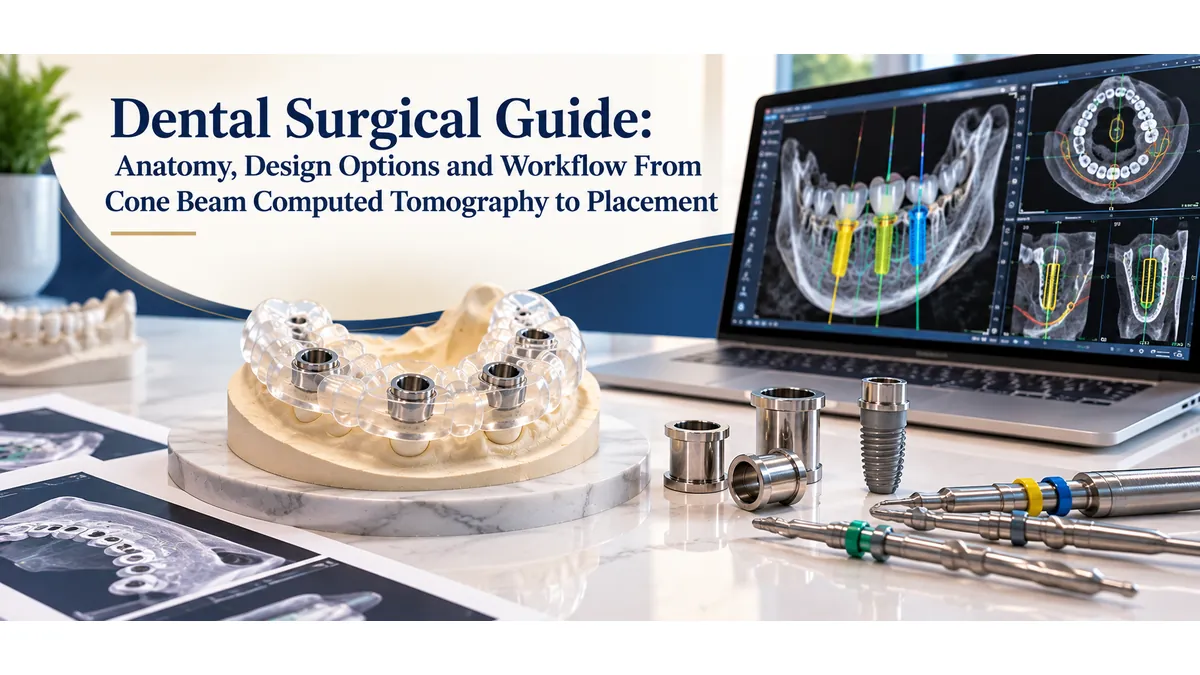
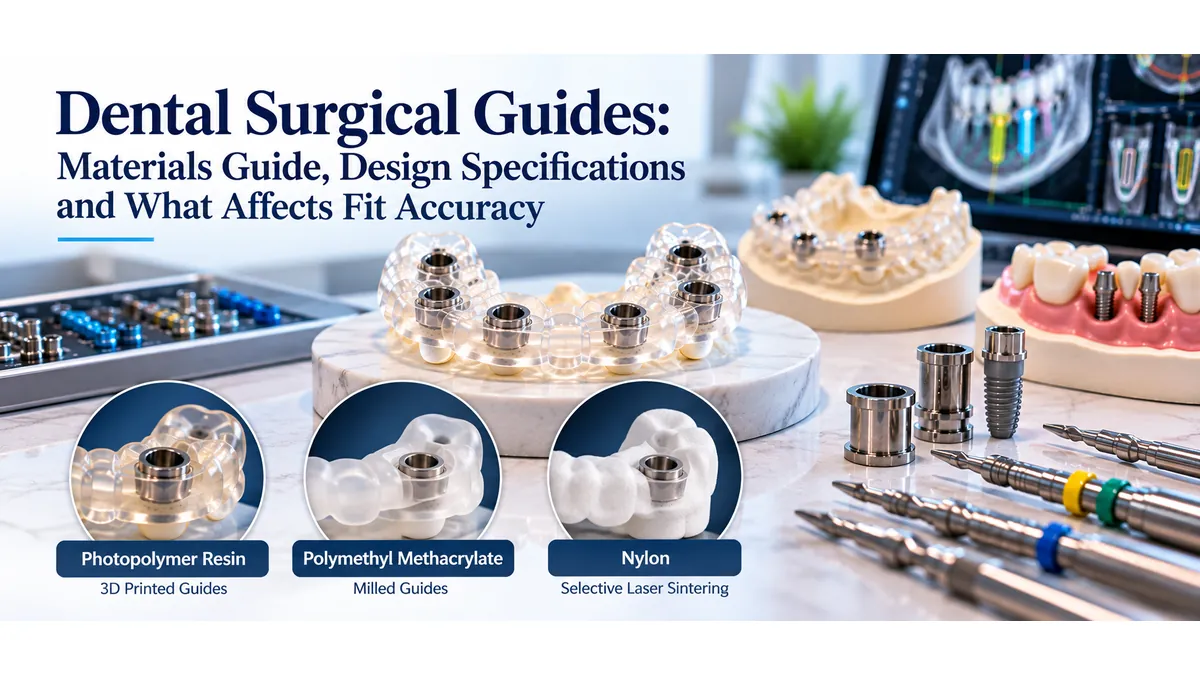
A dental surgical guide positions the drill at the exact angle and depth determined during virtual planning. Whether the finished guide delivers that precision at the chairside depends on three interrelated factors: the material the guide is fabricated from, the design specifications that govern how the body seats on the patient, and the fabrication process that translates the digital plan into a physical object. Understanding each of these factors helps clinicians evaluate the guides they order and interpret the results they see in the surgical field. This article covers everything that affects the accuracy and fit of dental surgical guides for implant placement from material selection through final quality review.
Why Material Selection Defines Guide Performance
The material determines how faithfully the fabricated guide matches the digital design, how stable the guide remains under drilling forces, and whether it can be sterilized between the planning appointment and the surgical date. A guide that distorts during post-processing or flexes under drill torque delivers results that deviate from the virtual plan, regardless of how precisely that plan was constructed.
This is why material selection is not a cosmetic decision. It shapes every downstream accuracy variable in the workflow. The goal of the surgical guide design and fabrication process is to close the gap between the implant position the clinician planned and the implant position achieved in the patient. The material is where that gap either narrows or widens first.
Materials Used in Dental Surgical Guide Fabrication
Three material categories account for the majority of dental surgical guides in current clinical use: photopolymer resins fabricated by additive printing, polymethyl methacrylate fabricated by subtractive milling, and nylon fabricated by selective laser sintering. Each has a distinct accuracy profile, clinical handling characteristic, and cost structure.
Photopolymer Resin for 3D Printed Guides
Most guides fabricated today are made from photopolymer resin cured by ultraviolet light in a stereolithography or digital light processing printer. Medical-grade resins are formulated to be biocompatible and cytotoxicity-tested, and they are registered as short-term intraoral contact devices under applicable medical device regulations. Common proprietary materials include NextDent Surgical Guide resin and Formlabs Dental SG resin, both of which are designed specifically for this application.
After printing, resin guides require a post-curing step to complete polymerization. This step directly affects final dimensional accuracy. Under-cured resin continues to shrink after the guide leaves the printer, pulling critical surfaces away from their planned positions. Over-cured resin can become brittle and prone to fracture under drilling load. A reputable implant surgical guide fabrication lab post-cures under calibrated ultraviolet intensity and temperature conditions rather than relying on ambient exposure or uncalibrated curing units.
Resin guides are typically transparent or amber-tinted. This allows the surgeon to visually confirm guide seating before drilling begins. Their moderate rigidity resists deflection under normal surgical loads while remaining lightweight enough for patient comfort during the procedure.
Milled Polymethyl Methacrylate
Milled guides are produced by subtractive machining of a pre-polymerized polymethyl methacrylate puck in a computer-aided design and computer-aided manufacturing milling unit. The subtractive process removes material from a homogeneous blank rather than building up layers, which generally produces tighter dimensional accuracy than additive printing at equivalent resolution settings.
Milled guides are denser and stiffer than printed resins. This can be an advantage under heavy drilling loads but requires more precise chairside adjustment to achieve a positive seat on tissue or tooth surfaces. The subtractive process also makes it more difficult to produce the internal geometries required for multi-sleeve cases with closely spaced drill positions. For those cases, printed resin remains the more practical fabrication method.
Nylon via Selective Laser Sintering
Selective laser sintering uses a laser to fuse nylon powder particles into a solid form without requiring a liquid resin intermediate. The result is a guide with higher impact resistance than resin and a degree of flexibility that allows the guide body to conform slightly to minor tissue variation at seating. Selective laser sintering guides are less common in mainstream guided implant surgery. Their primary use in the current market is in research protocols and specialty full-arch applications where their mechanical properties offer a specific advantage.
Design Specifications That Determine Guide Accuracy
The material provides the accuracy ceiling. The design specifications determine whether the fabricated guide reaches that ceiling or falls short of it. Three design parameters account for most of the fit variation clinicians encounter. A thorough understanding of the guide design and fabrication process allows clinicians to submit complete case files and review lab output with informed criteria.
Sleeve Type and Inner Diameter
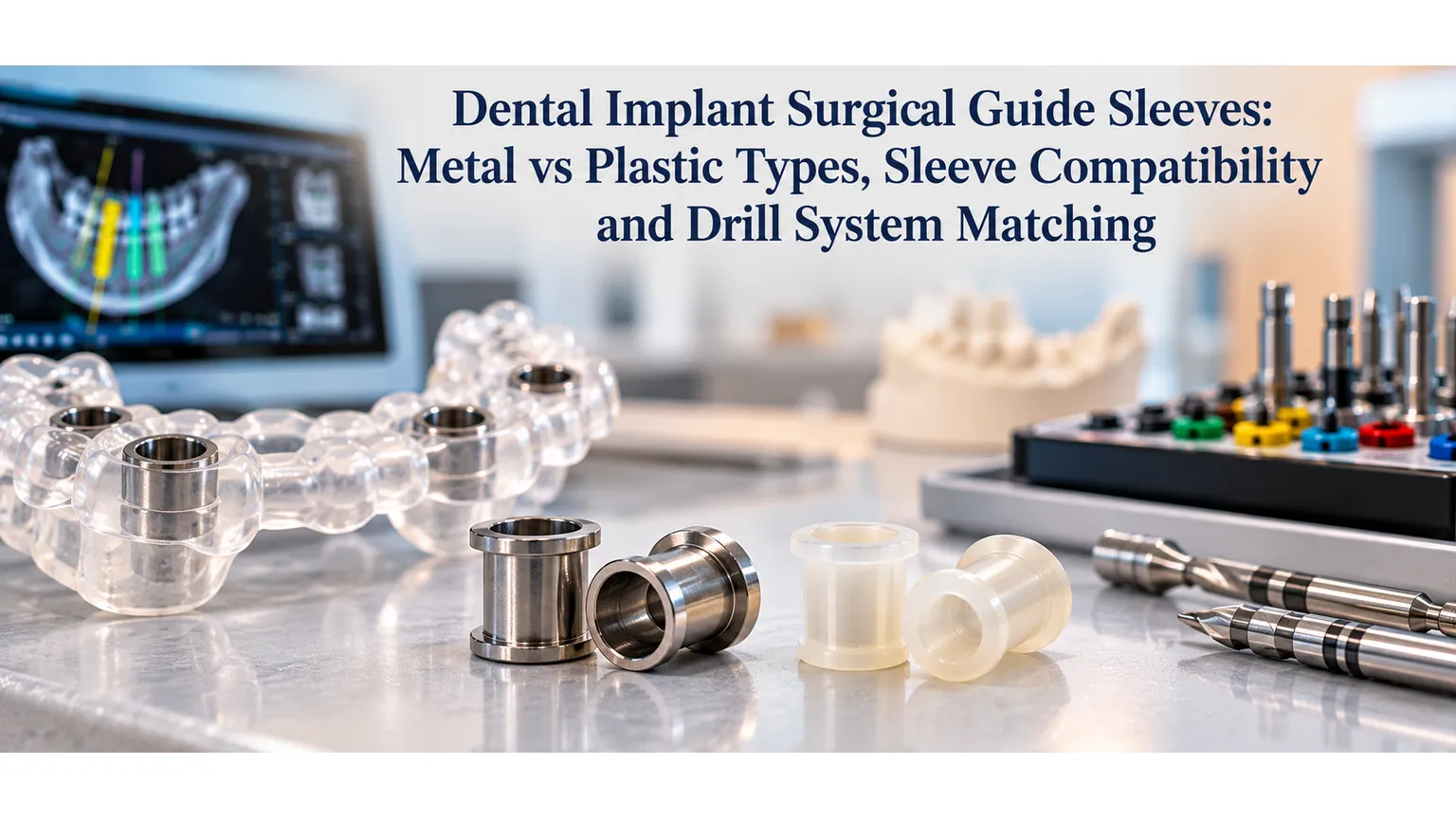
The sleeve is the bushing inserted into the guide body that receives the drill and controls its trajectory. Metal sleeves, made from titanium or surgical-grade stainless steel, are the clinical standard for fully guided surgery. Their inner diameter must correspond precisely to the outer diameter of each drill in the guided surgery kit sequence. A mismatch of even 0.1 millimeter between the sleeve inner diameter and the drill outer diameter introduces angular error that compounds with drilling depth, producing a final implant position that deviates from the virtual plan at the apex.
Plastic sleeves are used in some partially guided systems where the sleeve is integrated into the resin body. They offer a simpler manufacturing pathway and reduce per-unit material cost, but they are less resistant to drill torque and wear faster over successive drill passes in multi-implant cases.
Wall Thickness and Body Geometry
Minimum wall thickness around each sleeve housing must be sufficient to resist deformation under drilling forces. Current fabrication practice requires at least 1.5 to 2 millimeters of material surrounding the sleeve bore. Walls thinner than this threshold flex under drill load, translating the planned implant trajectory into an executed trajectory with accumulated angular error. In adjacent-implant cases, where two sleeves sit close together, the wall between them must be reviewed by the fabricating lab as part of its design check before the guide goes to print or mill.
The guide body must also extend far enough from the sleeve housings to provide a stable platform during drilling. A body that rocks or lifts during the procedure loses directional control regardless of how precisely the planning was performed.
Support Surface Architecture
The undersurface that contacts the reference anatomy, whether tooth structure, soft tissue, or exposed bone, must closely match the patient's actual surface geometry. For tooth-supported guides, the undersurface is modeled from the intraoral scan and must seat positively on the occlusal surfaces of adjacent teeth with no rocking. For tissue-supported guides, the contact surface must account for tissue compressibility, which varies by patient and by location in the arch. For bone-supported guides, the surface must match the alveolar contour visible after flap reflection.
Any deviation between the planned support surface and the actual anatomy it seats against introduces a rotational or translational offset that carries through to implant placement. This is why scan quality and DICOM-to-scan merge fidelity affect fit accuracy at the support surface level, not just at the sleeve level.
Tooth-Supported, Tissue-Supported, and Bone-Supported Guide Designs
The support classification of a guide describes what the guide body rests on during surgery. Each classification has a distinct accuracy profile and is appropriate for specific clinical scenarios. Choosing the wrong support type for a given case is one of the most common sources of guide misfit that reaches the surgical appointment.
Tooth-supported guides are the most accurate in terms of repeatable seating. The occlusal surfaces of natural teeth provide a hard, dimensionally stable reference. These guides are appropriate for partially edentulous patients with adequate adjacent dentition in good condition. The intraoral scan must capture the reference teeth in full detail for the undersurface model to seat predictably.
Tissue-supported guides are used when no adjacent teeth are available to anchor the guide. Their accuracy is more variable because soft tissue can compress, shift, or change volume between the scan appointment and the surgical date. Tissue-supported guides require more careful seating verification before drilling begins. Working with dental surgical guide design specialists who evaluate the tissue support plan at the design stage helps identify cases where a bone-supported guide would produce better clinical results.
Bone-supported guides are used in fully edentulous cases where flap surgery is planned. The guide seats directly on the alveolar bone after reflection. Their accuracy is high when the bone surface is captured completely in the cone beam computed tomography volume and the guide body covers enough bony surface area to prevent rocking. They require a surgical appointment that includes flap reflection, which adds procedure time and postoperative healing requirements.
What Affects Final Fit Accuracy in the Surgical Field
Several variables between the digital planning session and the moment the guide seats in the patient's mouth can reduce or eliminate the accuracy the virtual plan achieved. A custom implant surgical guide lab that performs a design review before fabrication catches some of these variables before they reach the surgery. Others require attention at the clinical level.
DICOM-to-STL Merge Quality
The accuracy of a guided surgery case begins with how well the cone beam computed tomography volume aligns with the intraoral or model scan. If the merge is imprecise, the virtual implant positions and the guide support surface are planned on a combined model that does not accurately represent the patient. This error cannot be corrected at the fabrication stage. Labs that perform a merge quality check before accepting a planning file provide a critical upstream quality gate.
Post-Cure Dimensional Change in Printed Resins
Printed resin guides shrink during the post-cure process. The amount of shrinkage depends on the resin formulation, the cure energy applied, and the support structure removal process. Well-controlled post-cure protocols minimize net dimensional change and make it predictable. Poorly controlled post-cure produces guides whose critical dimensions, sleeve positions and support surface geometry, diverge from the digital design in ways that are not detectable by visual inspection.
Sleeve Offset and Height Calculation
The sleeve must be positioned at the correct height above the tissue or bone reference surface so that the drill enters the osteotomy at the correct depth. If the software calculates tissue thickness incorrectly, or if the clinician does not manually verify and adjust the sleeve height offset, the finished guide will position the drill shallower or deeper than planned. The drill protocol submitted with the case file gives the fabrication lab the reference it needs to cross-check sleeve height against expected tissue thickness before confirming the design.
Sterilization Requirements and Biocompatibility Standards
Dental surgical guides are classified as medical devices that contact the oral mucosa during surgery. They must be sterilized before use. The standard sterilization method for photopolymer resin guides is immersion in cold sterilant solution, typically glutaraldehyde or ortho-phthalaldehyde, for the manufacturer-specified contact time. Autoclave sterilization is generally not compatible with resin guides, which can warp at autoclave temperatures.
The biocompatibility of the guide material must be documented by the manufacturer. Clinicians should confirm that the resin used by their fabrication lab is registered for intraoral short-term contact under ISO 10993 or an equivalent framework. This documentation should be available from the lab on request. Reviewing surgical guide pricing and specifications provides a starting point for confirming what standards are applied to each guide type at the fabrication level.
Milled polymethyl methacrylate guides can typically be autoclaved if the blank material is rated for autoclave temperatures, but this should be confirmed with the blank manufacturer. Nylon selective laser sintering guides generally tolerate sterilization by gamma irradiation or ethylene oxide.
Conclusion
The material a dental surgical guide is made from, the design specifications that govern its body geometry and sleeve placement, and the fabrication process that translates the digital plan into a physical object each contribute to how accurately the guide performs in the surgical field. A guide that fails at any one of these stages introduces error that cannot be recovered at chairside.
For clinicians ordering guides through an external fabrication lab, the most important quality questions are whether the lab uses a biocompatible, registered material; whether it applies a controlled post-cure or milling process; and whether it performs an independent design review before printing. These three factors, more than any single piece of planning software or equipment, determine whether the guide a clinician receives is the guide the patient needs.
To review how Guided Excellence approaches material selection, design review, and fabrication quality control for every case submitted, visit the surgical guide design and fabrication process page. When you are ready to submit a case, visit the implant surgical guide services page for a full overview of guide types and specifications. To discuss material requirements for a specific case with the fabrication team, reach out through the Guided Excellence dental surgical guide design page.