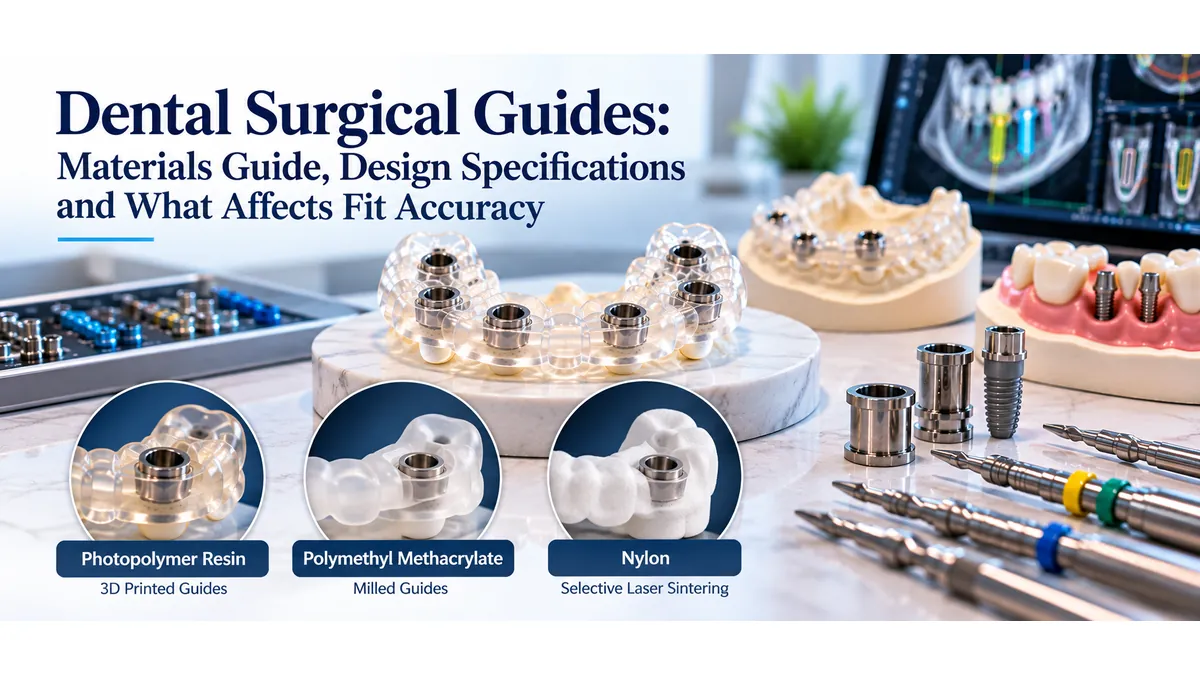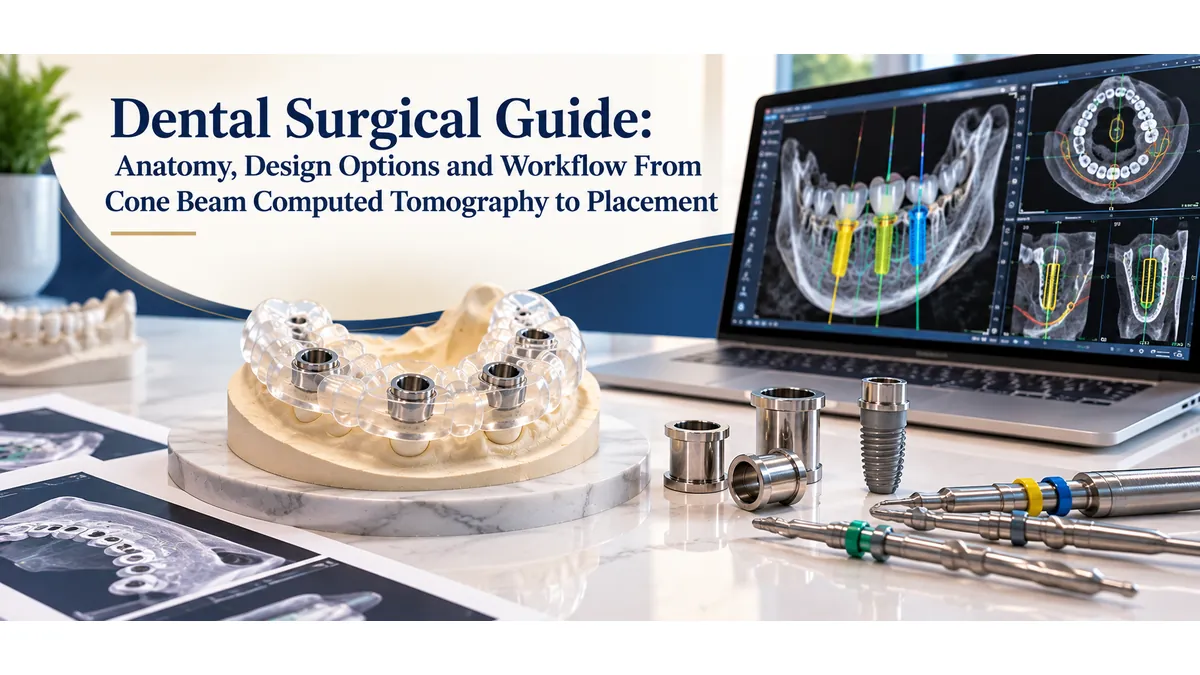
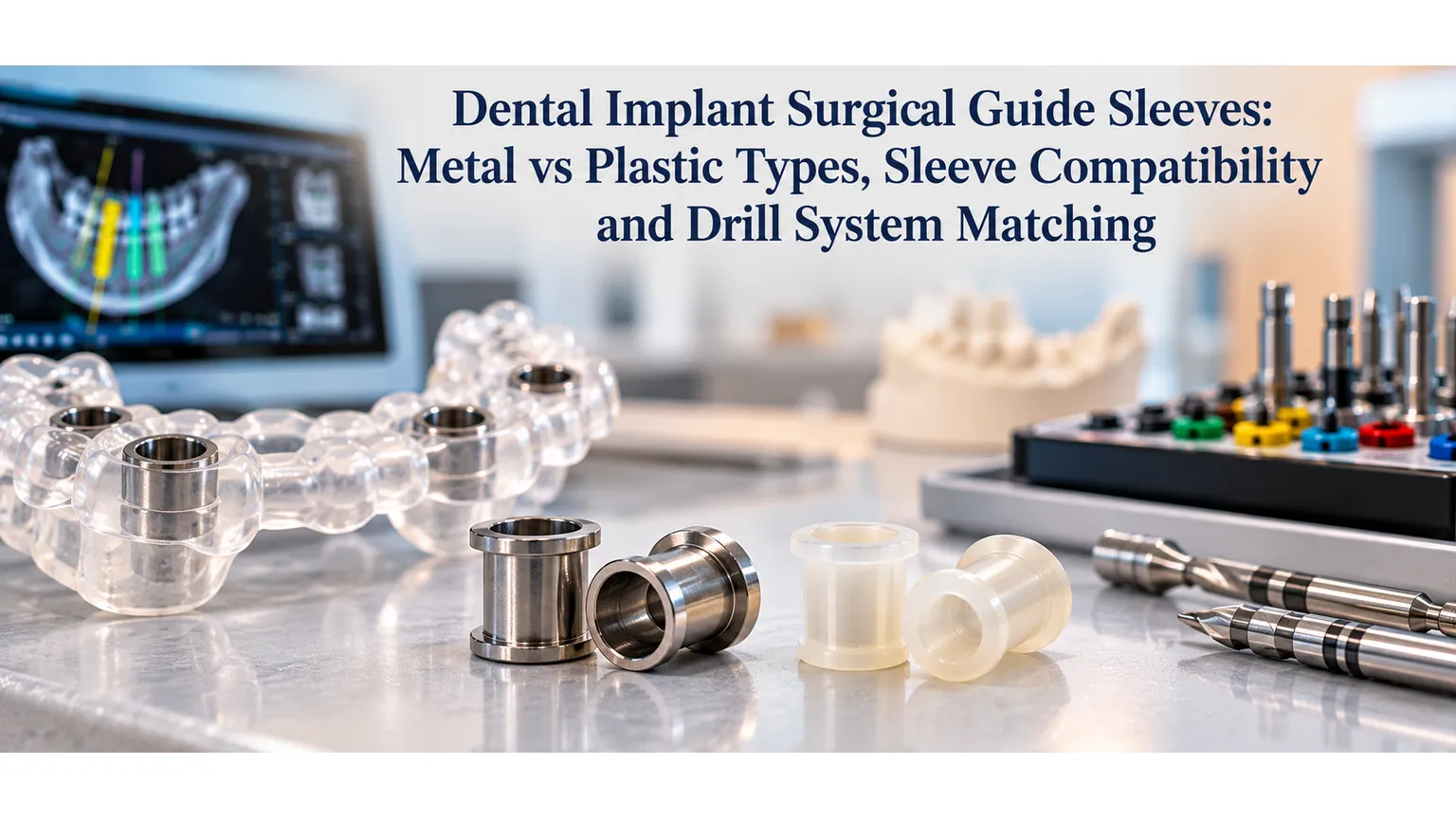
A surgical guide is only as precise as its weakest component, and the sleeve is where the entire system either holds or fails. The sleeve is the small cylindrical insert embedded in the guide body that physically constrains the drill during surgery. Its inner diameter, material, length, and compatibility with the chosen drill kit determine whether the implant lands where the plan dictated, or whether it deviates in a way that affects the restoration and, in worst cases, threatens vital structures. Understanding sleeve specifications is not optional for anyone involved in implant surgical guide design and fabrication. It is foundational.
This article covers the two main sleeve material categories, what the research says about their comparative accuracy, how sleeves are sized to match drill systems, and what clinicians and labs need to verify before a guide goes into production.
The Role of the Sleeve in Guided Implant Surgery
In static guided implant surgery, the surgical guide template physically positions the drill at the planned angulation, entry point, and depth. The sleeve is the precision interface through which that positioning happens. When the surgeon inserts the drill through the guide, the drill shank passes through the sleeve bore, and the sleeve constrains radial movement, meaning the drill cannot deviate laterally from the planned axis.
The sleeve does not prevent axial movement, which is why depth stops and stop rings attached to the drill are used alongside the sleeve to control how deep the drill travels. Together, the sleeve and stop ring system translates a virtual treatment plan into controlled surgical motion.
The accuracy of the entire guided surgery workflow, from cone beam computed tomography scan through planning software to physical guide, converges at the sleeve. A well-fabricated sleeve in a well-fabricated guide produces results consistent with the planning data. A sleeve with incorrect inner diameter, poor seating in the guide, or material that deforms under drilling load introduces error regardless of how precise the upstream planning was. This is why selecting the right sleeve type is one of the first decisions made during surgical guide case planning and fabrication.
Metal Sleeves: Stainless Steel and Titanium
Metal sleeves, manufactured from stainless steel or titanium, are the industry standard for precision guided implant surgery. They are machined to tight tolerances and press-fit into pre-drilled or printed wells in the guide body. The metal bore provides a smooth, low-friction surface for the drill shank to pass through, and the rigid material maintains its geometry under the rotational load and heat generated by drilling.
Accuracy and Clinical Performance
A study published in the British Dental Journal evaluated the accuracy of implants placed using computer-aided design and computer-aided manufacturing surgical templates with either metal or polyether ether ketone sleeves. The in vitro analysis found that metal sleeves consistently produced lower angular deviation at the implant apex compared to polymer alternatives, particularly in longer osteotomy sequences where cumulative drift becomes a greater concern.
The Journal of Prosthodontics has also published data on the influence of metal guide sleeves on implant placement accuracy and precision, concluding that metallic sleeves contribute meaningfully to reducing variability in both angular and linear deviation metrics. These findings align with the fundamental physics: a harder, more dimensionally stable material constrains the drill more consistently over repeated drill passes.
When Metal Sleeves Are the Right Choice
Metal sleeves are appropriate for full arch cases, All-on-4 and All-on-6 restorations, cases involving implants placed near critical anatomy such as the inferior alveolar nerve or maxillary sinus, and any situation where the guide will be used for sequenced multi-unit placement. Their rigidity and durability also make them the better choice when drilling at higher speeds, as they do not generate heat buildup in the way that some polymer materials can.
Most implant system manufacturers, including Nobel Biocare and Straumann, publish specific guided sleeve specifications for their drill kits. These specs define the required sleeve inner diameter that matches the drill shank diameter for each step in the osteotomy sequence, and metal sleeves are produced to hold these tolerances reliably across a full surgical sequence.
Plastic Sleeves: Polyether Ether Ketone and Acrylic Resin
Plastic sleeves encompass two main categories: sleeves made from polyether ether ketone (commonly called PEEK), a high-performance thermoplastic with excellent mechanical properties, and simpler integrated resin sleeves formed directly into the guide body material during 3D printing or thermoforming.
Polyether Ether Ketone Sleeves
Polyether ether ketone is a semi-crystalline polymer with mechanical properties that exceed those of standard resins by a significant margin. It has good dimensional stability, can be machined to precise tolerances, and is biocompatible. When used as a surgical guide sleeve material, polyether ether ketone performs better than generic acrylic sleeves and is considered a viable alternative to metal in lower-complexity cases.
The same British Dental Journal study noted that polyether ether ketone sleeves produced acceptable accuracy for single-tooth and small-span cases, with the accuracy gap between metal and polyether ether ketone widening in full arch scenarios where the guide template must maintain dimensional integrity across a larger span. For practices or labs working within tighter budget constraints on uncomplicated cases, polyether ether ketone sleeves can deliver clinically acceptable outcomes.
Integrated Resin Sleeves
The most economical approach to sleeve fabrication is to print or machine the sleeve geometry directly into the guide body, with no separate insert at all. This is possible with high-performance guide resins and is common in lower-cost digital workflow systems. The limitation is that standard guide resins, even surgical-grade ones, have higher surface friction than metal and are less dimensionally stable under heat and mechanical load.
Integrated resin sleeves are generally suitable for low-speed drilling protocols, single-tooth cases with straightforward anatomy, and situations where the guide will be used only once by an experienced clinician who can account for any minor deviation. They are not appropriate for high-speed instrumentation or cases where angular precision is critical.
Metal vs Plastic Surgical Guide Sleeves: Direct Comparison
The table below summarizes the key clinical and practical differences between metal and plastic surgical guide sleeves to help clinicians and labs select the appropriate sleeve type for each case.
| Property | Metal Sleeve | Plastic Sleeve |
|---|---|---|
| Material | Stainless steel or titanium | Polyether ether ketone (PEEK) or acrylic resin |
| Surface friction | Very low, smooth metal bore | Slightly higher, depends on resin finish |
| Dimensional stability | Excellent, resists heat and torque | Good, may flex slightly under drilling load |
| Drill speed compatibility | High and low speed drills | Typically low speed only to avoid heat buildup |
| Radiopacity | High, visible on imaging | Low or radiolucent |
| Cost per guide | Higher due to manufacturing | Lower, integrated into resin body |
| Best use case | Multi-unit, full arch, high-stakes cases | Single-tooth, lower-complexity cases |
Sleeve Inner Diameter: The Foundation of Drill System Compatibility
The most critical specification for any surgical guide sleeve is its inner diameter, which must match the outer diameter of the drill shank being used. If the inner diameter of the sleeve is too large, the drill will rattle within the sleeve, causing lateral deviation that undermines the entire purpose of guided surgery. If the inner diameter is too small, the drill will not pass through, making the guide unusable.
Different implant systems use different drill shank diameters, and manufacturers often use different diameters at different stages of the osteotomy sequence. A pilot drill may have a 2.0 millimeter shank, the first sequential drill 2.8 millimeters, the next 3.5 millimeters, and so on depending on the planned implant diameter and the manufacturer's specific protocol.
This means that a single guide may need multiple sleeves at different inner diameters, one for each drill in the sequence, or the same sleeve can be used with sequential drills if the lab has confirmed that the drill shanks share a common outer diameter. Confirming this before guide fabrication is one of the most important steps in the surgical guide case submission and planning process.
Drill System Matching: Why the Implant Brand and Kit Version Matter
Surgical guide sleeves are not universal. Each major implant manufacturer produces guided surgery drill kits with specific shank diameters, and the sleeves embedded in a guide must be specified for that exact system. Using a guide fabricated with Nobel Biocare sleeve specifications on a Straumann drill kit, or vice versa, will produce misfits that may not be immediately obvious during guide seating but will result in incorrect osteotomy positioning.
Manufacturer-Specific Sleeve Specifications
Nobel Biocare guided surgery uses pilot drill sleeves in 1.5 millimeter and 2.0 millimeter inner diameters for the initial guided drill steps, with sequential sleeves for larger diameters. Their guided lab components system includes color-coded sleeves and stop rings designed to work as an integrated system with their guided drill kit. Other manufacturers, including Straumann, Zimmer Biomet, BioHorizons, and Dentsply Sirona, each publish their own guided surgery protocols with specific sleeve inner diameters for each drill step.
SICAT, a planning software and guide fabrication platform, publishes a guided sleeve options document that maps sleeve specifications to compatible implant systems, making it easier for labs and clinicians to confirm compatibility before fabrication begins. Working with a lab that has access to these reference materials and actively verifies sleeve-to-drill compatibility for each case is an important quality safeguard.
Sleeve Height and Its Effect on Access
In addition to inner diameter, sleeve height, also called sleeve length, affects how the drill is guided during surgery. Longer sleeves provide more lateral constraint along the drill shank, which improves angular precision. However, longer sleeves also require more space between the guide base and the bone surface, which can be a problem in posterior regions or in patients with limited mouth opening. Short sleeves or open sleeves may be necessary in these situations, at the cost of some degree of angular control.
The appropriate sleeve height is determined during case planning based on the guide support type, the available interocclusal space, and the planned implant depth. This decision should be made explicitly in the planning phase, not assumed during guide fabrication.
Verifying Compatibility Before Guide Fabrication
Compatibility errors between sleeve specifications and drill systems are among the most common avoidable problems in guided surgery, and they consistently cause delays, remakes, and clinical frustration. Preventing them requires a systematic verification step before the guide is fabricated. When working with Guided Excellence for implant surgical guide fabrication, the case submission process includes a mandatory compatibility confirmation step where the implant system, planned implant size, and drill kit version are verified against the sleeve specifications before guide production begins.
When submitting a case to any lab, the information that must be confirmed includes: the implant manufacturer and system name, the specific implant diameter and length planned for each site, the drill kit version and generation in use at the clinic, whether the clinic uses guided surgery drills or standard drills with guided adapters, and whether any implant-specific stop rings or depth keys are part of the protocol.
Clinicians who are new to guided surgery, or who are switching implant systems, should confirm sleeve compatibility explicitly with the lab before submitting a case. Contacting the Guided Excellence team before the first case with a new system is a straightforward way to confirm that all specifications are aligned.
How Sleeve Type Affects Guide Design and Cost
The choice of sleeve material affects not just clinical accuracy but also guide fabrication time, cost, and the overall design of the template. Metal sleeves must be sourced separately, press-fit or bonded into the guide body, and verified for seating before delivery. This adds steps to the fabrication workflow and materials cost, which is reflected in the final guide price. Surgical guide pricing at Guided Excellence is transparent about what is included at each service level, including sleeve material and the extent of compatibility verification performed before delivery.
Guides with integrated resin sleeves are faster and less expensive to produce but carry the limitations described earlier. For practices managing a mixed case load, a practical approach is to reserve metal-sleeved guides for full arch, multi-unit, and anatomically complex cases while using resin-integrated guides for straightforward single-tooth cases where the accuracy premium of metal is less critical.
If you have cases that fall somewhere in between, or are unsure which sleeve specification applies to your planned implant system, submit the case details to Guided Excellence for a planning review. The team can recommend the appropriate sleeve type based on the case requirements and confirm drill compatibility before any fabrication begins.
What to Ask Your Lab About Sleeves
Not every dental lab that fabricates surgical guides performs explicit sleeve-to-drill compatibility verification. When evaluating a guide fabrication partner, the following questions help determine whether their process is rigorous enough to protect clinical outcomes.
- What sleeve material do you use as your standard, and do you offer metal sleeves for complex cases?
- How do you confirm sleeve inner diameter compatibility with the specific drill kit we use at our clinic?
- Do you have up-to-date sleeve specifications for our implant system and drill kit version?
- What is your policy if a compatibility issue is found after the guide is fabricated?
- Are the sleeves sourced from the implant manufacturer, or are they third-party components?
A lab that can answer these questions clearly and specifically is one that takes guide accuracy seriously. Guided Excellence implant surgical guides are fabricated with verified sleeve specifications matched to the case submission data, and every guide goes through a final review before dispatch to confirm that the sleeve geometry is consistent with the planning data.
Conclusion
The surgical guide sleeve is a small component with an outsized effect on the accuracy and reliability of guided implant surgery. The choice between metal and plastic affects dimensional stability, drill compatibility, and ultimately how closely the placed implant matches the treatment plan. Sleeve inner diameter must be matched precisely to the drill system in use, and that matching must be confirmed explicitly before guide fabrication begins, not assumed.
Whether you are planning a straightforward single-tooth case or a complex full arch reconstruction, getting the sleeve specification right is as important as getting the implant position right in the software. The two are directly connected. Working with a lab that understands this and has the systems in place to verify compatibility on every case is the most reliable way to ensure that the plan and the surgical result stay aligned. Explore Guided Excellence surgical guide design and fabrication services and submit a case for review to get started with a verified guided surgery workflow.