
When dentists talk about using surgical guides for implant placement, they are not always describing the same thing. Two fundamentally different approaches exist: pilot-drill guidance and fully guided surgery. Both involve a surgical guide. Both improve on freehand surgery. But they differ significantly in how much of the procedure is mechanically controlled, and therefore how much accuracy improvement they deliver.
What Pilot-Drill Guided Surgery Is
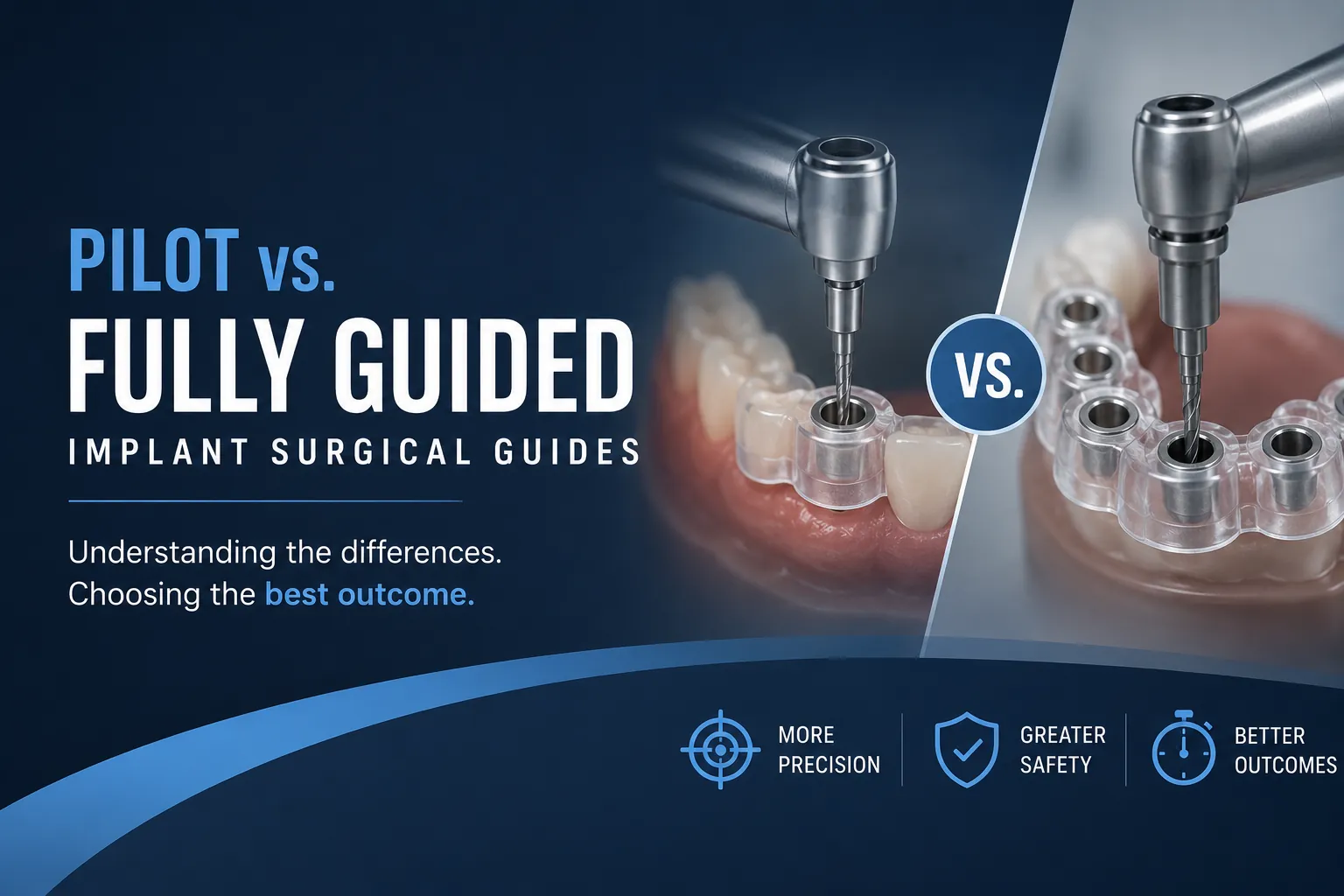
In pilot-drill guidance, also called partial guidance, the surgical guide is used only for the initial pilot drill, the smallest diameter drill that establishes the osteotomy entry point and initial direction. Once the pilot drill has been used, the guide is removed. The remainder of the drilling sequence is completed freehand.
The guide controls: the entry point location and the initial drill angulation for the first 3 to 5mm. The guide does not control: the angulation of any subsequent drill, the depth of any drill, or the final implant position.
Pilot-drill guides are simpler to fabricate, a single sleeve per implant rather than multiple sleeves, and slightly less expensive. They are ordered when the clinician wants directional assistance at the start of drilling but intends to complete the osteotomy freehand. At Guided Excellence, we design both guide types, specify your preference when submitting your case.
What Fully Guided Surgery Is
In fully guided surgery, the surgical guide remains in place for the entire drilling sequence. Every drill in the protocol, from the smallest pilot drill to the final profile drill, is inserted into a dedicated sleeve in the guide. Each sleeve constrains the drill to the planned direction. Depth-limiting stops within the sleeves control the depth of each drill automatically.
The guide controls everything: every drill's entry point, angulation, and depth throughout the complete drilling sequence. This is the standard approach for precision implant surgical guides at Guided Excellence.
Accuracy Comparison: The Numbers That Matter
Pilot-Drill Accuracy
Research on pilot-drill guidance consistently shows performance between freehand and fully guided surgery: position accuracy at apex 1.5 to 2.5mm mean deviation, angular accuracy 4 to 8 degrees mean deviation, depth accuracy 0.5 to 1.5mm mean deviation. This is better than pure freehand but significantly worse than fully guided surgery. After the guide is removed, every subsequent freehand drill introduces additional deviation that compounds toward the final implant position.
Fully Guided Accuracy
Fully guided surgery achieves consistently superior results: position accuracy at apex 0.5 to 1.0mm mean deviation, angular accuracy 2 to 5 degrees mean deviation, depth accuracy 0.3 to 0.8mm mean deviation. The accuracy advantage of fully guided surgery over pilot-drill guidance is 2 to 3 times improvement in position and angular accuracy, a clinically meaningful difference in the case types where precision matters most.
Clinical Implications of the Accuracy Difference
Esthetic Zone Cases
For anterior zone implants, 1.5 to 2.5mm accuracy from pilot-drill guidance may produce visible esthetic compromise. A 2mm error in the bucco-lingual dimension creates an emergence profile problem that is difficult and expensive to correct. Fully guided surgery's 0.5 to 1.0mm accuracy provides the precision margin that anterior esthetic cases require.
Nerve Canal Proximity
When the planned implant apex is within 3mm of the inferior alveolar nerve canal, pilot-drill accuracy of 1.5 to 2.5mm at the apex creates a real probability of nerve canal contact in freehand drilling after the guide is removed. Fully guided accuracy of 0.5 to 1.0mm, combined with the planned 1.5 to 2.0mm clinical clearance, provides adequate safety margin throughout the full drilling sequence.
Full Arch Cases
Full arch implant cases are not appropriate for pilot-drill guidance. The cumulative positional errors from four to six pilot-guided-then-freehand implants create inter-implant relationship deviations that prevent passive prosthesis seating. Full arch cases require fully guided surgery without exception.
When Pilot-Drill Guidance Is Reasonable
Pilot-drill guidance is a reasonable choice only in limited circumstances: simple single posterior tooth cases in generous bone anatomy, performed by experienced surgeons, where esthetic demands are low and anatomy is not proximity-critical. Even in these cases, fully guided surgery provides better accuracy and time savings. Some surgeons use pilot-drill guidance as a stepping stone when transitioning from freehand to fully guided surgery, once comfortable, most transition to fully guided for all cases.
Guide Design Differences
Pilot-drill guides have a single sleeve per implant, no depth-limiting sleeve features, and smaller guide bodies removed after the pilot drill. Fully guided designs have multiple sleeves per implant (one for each drill in the system protocol) and depth-limiting sleeve features for each drill size. Both are available at Guided Excellence. See our implant surgical guide design options.
Making the Choice for Your Cases
- Esthetic zone: fully guided, no exceptions
- Nerve canal proximity under 3mm: fully guided, no exceptions
- Full arch or multi-implant: fully guided, no exceptions
- Immediate implant placement: fully guided strongly recommended
- Simple posterior single tooth, experienced surgeon, generous bone: pilot-drill acceptable
- Learning curve (under 50 cases): fully guided for all cases
When in doubt, choose fully guided. Guides never make a case worse, they only add precision. View our transparent pricing for both guide types.