
Full-arch implant restoration is the most complex procedure in implant dentistry. Placing four to six implants simultaneously, coordinating their angulations and depths, and delivering a functional provisional prosthesis on the same day requires a level of precision that freehand surgery simply cannot reliably provide.
Surgical guides exist precisely for cases like this, where cumulative positional errors across multiple implants can make the difference between a prosthesis that seats passively and a case that requires extensive revision. This article explains how surgical guides address the specific challenges of full-arch implant procedures, from planning through same-day loading.
The Unique Challenges of Full-Arch Implant Surgery
The Cumulative Error Problem
In a single-implant case, a freehand positional error of 2mm affects one implant and one restoration. In a full-arch case, four to six freehand positional errors combine. Even if each individual implant is within 2mm of planned position, the combined effect on prosthesis fit can be catastrophic, the multi-unit abutment positions may be too far from the provisional prosthesis design to allow passive seating without significant modification.
A surgical guide constrains all implant positions simultaneously to a single coordinated design. The guide does not allow each implant to accumulate individual positional variation, all four to six implants emerge at their planned positions relative to each other, and relative to the prosthesis that was designed for those positions.
Immediate Loading Requirements
All-on-4 and All-on-6 protocols typically involve same-day loading, the provisional prosthesis is attached to the implants on the day of surgery. This requires implant positions that are accurate enough for the provisional to seat without adjustment, sufficient primary stability across all implants, and abutment platform heights that allow the prosthesis to engage all implants simultaneously.
Without a surgical guide, achieving all three of these requirements simultaneously in a single surgery is largely dependent on surgeon skill and favorable anatomy. With a guide, the implant positions are delivered to the same coordinates used to design the provisional, passive seating becomes predictable rather than aspirational.
Posteriorly Angled Implants
The All-on-4 concept uses posteriorly angled implants, typically 30 to 45 degrees, to maximize bone engagement without sinus augmentation in the maxilla and to avoid the mandibular nerve in the mandible. These angled implants require precise angulation control to engage the planned bone volume and achieve the abutment angles compatible with the prosthetic design.
Freehand angular control for angled implants is highly variable, different surgeons achieve different angles, and the same surgeon achieves different angles on different days. A surgical guide constrains the posterior implant angulation to the planned angle within 2 to 3 degrees, making the All-on-4 concept reproducible. See how our full arch surgical guides are designed for these cases.
How Surgical Guides Address Each Full-Arch Challenge
Coordinated Multi-Implant Positioning
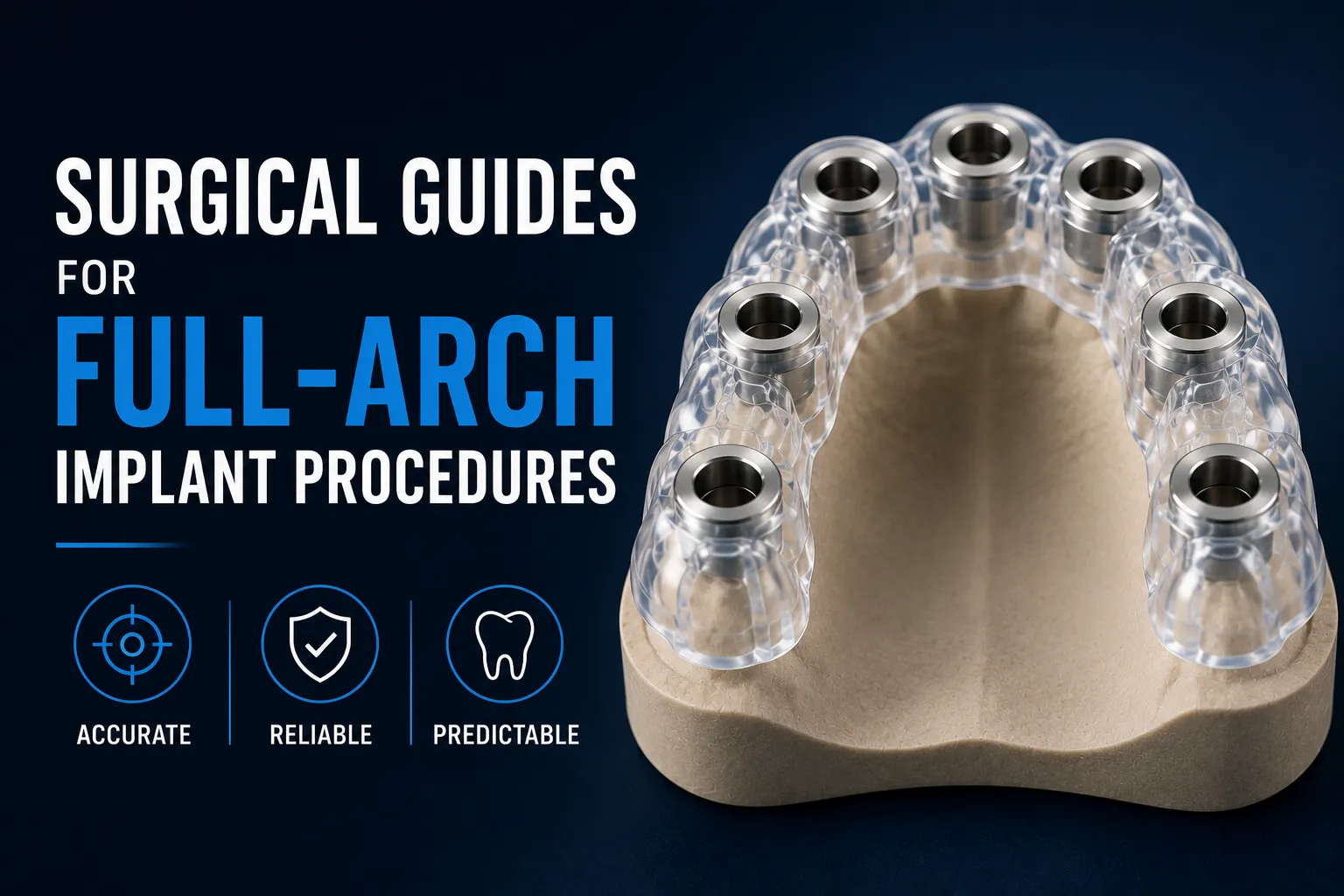
A full-arch surgical guide contains four to six drill sleeves, one for each planned implant, all designed and fabricated as a single integrated unit. The sleeve positions encode the planned inter-implant relationships: spacing, parallelism (for straight implants), specific angulations (for angled implants), and arch coordination.
Because all sleeves are positioned relative to the same anatomical reference, the cumulative positional variation that characterizes freehand multi-implant cases is eliminated. Each implant emerges at its planned position relative to every other implant, the arch geometry is controlled, not estimated.
Same-Day Loading Reliability
When full-arch implants are placed using a surgical guide designed in conjunction with the planned provisional prosthesis, the implant positions match the prosthesis design. Multi-unit abutments connect to each implant and the provisional prosthesis seats over all of them simultaneously, without forcing, adjusting, or grinding.
Without a guide, same-day provisional seating often requires chairside adjustment that extends operative time and introduces uncertainty about whether the adjusted fit will remain stable under function. With guide-accurate implant positions, first-time passive fit is achievable as a standard outcome rather than a best-case scenario.
Bone Reduction Integration
Many full-arch cases require bone reduction, removing excess alveolar bone to create a flat prosthetic platform at the correct vertical dimension. Bone reduction must be coordinated with implant positioning: too much reduction and implants are placed in insufficient bone; too little and the prosthetic platform is at the wrong height.
Bone reduction guides can be designed as part of the same planning session as the implant placement guide, ensuring that the reduction level and implant positions are precisely coordinated. Our implant surgical guide lab designs both guides as integrated components of the same treatment plan when full arch cases require bone reduction.
The Full-Arch Guided Surgery Workflow
Virtual Planning
Full-arch planning begins with a complete three-dimensional patient model: CBCT for bone anatomy and an intraoral scan for current tooth and tissue positions. The treatment team places virtual implants in positions that maximize bone engagement, avoid anatomical risk structures, maintain appropriate spacing, and support the planned prosthesis design.
For All-on-4 cases, the two anterior implants are positioned vertically in the anterior bone, and the two posterior implants are angled distally to engage posterior bone while avoiding the sinus or nerve. This virtual plan is reviewed for prosthetic compatibility before guide fabrication begins.
Guide Fabrication
The approved virtual plan is converted to a guide that seats on the patient's ridge anatomy (for full-arch edentulous cases) or on the most stable available teeth (for full-arch cases where some teeth remain until surgery). Metal drill sleeves encode the position and angulation of each implant, and retention pins anchor the guide during the extended multi-implant drilling sequence. Our dental surgical guide design team produces full arch guides with consistent sleeve accuracy for every implant in the case.
Surgery
With the guide in position and verified for passive seating, drilling proceeds systematically for each implant site. The guide controls direction, angulation, and depth for every drill in the sequence. After all osteotomies are prepared, the guide is removed and implants are placed following the channels created by the guided drills.
Torque is measured for each implant to confirm adequate primary stability for immediate loading. When all implants meet the torque threshold, multi-unit abutments are connected and the provisional prosthesis is attached, verified for passive fit, adjusted for occlusion, and delivered.
Clinical Evidence for Full-Arch Guided Outcomes
Research on full-arch guided surgery consistently demonstrates improved outcomes compared to freehand approaches:
- Operative time reduction of 60 to 90 minutes per case compared to freehand multi-implant surgery
- First-time passive prosthesis seating achieved in 90 to 95% of guided cases versus 60 to 70% freehand
- Implant survival rates of 98%+ at 3-year follow-up for guided full-arch cases
- Fewer intraoperative complications and implant positional deviations
Cost Considerations for Full-Arch Guides
Full-arch surgical guides cost more than single-tooth guides due to greater design complexity and fabrication requirements. At Guided Excellence, full-arch guide pricing starts at $150 base plus $50 per additional implant, a 4-implant All-on-4 guide is $300, and a 6-implant All-on-6 guide is $400. See our complete surgical guide pricing.
The return on investment for full-arch guides is exceptionally clear. A 60 to 90 minute reduction in operative time at typical overhead costs saves $300 to $750 per case. A single avoided provisional remake (cost: $500 to $2,000) exceeds the guide cost. The guide pays for itself on every case before counting the long-term value of better implant positioning.