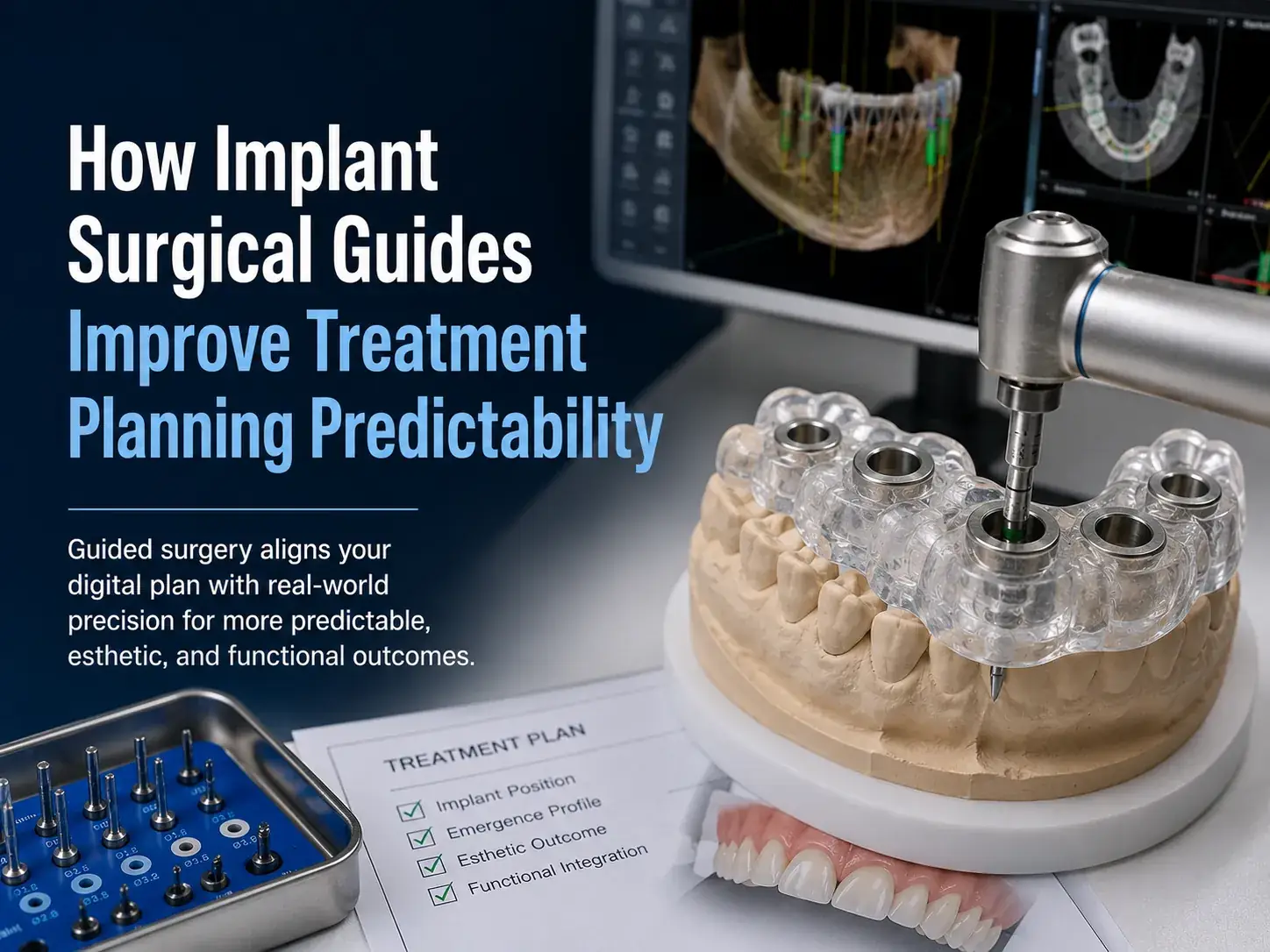

Treatment planning in implant dentistry involves making decisions whose consequences unfold months in the future: where the implant will go, how the crown will emerge, what the tissue will look like, and whether the bite will function correctly. The gap between the planned outcome and the delivered outcome determines whether a case succeeds or requires revision.
Surgical guides close this gap. By mechanically delivering implants to their planned positions, they transform treatment planning from an educated prediction into a reliable pathway to a defined outcome. This article explains how surgical guides improve predictability at every stage of the treatment planning process, from the initial consultation through final restoration.
The Predictability Problem in Freehand Implant Surgery
Freehand implant surgery introduces variability at the most critical point in the entire treatment sequence: surgical execution. Even an excellent treatment plan becomes unpredictable when the execution depends entirely on the surgeon's real-time judgment under surgical conditions.
Freehand positional accuracy of plus or minus 2 to 3mm means that the actual implant position may differ from the planned position by an amount that significantly affects every downstream decision. The crown designed for the planned position may not fit the actual emergence profile. The gingival architecture expected around the planned position may not form around the actual position. The bone loss pattern around the planned position may differ from what occurs around the actual position.
Surgical guides constrain execution to match planning. The plan designed for the patient becomes the outcome delivered in surgery, consistently, regardless of surgeon experience or case complexity. This is the fundamental predictability advantage of implant surgical guides.
How Guides Improve Pre-Surgical Planning Confidence
Visualization-Based Planning Replaces Estimation
With CBCT and planning software, treatment planning is no longer based on flat radiographic estimations. The clinician can visualize the three-dimensional relationship between planned implant positions, bone anatomy, adjacent roots, nerve canals, and sinus floors before a drill is picked up. This visualization capability enables confident planning decisions, moving an implant 1mm mesially to improve root clearance, adjusting angulation 5 degrees to optimize screw access, that were previously impossible without intraoperative improvisation.
The confidence that comes from this visualization is compounded when the planner knows that a surgical guide will deliver the plan. Planning decisions can be made based on what is optimal, not based on what can be executed freehand under surgical conditions.
Prosthetic Integration Before Surgery
The most significant planning improvement that guides enable is true prosthetic-driven planning. When the surgeon knows the guide will deliver the planned implant position, the restoration can be designed around the optimal implant position rather than adapting to wherever the implant actually ended up. Our dental surgical guide design approach begins with the restoration requirement and works backward to the implant position, not the reverse.
In practice, this means the restorative dentist can design the final crown before surgery begins, knowing the implant position will match the design. The patient can be shown a digital simulation of the final result. The treatment timeline can be planned with specificity rather than estimates.
Predictability in Esthetic Cases
Esthetic zone implant cases are where the predictability advantage of guided surgery is most visible and most valuable. In the maxillary anterior region, every dimension of implant position, depth, bucco-lingual position, mesio-distal position, angulation, affects crown esthetics directly.
Freehand anterior implant cases are inherently unpredictable because the surgical outcome cannot be matched to the restorative design with the precision that esthetics require. Surgeons and restorative dentists working in the anterior zone without guides accept that the final restoration will need to adapt to wherever the implant ended up, sometimes successfully, sometimes with visible compromise.
Guided anterior implant cases are predictable because the prosthetically-driven plan is delivered mechanically. The crown designed for the planned implant position fits the implant that was placed at the planned position. The emergence profile, the tissue support, and the gingival architecture all develop as planned rather than as approximated.
Predictability in Multi-Implant Cases
When multiple implants must be placed for a bridge or multi-unit restoration, predictability requirements multiply. Each implant must not only be at its own planned position, the implants must also be in the correct relationship to each other. Spacing, parallelism, and arch coordination must all be achieved simultaneously.
Freehand multi-implant cases have high variability in inter-implant relationships. Even when individual implants are placed reasonably close to their planned positions, the combined effect of multiple small deviations creates prosthetic challenges: bridges that do not seat passively, abutment angles that conflict, and crown designs that must compromise to accommodate actual implant positions.
A single surgical guide controls all implant positions simultaneously, enforcing the planned inter-implant relationships as mechanical constraints rather than as goals for freehand estimation. The result is a multi-implant case where the bridge was designed for the implant positions that were actually placed, because those are the same positions.
How Guides Improve Communication With Patients
Treatment planning predictability has a patient communication dimension that is often underappreciated. Patients want to know what they will end up with. In freehand implant treatment, the honest answer is: "We plan for this result, and we expect to achieve it, but we cannot guarantee exactly what the final outcome will look like."
In guided implant treatment, the answer changes: "We design the final restoration first, plan the implant position to support it exactly, and use a custom guide to place the implant at the planned position. The result you are seeing now is the result you will have."
This is not just better marketing, it is clinically more accurate. Guided surgery genuinely improves outcome predictability, and patients who understand this are better informed. The digital visualization from planning software allows patients to see their planned result before surgery begins, which improves informed consent quality and sets accurate expectations.
Long-Term Predictability: Implant Survival and Maintenance
Treatment planning predictability extends beyond the initial restoration to long-term outcomes. Implants that are placed at planned positions to support optimally designed restorations experience more favorable biomechanical loads, better bone maintenance, and more consistent long-term survival than implants placed in compromised positions with adapted restorations.
The long-term evidence supports this: guided implants show 5-year survival rates of 98 to 99% compared to 94 to 97% for freehand placements. The predictability advantage of guided surgery compounds over time, better initial positioning produces better long-term maintenance profiles.
At Guided Excellence, Dr. Baghoomian's personal review of complex cases ensures that the treatment plan not only achieves surgical feasibility but also positions implants for long-term prosthetic and biological success. Submit your case and experience the planning predictability that guided surgery enables.