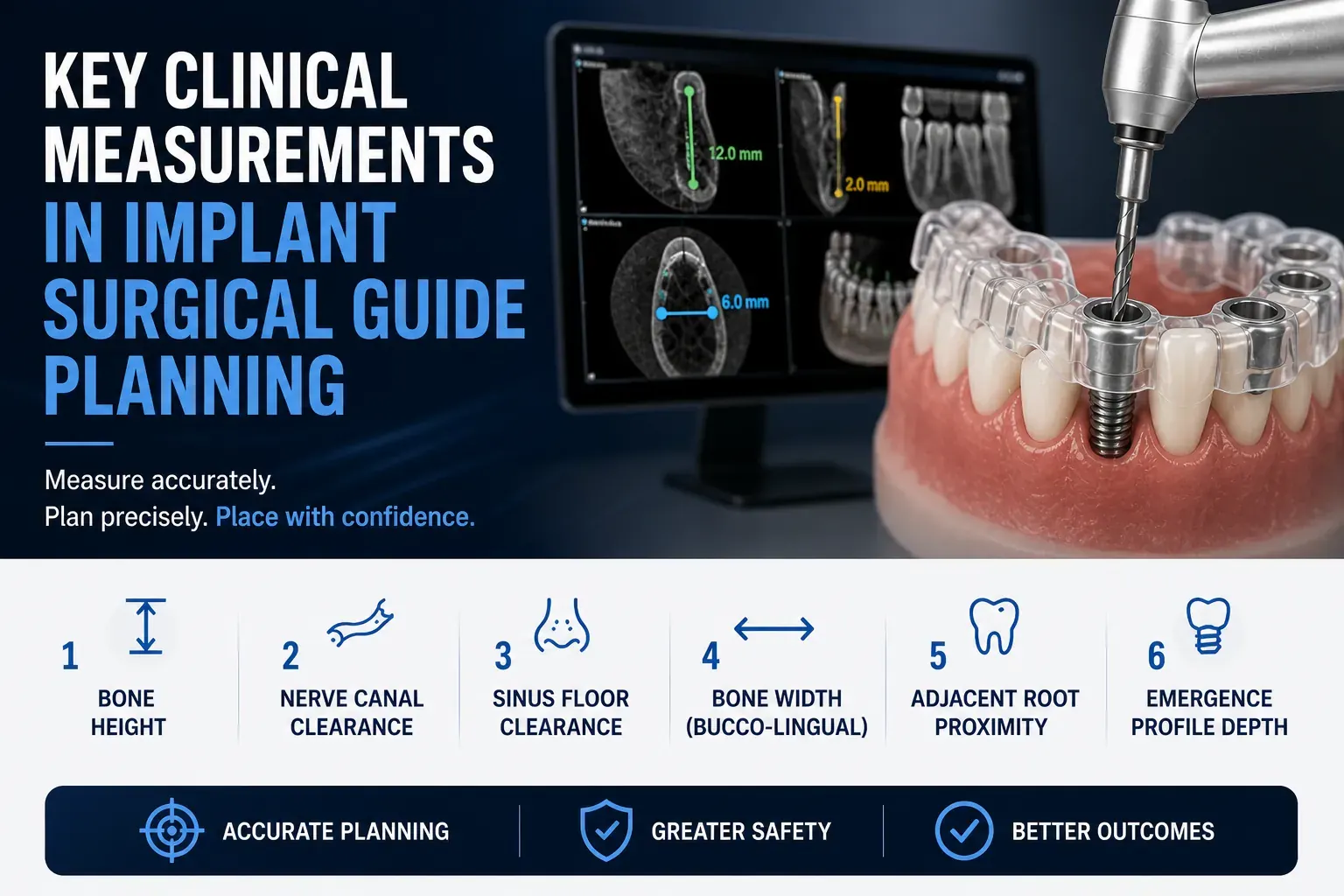

Every surgical guide is built from measurements. The bone height at the implant site, the distance from the planned apex to the nerve canal, the width of available bone, the proximity to adjacent roots, each enters the planning process as a number that constrains or enables design decisions.
Understanding what measurements matter, how they are taken, and how they influence guide design helps dentists review virtual plans more critically and submit better case information.
Measurement 1: Bone Height (Apical-Coronal)
Bone height is the vertical distance from the alveolar crest to the nearest anatomical boundary, the inferior alveolar nerve canal in the mandible or the maxillary sinus floor in the maxilla. Measured in cross-sectional CBCT views taken perpendicular to the arch at the planned implant site.
Clinical significance: bone height determines the maximum implant length that can safely be placed. Standard implants require 12 to 14mm of usable bone height. When bone height is 10 to 12mm, shorter implants are required. Below 8mm, augmentation is typically needed before placement.
Guide design impact: the depth-limiting sleeve is engineered to stop the drill at the depth that places the implant within the available bone height while maintaining minimum 1.5 to 2.0mm clearance above the nerve or sinus. This calculation is performed individually for each implant position in every case at Guided Excellence. See our surgical guide design process.
Measurement 2: Nerve Canal Clearance
Nerve canal clearance is the distance from the planned implant apex to the superior border of the inferior alveolar nerve canal. Measured from the bottom of the planned implant at the planned depth to the top of the nerve canal outline in cross-sectional CBCT views.
Clinical standard: minimum 1.5mm clearance, with 2.0mm preferred. Values below 1.5mm carry elevated paresthesia risk. Values below 1.0mm represent direct proximity risk.
Guide design impact: this is the most safety-critical measurement in mandibular guide design. A depth stop set 2mm too deep can turn a safe case into a nerve contact event. Every millimeter of nerve clearance depends on the guide's depth stop accuracy.
Measurement 3: Sinus Floor Clearance
Sinus floor clearance is the distance from the planned implant apex to the cortical sinus floor in the maxillary posterior. Measured in coronal CBCT cross-sections at the exact planned implant position. Clinical standard: 1.0 to 2.0mm minimum clearance without sinus involvement.
Guide design impact: the same depth stop precision that protects the nerve in the mandible protects the sinus floor in the maxilla. A sleeve stop that is 2mm too deep can turn a straightforward posterior maxillary case into a sinus perforation event.
Measurement 4: Bone Width (Bucco-Lingual)
Bone width is the horizontal distance between the buccal and lingual cortical plates at the planned implant level. Measured in axial CBCT cross-sections at the planned implant depth. Clinical standard: minimum 5.5 to 6.0mm for standard diameter implants.
Guide design impact: bone width determines the lateral freedom of implant placement. A narrow ridge constrains the acceptable bucco-lingual placement zone, the guide sleeve must be positioned to keep the implant within this zone with adequate bone on all sides.
Measurement 5: Adjacent Root Proximity
Adjacent root proximity is the distance from the outer surface of the planned implant to the nearest adjacent tooth root. Measured in axial and cross-sectional CBCT views. Clinical standard: minimum 1.5mm from root surface. Values below 1.5mm risk root damage during drilling and potential tooth loss.
Guide design impact: mesio-distal sleeve position is constrained by root proximity on both sides. When teeth are close together, the available mesio-distal implant placement zone may be narrow, requiring especially precise sleeve positioning.
Measurement 6: Emergence Profile Depth
Emergence profile depth is the distance from the planned gingival margin to the implant platform position. Derived from combining gingival margin position from the intraoral scan with bone crest position from CBCT.
Clinical standard: the implant platform is typically positioned 3 to 4mm apical to the gingival margin in anterior esthetic cases to allow adequate soft tissue depth for natural emergence profile development.
Guide design impact: emergence profile depth determines the sleeve depth stop position, which determines how deep the implant platform is positioned relative to tissue. Getting this right is key to achieving natural emergence profiles in esthetic cases, which is why our custom surgical guide design always begins with the restoration requirement.
How These Measurements Interact
Bone height sets the maximum implant length. Nerve or sinus clearance reduces the usable bone height by the required safety margin. Bone width determines whether the planned diameter fits. Root proximity constrains mesio-distal position. Emergence profile depth determines platform position. These measurements interact, a change in one affects the feasibility of others.
This is why experienced clinical review catches planning problems that software automation might miss. At Guided Excellence, Dr. Baghoomian reviews complex cases for multi-measurement conflicts before guide fabrication begins. Submit your case and benefit from this clinical review as part of our standard service.