
The evidence that guided surgery is more accurate than freehand surgery is well established. The more nuanced clinical question is: in which cases does that accuracy difference translate into meaningfully better patient outcomes? Understanding this helps practices allocate resources effectively.
The short answer is: in more cases than most dentists initially assume. This article provides a practical decision framework for identifying when guided surgery is essential, when it is strongly recommended, and when freehand surgery is a reasonable alternative.
The Core Clinical Principle
The value of guided surgery is proportional to the cost of positional error in a given case. When positional error is tolerable, adequate bone in all directions, no esthetic demands, no adjacent anatomical risk, the accuracy advantage of guides provides efficiency and consistency benefits without significantly changing patient outcomes. When positional error is not tolerable, the accuracy advantage of guides is the difference between a safe, predictable outcome and a complication requiring revision.
Category 1: Guided Surgery Is Essential
Esthetic Zone Implants
Any implant in the maxillary anterior region (canine to canine) requires guided surgery. In the esthetic zone, implant position determines everything visible: crown emergence, gingival contour, tissue architecture, and symmetry. A 1mm positional error in the bucco-lingual dimension, the depth, or the mesio-distal position creates a visible esthetic problem that is difficult and expensive to correct. The revision cost, additional surgery, bone grafting, tissue management, and replacement, exceeds the guide cost by orders of magnitude.
Proximity to the Inferior Alveolar Nerve
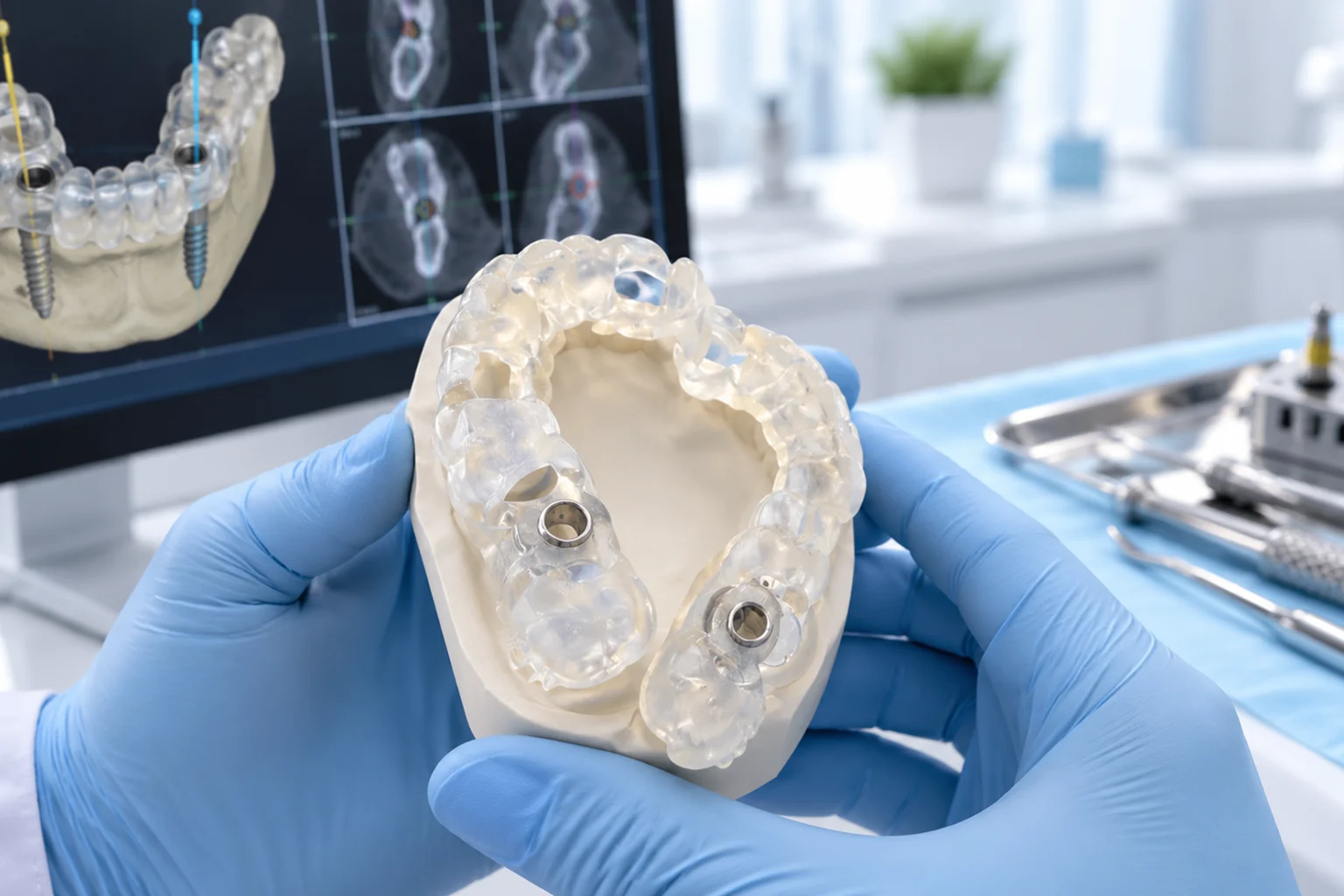
When the planned implant apex will be within 3mm of the inferior alveolar nerve canal, guided surgery is a patient safety requirement. Freehand depth accuracy of plus or minus 2 to 3mm means a meaningful proportion of freehand cases at this bone height will result in drill or implant contact with the nerve. Every implant surgical guide from Guided Excellence has these safety margin calculations verified before fabrication.
Maxillary Implants Near the Sinus Floor
The same safety logic applies in the maxillary posterior. When bone height below the sinus floor is limited, 8 to 12mm, freehand depth miscalculation risks sinus perforation. Guided depth control maintains sinus clearance based on the actual CBCT-measured anatomy at the specific implant site.
Immediate Implant Placement
Extraction socket anatomy guides freehand drills toward the socket apex, often not the prosthetically ideal direction. The typical result is implants placed too buccally, too shallowly, or at angles that compromise the emergence profile. In the esthetic zone especially, these errors are clinically visible and difficult to correct. Guided surgery constrains the drill to the planned prosthetically-driven axis regardless of socket geometry.
Multiple Adjacent Implants and Full Arch
When two or more implants must be coordinated for a bridge, multi-unit restoration, or full arch, guided surgery is essential for achieving the inter-implant relationships that prosthetics require. Spacing, parallelism, and arch coordination cannot be reliably achieved freehand across multiple implants.
Category 2: Guided Surgery Is Strongly Recommended
High Esthetic Expectations
Patients who express high esthetic expectations deserve the accuracy that guided surgery provides. The precision benefit is real and communicable: the implant will be placed exactly where planned, to support a restoration designed specifically for that position.
Limited Bone Volume
When ridge height is 10 to 12mm and ridge width is 5 to 6mm, the acceptable placement zone is narrow. Freehand surgery in this geometry risks cortical perforation, inadequate bone depth, or positioning outside the available bone envelope. Guided surgery navigates tight anatomy reliably.
Surgeons in the Learning Curve
For dentists placing fewer than 50 to 100 lifetime implants, guided surgery is strongly recommended for all case types. Guides reduce skill dependency, a surgeon placing their first 20 implants with guides achieves accuracy comparable to experienced operators.
Medically Compromised Patients
Patients with cardiovascular conditions, diabetes, anticoagulant therapy, or other conditions that increase surgical risk benefit from the time reduction that guided surgery delivers. Shorter surgeries mean less physiological stress, less anesthetic exposure, and faster recovery. See our complete surgical guide options for all patient types.
Category 3: Freehand Is Acceptable
A narrow set of circumstances makes freehand surgery a reasonable choice: a single posterior tooth implant with bone height over 12mm clearance above nerve or sinus, bone width over 7mm, clear anatomical landmarks, no esthetic demands, standard occlusal loading, and an experienced surgeon with established freehand technique. Even in this scenario, guided surgery provides time savings and accuracy improvements, guides never make cases worse.
A Simple Decision Algorithm
- Esthetic zone implant? YES → guided surgery required
- Implant within 3mm of nerve canal or sinus floor? YES → guided surgery required
- Immediate implant placement? YES → guided surgery strongly recommended
- Multiple adjacent implants or full arch? YES → guided surgery required
- Surgeon early in learning curve? YES → guided surgery for all cases
- Medically compromised patient? YES → guided surgery strongly recommended
- Simple posterior single tooth, generous bone, experienced surgeon? Freehand acceptable, guides still better
When uncertain, choose guided. Submit your case and our team will verify that the guide design addresses your specific clinical requirements.