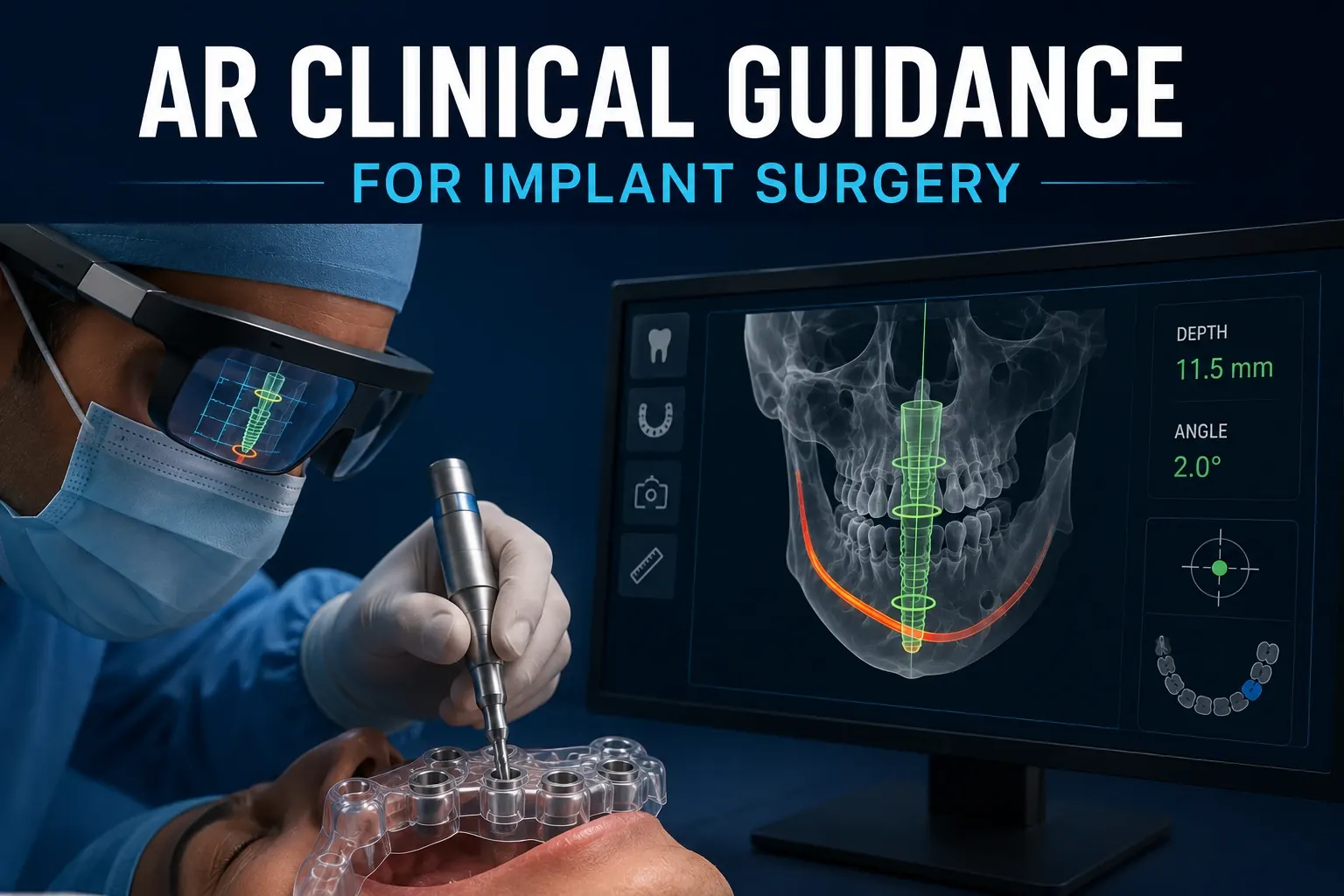

Augmented reality (AR) represents the frontier of surgical guidance technology. Unlike traditional surgical guides that mechanically constrain the drill, AR systems provide real-time digital visualization of the planned implant path overlaid on the surgical field. This article explores AR technology for implant surgery, explains how it complements traditional surgical guides, and discusses the current state and future of AR in implant dentistry.
Understanding Augmented Reality in Surgery
Augmented reality overlays digital information onto the surgeon's direct view of the surgical field. For implant surgery, AR systems display:
- Planned implant position and angle: The digitally planned trajectory rendered over the surgical site
- Critical anatomical structures: The nerve canal, sinus floor, and adjacent roots visualized in real time
- Real-time surgical progress: Drill position relative to the plan updated continuously
- Depth markers and directional guidance: Visual cues to confirm correct insertion depth and angulation
AR differs fundamentally from traditional surgical guides. Surgical guides (passive navigation) physically prevent deviation from the plan with no digital feedback required. AR systems provide visual guidance but rely on surgeon skill to execute.
Current AR Systems for Implant Surgery
X-Guide System (X-Nav Technologies)
Uses optical tracking to monitor drill position in real-time. Surgical reference markers track patient anatomy. Computer vision software continuously calculates drill position relative to the plan. The AR display shows real-time position on a monitor or AR glasses. Status: FDA approved and in clinical use with growing adoption.
Other Emerging Systems
Several research-stage AR systems are under development including ultrasound-based tracking systems and wearable AR headset platforms. These show promise but have limited clinical availability as of 2026.
Comparing Mechanical Guides vs. AR Systems
| Factor | Mechanical Guides | AR Systems |
|---|---|---|
| Accuracy | 0.5 to 1mm | 1 to 2mm |
| Operative Time | 20 to 30 min per implant | 25 to 40 min per implant |
| Cost per Case | $150 to $300 | $500 to $5,000+ |
| Equipment Cost | No hardware required | $100,000 to $500,000 |
| Learning Curve | Fewer than 10 cases | 50 to 100 cases |
Advantages of AR Systems Over Mechanical Guides
Real-Time Feedback
AR provides continuous position feedback allowing the surgeon to correct mid-drilling. This dynamic guidance capability is not available with passive mechanical guides, which constrain position at the start but cannot communicate deviation once drilling begins.
Flexibility During Surgery
AR allows course corrections throughout drilling. If unexpected anatomy is encountered, the plan can be adjusted in real time without fabricating a new guide.
Visualization of Anatomy
AR can display critical anatomical structures including nerves and sinuses directly on the surgical field, providing an additional layer of awareness that mechanical guides do not offer.
Limitations of AR Systems
Surgeon Dependency
AR provides information but relies on surgeon skill to act on it correctly. Mechanical surgical guides constrain deviation regardless of skill level, making outcomes less sensitive to individual surgeon experience.
Cost Barrier
High-end AR systems cost $100,000 to $500,000 for equipment plus ongoing software fees. By comparison, mechanical surgical guides cost $150 to $300 per case with no capital equipment investment. View our transparent guide pricing.
Hybrid Approach: Guides Plus AR Visualization
Some surgeons combine mechanical guides with AR visualization. The guide constrains the drill path for mechanical precision while AR displays real-time position and anatomy. This combination maintains mechanical guide precision while adding AR's visualization advantages for complex cases.
The hybrid approach is particularly relevant for full-arch and complex multi-implant cases where both positional accuracy and anatomical awareness are critical. Our implant surgical guides are fully compatible with AR overlay workflows.
The Future of AR in Implant Surgery
Next-generation AR systems are expected to feature:
- Improved tracking accuracy: Approaching mechanical guide precision of 0.5 to 1mm
- Integrated AI: Real-time position correction suggestions based on continuous analysis
- Real-time CBCT integration: Dynamic replanning during surgery based on live imaging
- Wireless headset visualization: Eliminating bulky monitor setups for streamlined workflows
At Guided Excellence, we focus on mechanical surgical guides the proven, accurate, cost-effective standard for implant dentistry. See our implant surgical guides or submit your case today.