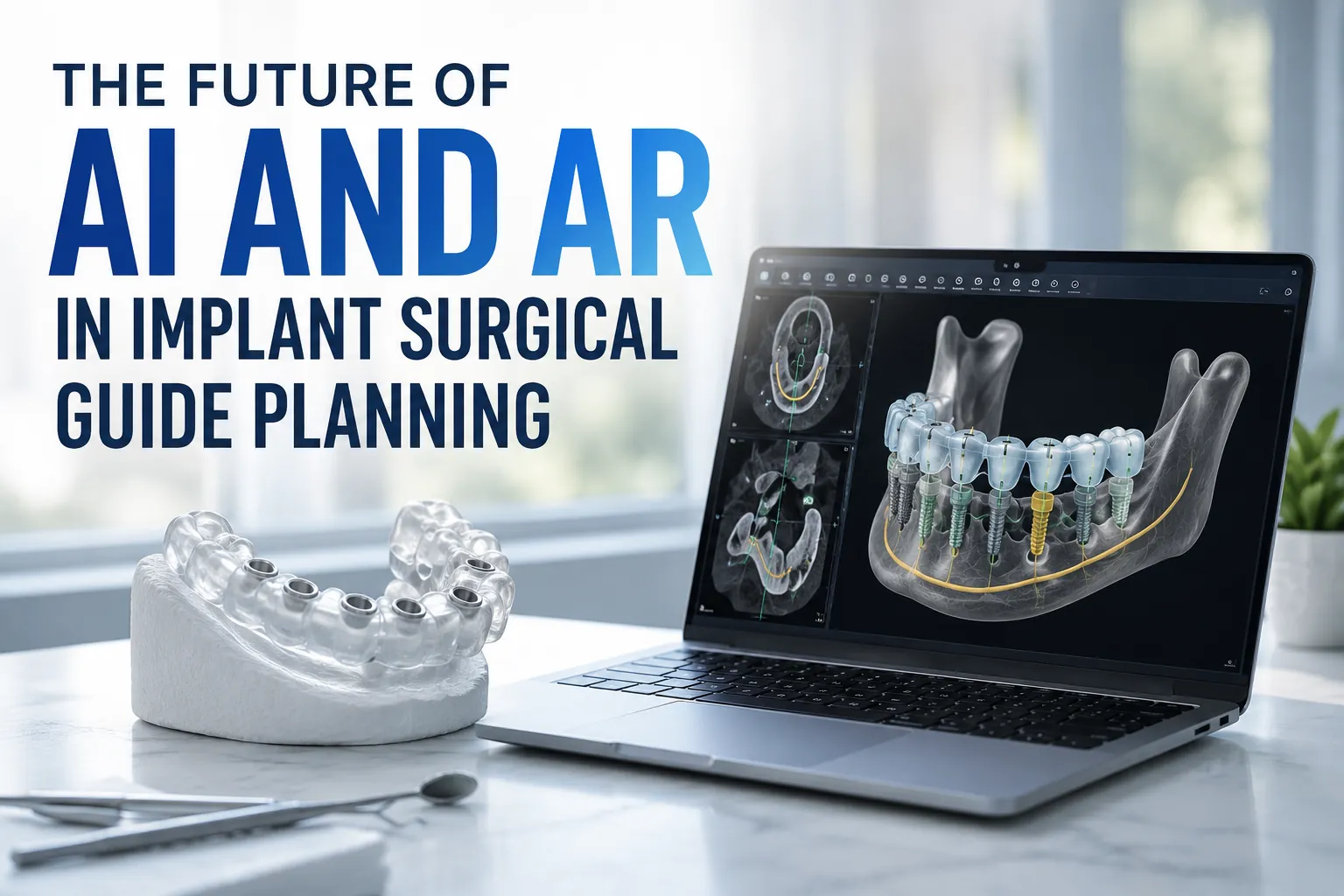

The surgical guide you receive today is already the product of sophisticated digital technology, CBCT imaging, intraoral scanning, CAD software, and precision 3D printing have transformed guide fabrication over the past decade. But the next phase of development, driven by artificial intelligence and augmented reality, promises to accelerate that transformation further.
Understanding where these technologies currently stand, what they are beginning to deliver clinically, and where they are heading over the next several years helps clinicians make informed decisions about when to adopt new tools versus when current-generation approaches remain the right choice.
Where AI Is Already Active in Implant Planning
Automated Anatomical Segmentation
The most mature AI application in implant planning is automated anatomical segmentation, the process of identifying and outlining specific structures within a CBCT dataset. Structures that previously required 15 to 30 minutes of manual tracing can now be identified automatically in seconds by AI algorithms trained on thousands of annotated CBCT datasets.
AI segmentation is now commercially available for the inferior alveolar nerve canal, maxillary sinus boundaries, individual tooth roots and crowns, cortical bone outlines, and ridge contours. Accuracy in straightforward anatomy is comparable to experienced human operators. In complex or unusual anatomy, AI segmentation still requires human review and correction, but the time savings even with correction are significant.
At Guided Excellence, we evaluate AI segmentation tools against our accuracy standards before integrating them into case workflows. The goal is faster planning without compromising the precision that makes our implant surgical guides reliable.
Implant Position Suggestion
Beyond segmentation, AI systems are beginning to suggest optimal implant positions based on simultaneous analysis of bone anatomy, adjacent root positions, sinus and nerve proximity, and prosthetic requirements. Early commercial implementations allow clinicians to input the desired prosthetic outcome and receive AI-generated implant position candidates that satisfy multiple clinical constraints at once.
These systems are not yet mature enough to replace clinical judgment, they require expert review and frequently produce suggestions that a clinician would modify. But they accelerate the planning process by providing a high-quality starting point rather than requiring the planner to begin from a blank model.
Outcome Prediction
AI trained on large retrospective clinical datasets can estimate implant survival probability, marginal bone loss risk, and prosthetic complication likelihood based on patient anatomy, bone density, systemic health indicators, and planned implant specifications. These prediction models are research-stage with some commercial implementations, useful as risk-stratification tools rather than definitive clinical guidance.
Augmented Reality in Implant Surgery: Current State
Real-Time Tracking Systems
Augmented reality surgical navigation systems, of which X-Guide (X-Nav Technologies) is the most established example, use optical tracking to display the drill's current position relative to the virtual plan on a monitor or heads-up display. Reflective markers attached to the patient and surgical handpiece are tracked by a camera system, and the software calculates the real-time three-dimensional position of the drill relative to the pre-operative plan.
Current clinical accuracy for AR tracking systems: 1.0 to 1.5mm at the implant apex. This is better than freehand surgery (2 to 3mm) but not yet matching static surgical guides (0.5 to 1.0mm). The accuracy gap means that for precision-critical cases, esthetic zone, nerve proximity, full arch, static guides currently outperform AR tracking.
Where AR Adds Value Today
AR navigation provides real-time drill position feedback, which static guides do not. This enables mid-course correction if the drill begins to deviate from the planned path. AR systems also display critical anatomical structures, nerve canals, sinus floors, as visual overlays during surgery, providing continuous safety awareness that static guides do not directly communicate.
For cases where anatomy changes intraoperatively, bone quality very different from CBCT prediction, unexpected cortical perforations, AR systems allow real-time replanning that static guides cannot accommodate. For standard cases with stable anatomy, our custom implant surgical guides deliver superior accuracy at far lower cost.
The Emerging Hybrid Approach
Some advanced practices are experimenting with combining static surgical guides and AR navigation. The guide provides the mechanical precision advantage for drill path constraint, while AR provides real-time position confirmation and anatomical visualization. The combination has shown promise in research settings, the question is whether the added workflow complexity justifies the incremental benefit for routine cases.
For complex cases, full arch, heavily compromised anatomy, revision implant surgery, this hybrid approach may offer meaningful advantages. For standard single-tooth and multi-implant cases, current static guides already deliver accuracy that AR systems have not yet matched.
Wearable AR: The Next Frontier
Next-generation AR development is focused on wearable heads-up displays, surgical loupes or glasses that overlay the planned implant position directly onto the surgeon's visual field without requiring a separate monitor. This removes the need to look away from the surgical field to check position, potentially improving both accuracy and workflow.
Several research groups are developing prototype systems. Commercial dental clinical availability is estimated 3 to 5 years away based on current development trajectories. The accuracy of these systems must improve significantly from current AR baseline performance to offer a clinical advantage over static guides for precision-critical cases.
Fully Automated Guide Design: How Close?
The ultimate expression of AI in surgical guide planning would be end-to-end automated guide design: submit imaging, receive a fabrication-ready guide with no human intervention. The technical pathway requires AI segmentation (partially available), AI implant position optimization (early commercial stage), AI guide geometry generation (partially available in some platforms), and automated quality verification (research stage).
Fully automated end-to-end design for routine cases is estimated 3 to 7 years from commercial reliability. The most significant remaining gap is not technical capability, it is clinical accountability. Guides produced entirely by AI without human clinical review represent a significant medicolegal and patient safety question that the field has not yet resolved.
At Guided Excellence, Dr. Baghoomian's personal clinical review of every case is a deliberate design choice, not a workflow inefficiency. Until AI systems demonstrate clinical judgment reliability comparable to experienced practitioners, human review remains a quality and safety asset. Learn more about our approach at our implant surgical guide lab.
What These Advances Mean for Dentists Right Now
The practical implication of AI and AR development for practicing dentists is straightforward: current-generation digital planning and static surgical guides already deliver the clinical benefits that make guided surgery valuable. AI improvements will make planning faster and AR improvements will add feedback options, but neither future development justifies waiting to adopt guided surgery now.
The right time to start using surgical guides is before these technologies mature further, not after. Every case placed with precision-guided surgery today benefits from current best practice. Future AI and AR enhancements will be additive, improving an already excellent workflow rather than replacing an inadequate one.
Submit your next case to Guided Excellence and experience what current-generation precision planning delivers. Our surgical guide pricing makes this standard of care accessible right now.