
The virtual plan is approved. The guide geometry has been designed and reviewed. Now what? Most dentists understand the planning and clinical sides of guided surgery well, but the production process between design approval and guide delivery is largely invisible, a black box that somehow produces a precision instrument in 3 to 5 days.
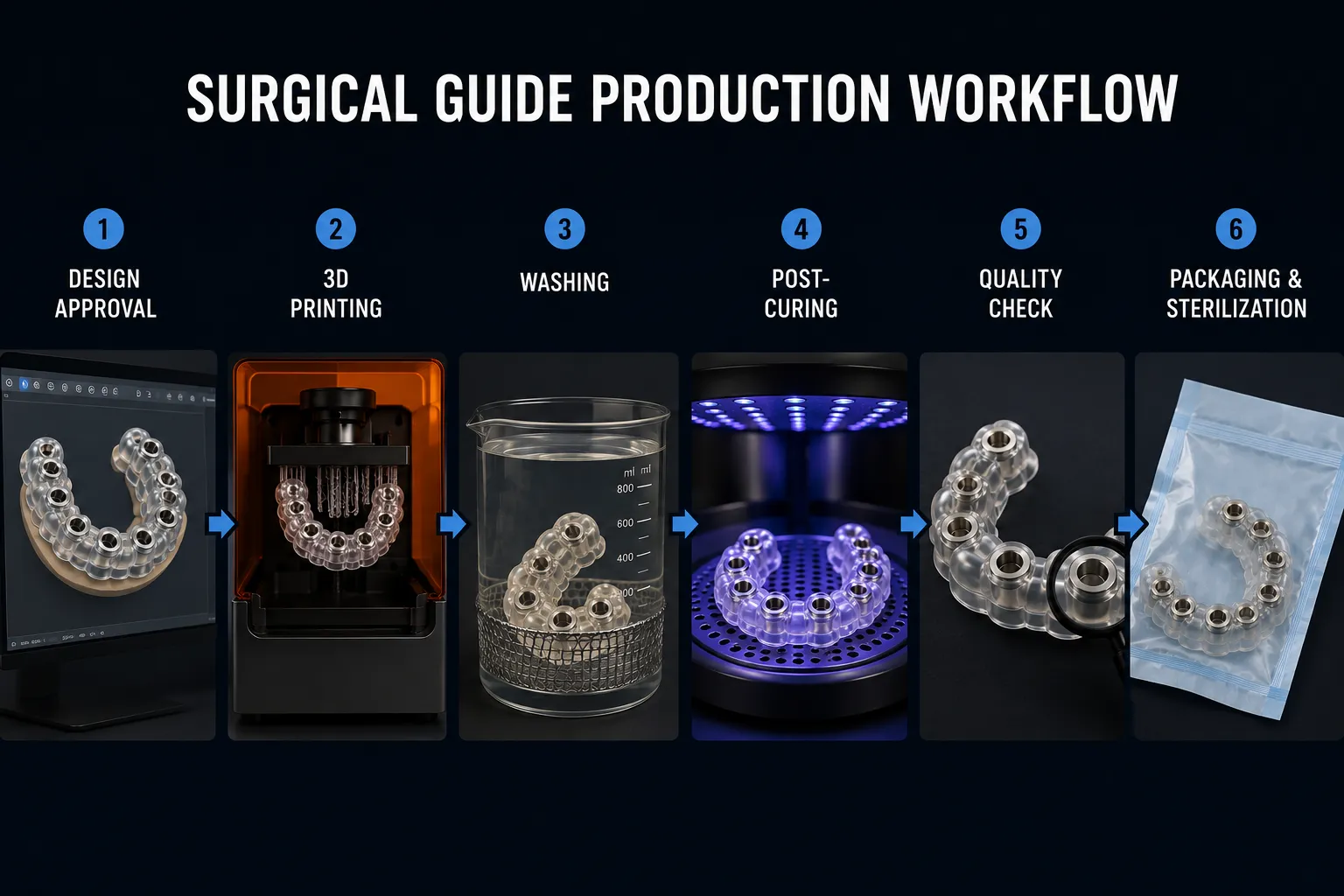
Understanding the production workflow matters because it explains what determines guide quality, what can go wrong and how it is caught, and what the turnaround time represents. This article walks through every stage of the surgical guide production workflow from design file to delivered guide.
Stage 1: Design File Preparation and Pre-Print Validation
The approved guide design exists in planning software as a three-dimensional digital model. Before manufacturing can begin, this model must be converted to a print-ready STL file and validated for manufacturability.
The pre-print validation checks several design properties that are easy to overlook in a CAD environment but critically important for physical production:
- Mesh integrity: the STL mesh must be watertight with no non-manifold edges, inverted surface normals, or holes that would cause print defects
- Wall thickness: all structural areas must meet minimum thickness requirements, areas below 1.0mm are flagged for potential structural vulnerability
- Feature geometry: drill sleeve dimensions, inspection window sizes, and retention feature geometry are verified against the approved design specification
- Print scaling: the STL file is confirmed to be at the correct 1:1 scale relative to patient anatomy, scaling errors would affect every dimension of the finished guide
Once the file passes validation, it is imported into print preparation software where the print orientation is optimized to minimize stair-stepping artifacts on critical seating surfaces and sleeve openings, and support structures are positioned to avoid contact with these same critical surfaces.
Stage 2: Printer Setup and Calibration Verification
Before any patient guide is printed, the equipment is calibrated. The SLA (stereolithography) printers used for precision dental guides require calibration verification of several parameters: build platform leveling and Z-axis zero position, laser power and scan speed, vat temperature, and mirror galvanometer alignment. At Guided Excellence, this calibration check is performed before each production run, not periodically. Discover more about our manufacturing and QC standards.
Resin is also verified before each batch of guides. Even from the same manufacturer, batch-to-batch variation in resin viscosity, photoinitiator concentration, and cure kinetics can affect print quality and dimensional accuracy. A resin batch that behaves differently from the baseline can produce guides with systematic dimensional errors. Incoming batch verification catches this before patient guides are produced.
Stage 3: SLA 3D Printing
With equipment calibrated and files prepared, printing begins. SLA printing works by projecting an ultraviolet laser onto a vat of liquid photopolymer resin. The laser traces the cross-section of the guide layer by layer, curing the liquid resin into a solid at each point the laser contacts it. The build platform descends one layer thickness (typically 25 to 50 micrometers) after each layer, and the process repeats until the complete guide geometry has been built up from the bottom.
A typical dental surgical guide takes 4 to 8 hours to print depending on size and complexity. The printing process runs continuously and is monitored for any deviation from expected layer quality. Full arch guides and multi-implant guides take longer and require more complex support structures than single-tooth guides.
When printing completes, the guide is attached to the build platform by its support structures. Careful removal using plastic tools prevents stress on the guide body and avoids damage to fine features.
Stage 4: Washing, Removing Uncured Resin
After removal from the build platform, the guide is coated in liquid uncured resin that must be completely removed before post-curing. Residual uncured resin creates several problems: it is a biocompatibility risk (reactive monomers can sensitize oral tissues), it will cure unevenly during post-processing creating surface deposits, and it prevents accurate dimensional measurement.
Washing involves immersing the guide in isopropyl alcohol or a proprietary dental resin solvent with active agitation. The washing process must reach all surfaces, including the narrow internal drill sleeve channels where residual resin can accumulate.
Washing completeness is verified using UV light inspection. Uncured resin fluoresces brightly under UV, any fluorescence after washing indicates incomplete removal and requires additional wash cycles. Only guides that show no residual fluorescence proceed to post-curing.
Stage 5: Post-Curing
Stereolithography printing only partially cures the resin during production. Post-curing using a high-intensity UV light source completes the polymerization, achieving the maximum mechanical properties the material is capable of.
Post-curing accomplishes four important outcomes: full mechanical strength and rigidity are achieved, all reactive monomers are converted (completing biocompatibility), dimensional stability during sterilization is established, and shelf life is maximized. The guide's final hardness, rigidity, and dimensional accuracy are all determined at this stage.
Post-cure time and intensity depend on the specific resin formulation. Guides are inspected after post-curing for complete hardness, the guide should be rigid and non-deflecting under hand pressure. Under-cured guides that retain any flexibility are returned for additional post-cure exposure.
Stage 6: Metal Sleeve Insertion and Alignment Verification
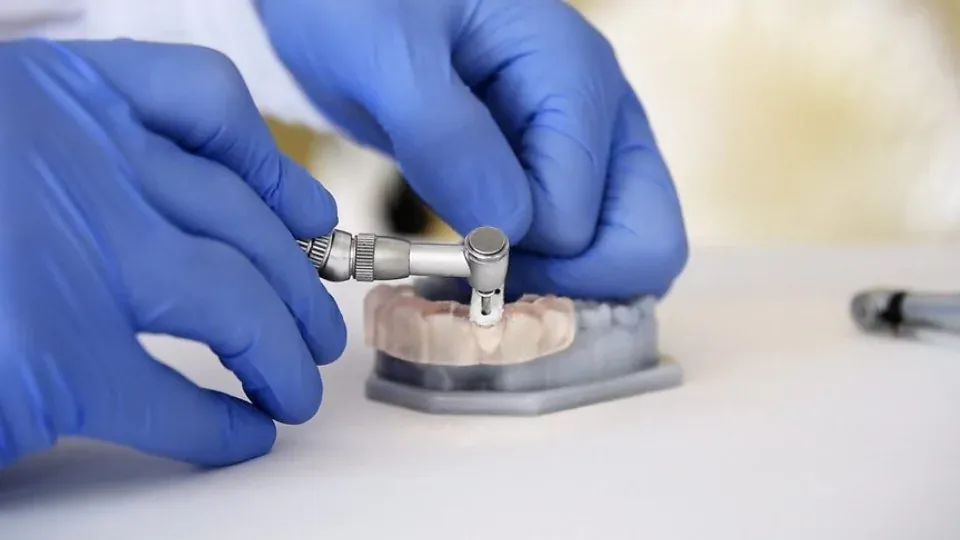
The drill sleeves are press-fit into the guide body's drill channels after post-curing. Metal sleeves, stainless steel or surgical-grade alloy, are used rather than relying on the printed resin channels alone because metal provides:
- Dimensional stability: metal maintains precise inner diameters through repeated sterilization cycles
- Wear resistance: metal withstands repeated drilling passes without diameter enlargement
- Precision: machined metal sleeves achieve tighter inner diameter tolerances than printed resin
Before insertion, each sleeve is measured individually. Inner diameter is confirmed to plus or minus 0.05 to 0.1mm against the specification for the ordered implant system. Any sleeve outside tolerance is rejected and replaced before the guide proceeds.
After insertion, sleeve alignment is verified to confirm each sleeve is coaxial with its drill channel, no tilt, no offset. A sleeve that is inserted at even 1 to 2 degrees of tilt introduces directional bias in the drill that manifests as position error at the implant apex.
Stage 7: Comprehensive Dimensional Inspection
With all sleeves installed, the guide undergoes dimensional inspection against the approved design specification. Every sleeve inner diameter is measured and recorded. Key span dimensions of the guide body are measured and compared to design values. Sleeve angulations are checked with digital gauges for cases with angled posterior sleeves.
Any dimension outside tolerance triggers either targeted rework (replacing an out-of-spec sleeve) or complete scrapping and reprinting if the guide body itself is outside specification. Guides outside tolerance are never released. This is a strict, non-negotiable standard in our implant surgical guide manufacturing process.
Stage 8: Model Fit Test, The Final Verification Gate
The most clinically meaningful quality test is also the simplest: seat the guide on the patient's physical three-dimensional model and verify that it fits perfectly. This test confirms everything about the guide that dimensional inspection cannot: the seating surface is accurate, the guide seats passively without rocking, all contact areas make proper contact, and retention features engage correctly.
A guide that rocks on the model will rock on the patient. A guide that seats perfectly on the model will seat perfectly in surgery. This test is the final gate before a guide is approved for shipment, no guide is released without passing it.
Stage 9: Sterilization and Packaging
After all quality checks are passed, the guide is sterilized by autoclave at 121 degrees C for 30 minutes. Chemical indicator strips are included in the packaging to provide visible confirmation that sterilization conditions were met. The sterilized guide is sealed in sterile barrier packaging, labeled with patient information and sterilization date, placed in protective outer packaging, and shipped with a tracking number.
The complete workflow from design file to delivered sterile guide takes 3 to 5 business days for standard cases, or 1 to 2 days for expedited requests. Submit your case to start the process.