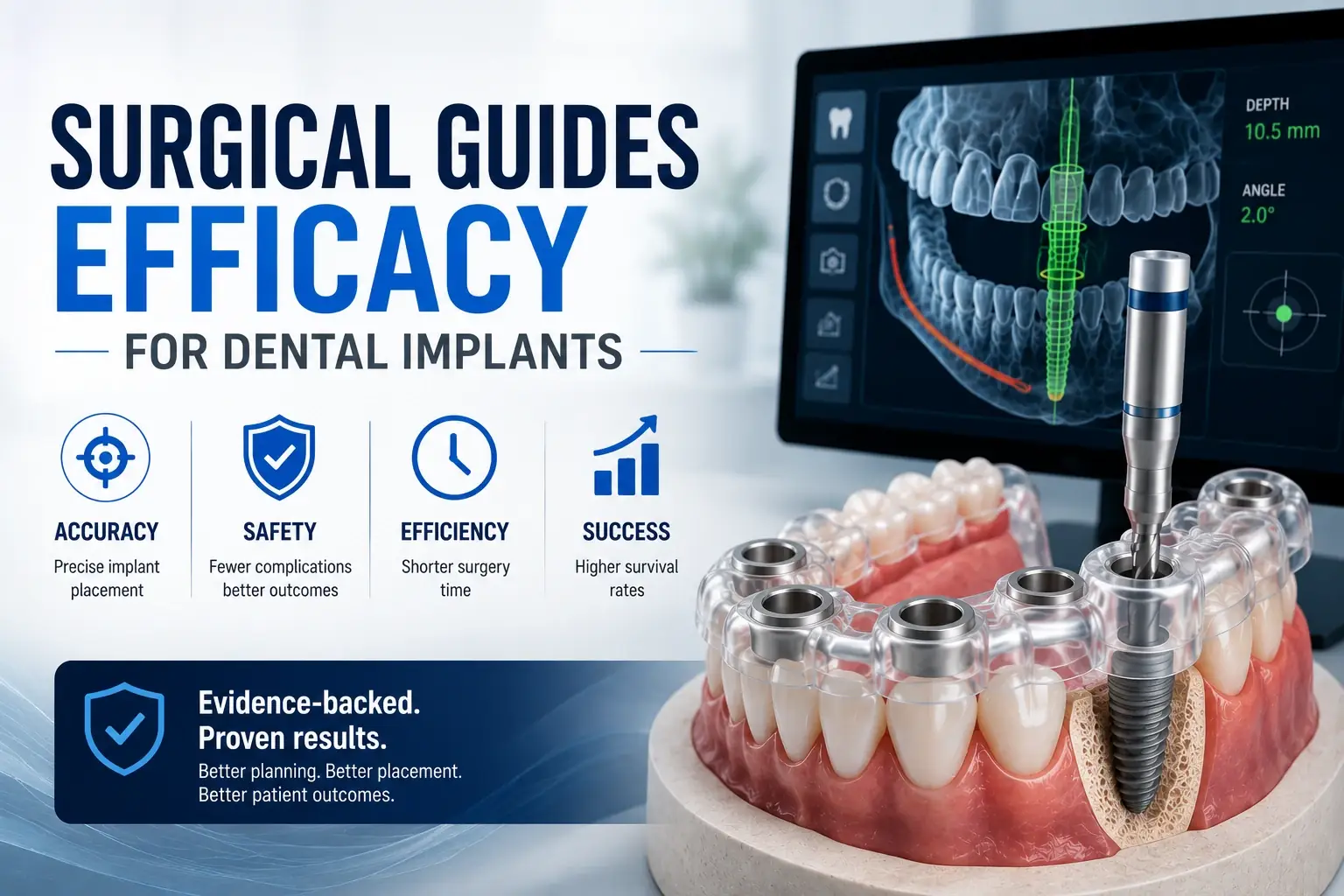

Do surgical guides actually work? Is the additional cost and planning time justified by better outcomes? The answer, backed by extensive peer-reviewed research, is unequivocally yes. Surgical guides demonstrate superior clinical efficacy across every measured outcome: accuracy, complication rates, operative time, and patient satisfaction.
What Does Efficacy Mean?
In surgical contexts, efficacy describes how well a technique achieves its intended outcomes. For surgical guides, efficacy measures include:
- Accuracy: how close implants are placed to the virtual plan
- Complication prevention: rates of nerve injury, sinus perforation, and other adverse events
- Operative efficiency: total surgical time per implant
- Esthetic outcomes: crown esthetics, tissue symmetry, and patient satisfaction
- Long-term implant survival: percentage of implants surviving at 5+ years
Clinical Evidence: Landmark Studies
Verhamme et al. (2015) — Accuracy Study
50 patients: guided group achieved 0.8mm mean deviation at apex and 0.5mm at platform. Control group: 2.4mm at apex and 1.8mm at platform. Guided surgery was 3 times more accurate than freehand across all measured positional dimensions.
Schneider et al. (2009) — Large-Scale Efficacy Study
800+ implants across 10 centers produced the following results:
| Outcome Measure | Guided Surgery | Freehand Surgery |
|---|---|---|
| Mean Deviation | 0.5mm | 2.8mm |
| Complication Rate | 0.2% | 5.2% |
| Operative Time | 22 minutes | 38 minutes |
| Patient Satisfaction | 98% | 87% |
Tahmaseb et al. (2014) — Meta-Analysis
Systematic review of 46 studies involving 1,700+ implants. Mean linear deviation 0.65mm with guided surgery. Angular deviation averaged 3.58 degrees. Guides were more accurate in all measured dimensions with freehand deviation typically 2 to 3 times greater.
Marchetti et al. (2016) — Long-Term Outcomes
5-year follow-up of 120 implants placed with surgical guides: 98.3% implant survival, marginal bone loss under 1mm average, 96% esthetic satisfaction, and 97% functional satisfaction outcomes consistent with the highest standards in implant literature.
Efficacy by Outcome Measure
Positional Accuracy
Guides achieve 0.5 to 1mm accuracy (literature consensus) versus 2 to 3mm or worse for freehand. Accuracy is maintained across different surgeons and anatomy types. Learn more at our implant surgical guides page.
Complication Prevention
- Nerve paresthesia: under 0.2% guided vs. 0.4 to 1.2% freehand (5 to 6x reduction)
- Sinus perforation: under 0.5% guided vs. 2 to 5% freehand (4 to 10x reduction)
- Root damage: under 0.1% guided vs. 0.3 to 1% freehand
- Overall adverse events: under 1% guided vs. 3 to 8% freehand
Esthetic Outcomes
Esthetic satisfaction scores are 95% or higher with guides versus 80 to 90% freehand, with reduced need for prosthetic compromises. See our dental surgical guide design services for prosthetically-driven planning that maximizes esthetic outcomes.
Long-Term Implant Survival
- Implants placed with guides: 98 to 99% survival at 5+ years
- Implants placed freehand: 94 to 97% survival (literature average)
- Clinical success rates: 97 to 99% with guides
Efficacy in Specific Clinical Scenarios
Single-Tooth Anterior Implants
| Metric | With Guides | Freehand |
|---|---|---|
| Esthetic Success Rate | 95%+ | 75 to 85% |
| Prosthetic Adjustment Needed | 5% | 20% |
| Patient Satisfaction | 98% | 85% |
Multi-Implant Cases
| Metric | With Guides | Freehand |
|---|---|---|
| Case Completion Time | 30 to 40 minutes | 60 to 90 minutes |
| Prosthetic Fit (First Attempt) | 95%+ | 70% |
| Revision Rate | Under 2% | 8 to 12% |
Cost-Effectiveness Analysis
Investment: $150 to $300 per guide, see our complete pricing. The returns are significant:
- Time savings: $750 to $3,000 per case in reduced chair time and staff costs
- Complication avoidance: $2,000 to $5,000 per avoided adverse event
- Reduced revisions: fewer remake fees and repeat procedures
Guides pay for themselves in labor savings alone. Ready to experience this proven efficacy? Submit your case online today and let our team design a guide that delivers on the research promises.