
Not all surgical guides are created equal. Two guides designed for the same patient can arrive looking similar and yet perform very differently in surgery. One seat passively, drills run true, and implants emerge exactly as planned. The other rocks slightly, creates uncertainty during drilling, and produces positions that require prosthetic adaptation.
The difference is quality, and quality has specific, measurable components. Understanding what separates a high-quality guide from an average one helps you evaluate guide laboratories, ask the right questions before ordering, and recognize when guide design or fabrication may be contributing to clinical variability.
Quality Dimension 1: Prosthetic-Driven Clinical Design
The most fundamental quality distinction is how the guide was designed. A high-quality guide is designed starting from the restoration, the final crown or prosthesis drives the implant position, not the other way around. This approach, called prosthetic-driven planning, ensures the implant is placed where the restoration needs it, not merely where the bone happens to allow it.
Guides designed from bone anatomy alone, placing implants at convenient positions within available bone without prosthetic context, may produce implants that survive but support restorations requiring angled abutments, compromised emergence profiles, or off-axis screw access. These are technically placed implants producing clinically suboptimal restorations.
At Guided Excellence, every guide design begins with the prosthetic requirement. Our dental surgical guide design team works from restoration-first planning on every case, including standard single-tooth cases where this distinction is no less important.
Quality Dimension 2: Clinical Review in the Design Process
Software can generate a guide automatically from a set of imaging inputs. Software cannot apply clinical judgment. The difference between a guide produced by algorithm alone and a guide produced with experienced clinical review can be decisive in complex cases.
Clinical review catches problems that software logic does not flag:
- An implant angulation that is technically within safety margins but produces a screw access channel through the buccal face of the crown
- A guide body geometry that is dimensionally correct but would block the surgeon's access in a flapless approach with limited mouth opening
- An angulation choice that is bone-driven rather than prosthetics-driven, positioning the implant where bone is best rather than where the restoration needs it
Dr. Zareh Baghoomian personally reviews complex cases at Guided Excellence before fabrication begins. This clinical filter is a quality asset that automation cannot replace. Learn more at our about page.
Quality Dimension 3: Fabrication Technology
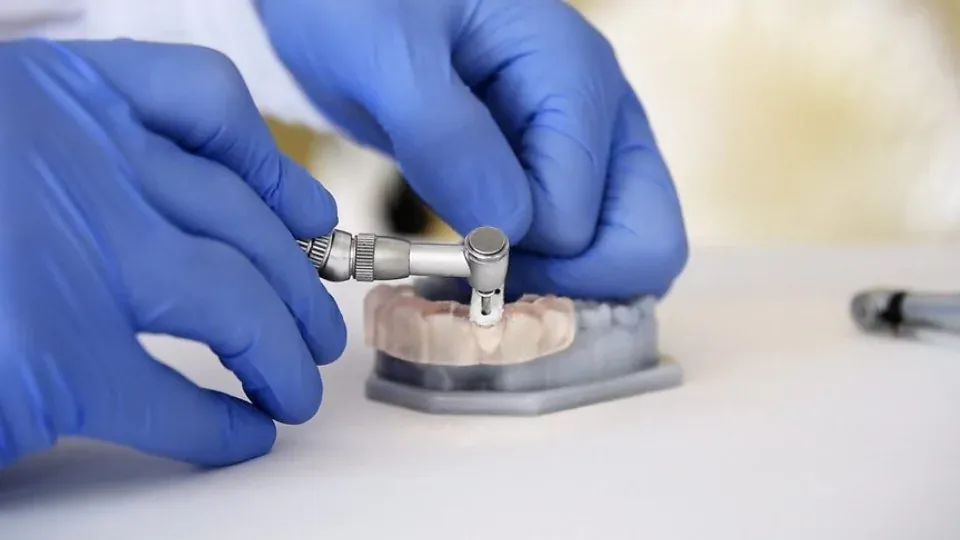
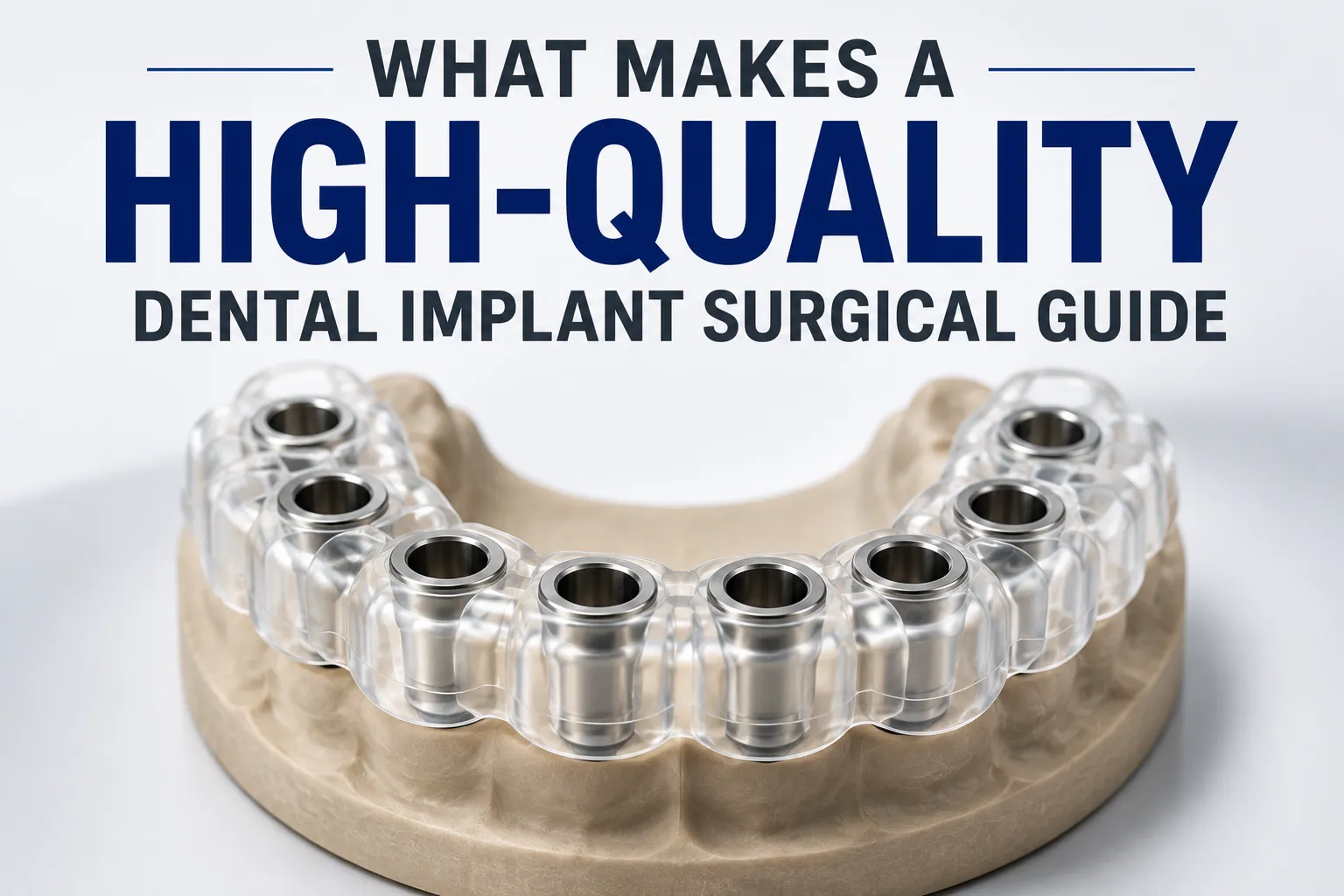
High-quality guides are fabricated using SLA (stereolithography) 3D printing, the most accurate 3D printing technology for dental surgical applications. SLA cures resin at 25 to 50 micrometer layer resolution, producing dimensional accuracy of plus or minus 0.1 to 0.3mm. Lower-resolution technologies produce guides that may appear similar on casual inspection but have worse sleeve geometry and seating surface accuracy.
The resin must be ISO 10993-compliant, certified biocompatible and sterilisation-stable. Guides made from uncertified resins risk biocompatibility concerns and dimensional instability during sterilisation cycles.
Quality Dimension 4: Precision Metal Sleeves
Drill sleeves are the most mechanically critical component of a surgical guide. Metal sleeves, stainless steel or surgical-grade alloy, must be machined to inner diameter tolerances of plus or minus 0.05 to 0.1mm matching the specific implant system drill sequence. The consequences of oversized sleeves are significant: every 0.1mm of excess sleeve diameter translates to measurable apex position error.
High-quality labs measure every sleeve inner diameter before insertion. This is not a sampling approach, it is performed on every sleeve. Labs that rely on supplier specifications rather than direct measurement accept tolerance variation that directly affects guide accuracy. This measurement is standard practice in our implant surgical guide lab.
Quality Dimension 5: Rigorous Quality Control
The most revealing difference between high-quality and average guide fabrication is what happens during quality control. High-quality labs perform:
- Dimensional inspection of every sleeve inner diameter in every guide
- Overall guide dimension verification against the approved design file
- Sleeve alignment verification confirming coaxial insertion with no measurable tilt
- Model fit test on every single guide before shipment, the guide seated on the patient model with zero rocking accepted
- Sterilisation stability testing confirming dimensions within plus or minus 0.2mm after autoclave
Average labs may perform some of these steps on selected cases or rely on visual inspection rather than measurement. The model fit test in particular is the step most commonly skipped, it takes time and requires maintaining the patient model, but it is the test that most reliably predicts whether the guide will seat correctly in surgery.
At Guided Excellence, no guide is shipped without passing the model fit test. This is non-negotiable. See how our full quality process works.
Quality Dimension 6: Seating Stability and Passive Fit
A high-quality guide seats completely and passively on first placement, lowering onto the anatomy under its own weight and gentle guidance with no pressing, twisting, or forcing required. Once seated, it shows no perceptible rocking under bilateral finger pressure from any direction and maintains its position throughout the complete drill sequence.
Passive fit is the clinical test that integrates everything: design accuracy, seating surface precision, and dimensional fabrication quality. A guide that passes the model fit test in the lab will deliver passive fit in surgery. A guide that required effort to seat on the model will be difficult to seat on the patient, and a guide that seats with difficulty should not be used.
Quality Dimension 7: Communication and Support
Quality extends beyond the physical guide to the relationship with the lab. A high-quality guide supplier acknowledges case receipt promptly, flags imaging concerns before design begins, provides confirmed delivery timelines with tracking, and replaces defective guides with priority turnaround at no charge. For complex cases, access to clinical expertise, a conversation with a clinician about design intent rather than a form field, is a quality differentiator.
Submit your first case to Guided Excellence at our case submission portal, and see our flat-rate pricing structure that makes high-quality guided surgery accessible.