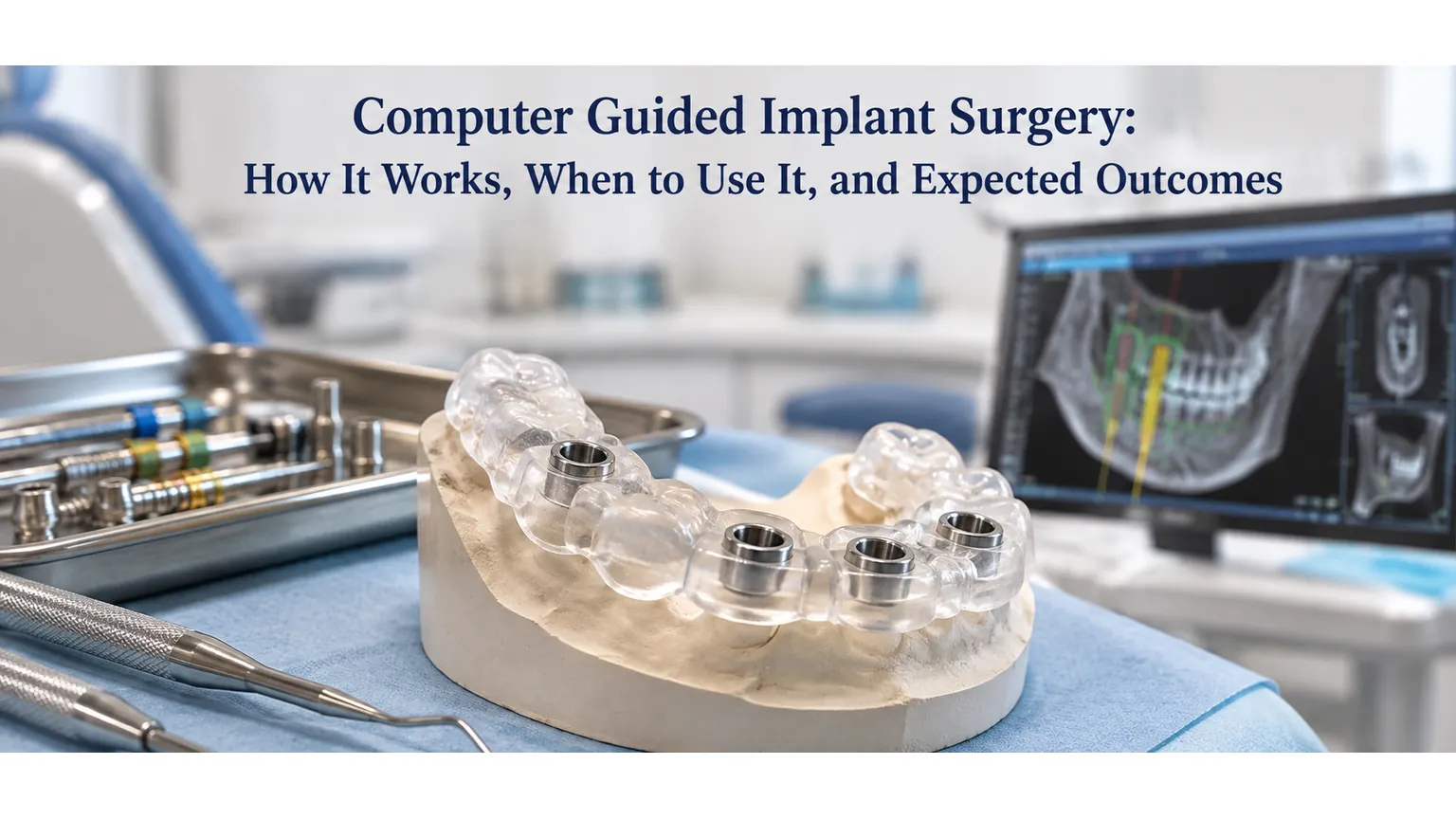
Placing a dental implant accurately is one of the most technically demanding procedures in restorative dentistry. A deviation of even a few millimeters at the apex can compromise a nerve, invade an adjacent root, or result in a restoration that does not fit correctly. Computer guided implant surgery changes that reality by giving surgeons a precise, three-dimensional roadmap before a single drill touches bone, dramatically reducing the risk of unexpected complications.
This guide explains exactly how the technology works, which patients benefit most, what the published research says about outcomes, and the role the surgical guide itself plays in achieving a successful result.
What Is Computer Guided Implant Surgery?
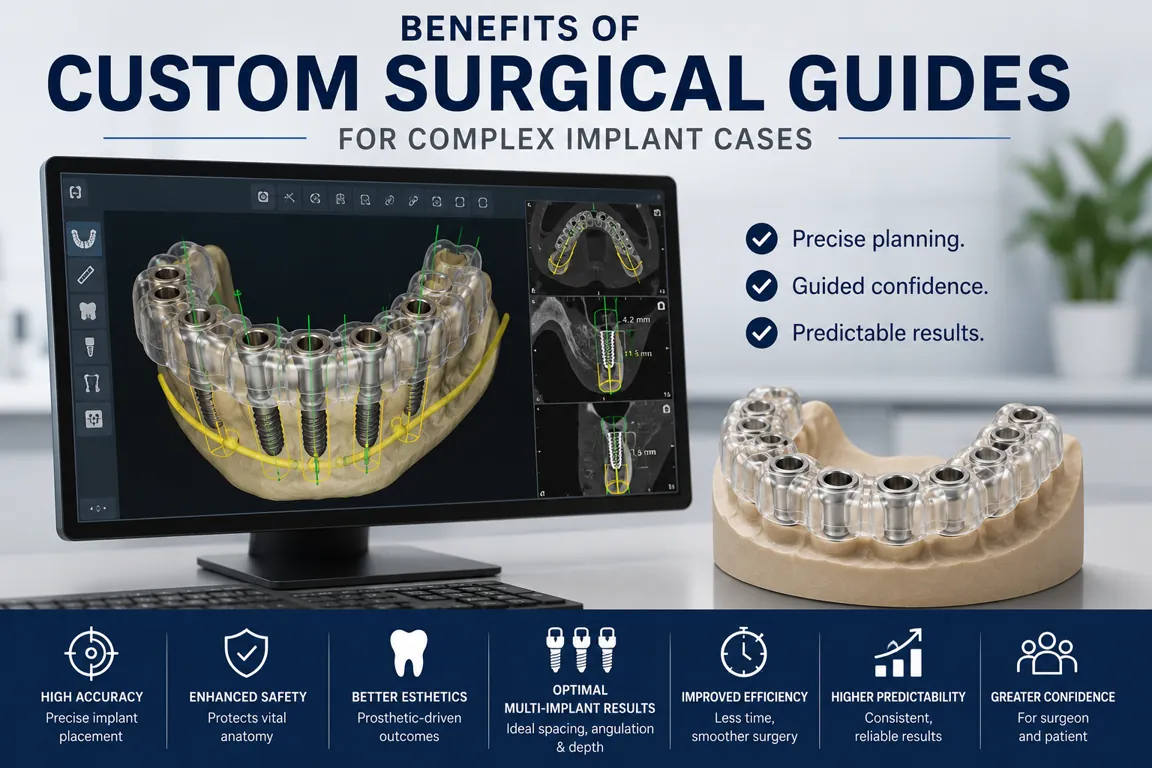
Computer guided implant surgery is a method of planning and executing dental implant placement using three-dimensional imaging data, specialized treatment planning software, and a patient-specific surgical guide that translates the virtual plan into physical reality in the operatory.
The technology was originally developed for neurosurgery, where the precision requirements are even more demanding than in dentistry. Over the past two decades it has been adapted and refined for implant dentistry, making it possible to plan exact implant position, angulation, and depth before surgery begins, and then reproduce that plan with remarkable accuracy during the procedure itself.
The key distinction between guided and conventional freehand surgery is not just the presence of a guide template. It is the entire workflow that precedes surgery: a cone beam computed tomography scan, digital models, virtual implant placement, and a fabricated guide that physically constrains the drill to follow the planned trajectory. Every step is connected, and accuracy at each stage contributes to the final result.
The Step-by-Step Process: From Scan to Surgery
Step 1: Cone Beam Computed Tomography Imaging
The process begins with a cone beam computed tomography scan of the patient's jaws. Unlike traditional dental radiographs, a cone beam computed tomography scan produces a three-dimensional image of the bone, soft tissue, existing teeth, root anatomy, sinus cavities, and vital structures such as the inferior alveolar nerve. The scan data is exported as a DICOM file and imported into treatment planning software.
The quality and resolution of the cone beam computed tomography scan directly influences the accuracy of the final guide. Scans with sufficient resolution allow the software to render fine anatomical detail, which is essential for identifying safe implant corridors that avoid nerves and neighboring roots.
Step 2: Digital Treatment Planning
Planning software allows the clinician or a trained technician to virtually position implants within the three-dimensional bone model. The software displays bone density, available bone height and width, the proximity of vital structures, and the ideal emergence profile for the final restoration. Implants can be rotated, translated, and repositioned in real time until the plan satisfies both surgical and restorative requirements.
This reverse-engineering approach, sometimes called prosthetically driven planning, begins with the desired position of the crown and works backward to determine the ideal implant position. By defining the restorative outcome first, the surgical team can place the implant to serve the final prosthesis rather than adapting the prosthesis to wherever the implant ended up.
Learn how this planning process integrates with the guide fabrication workflow at Guided Excellence dental surgical guide design.
Step 3: Surgical Guide Fabrication
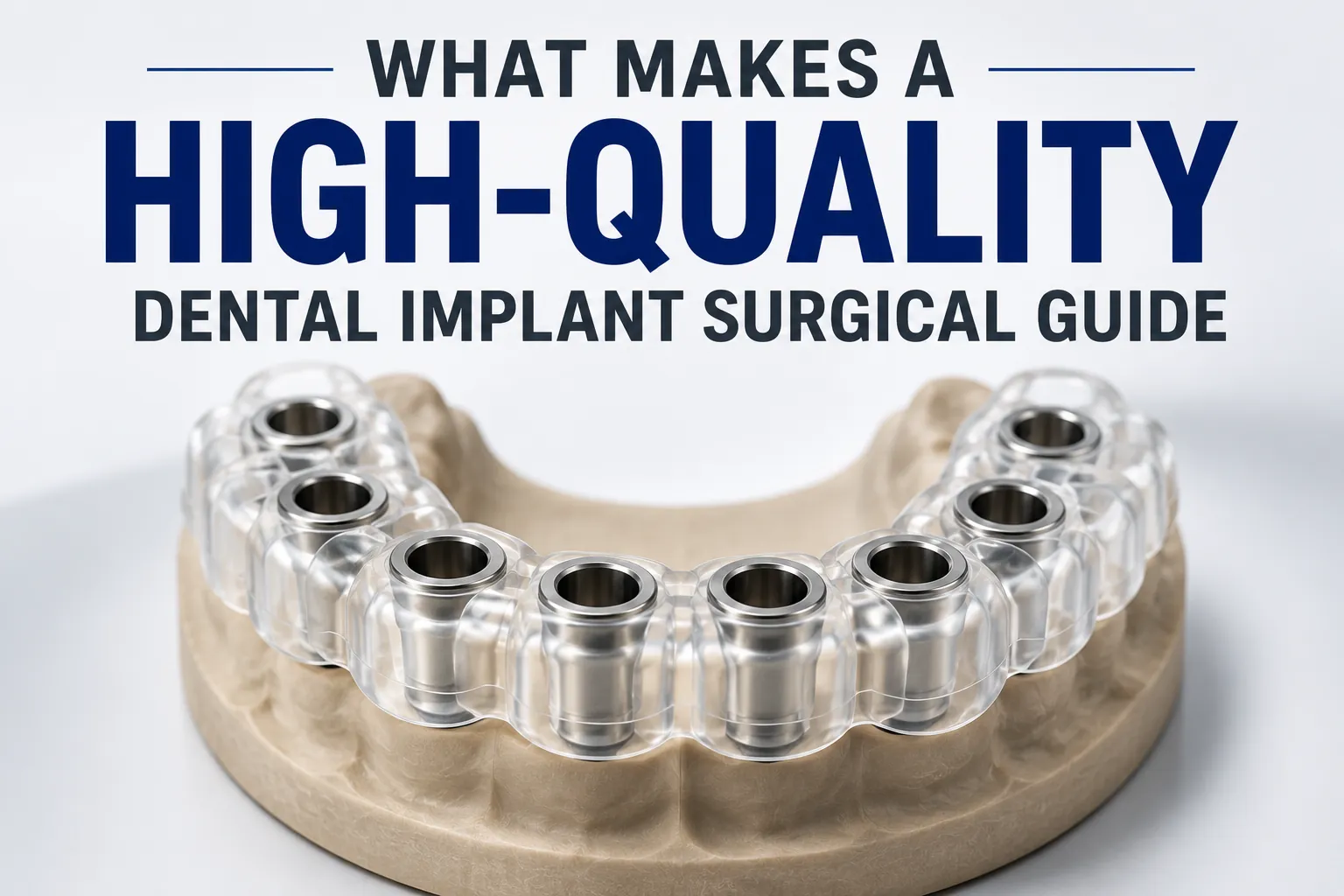
Once the treatment plan is approved, the guide design is sent to a dental laboratory for fabrication. Modern guides are typically 3D-printed in biocompatible resin and fitted with precision metal sleeves that constrain the drill at the planned diameter, depth, and angulation. The guide may be supported by the patient's remaining teeth, soft tissue, bone, or a combination, depending on the clinical situation. See the full range of implant surgical guide manufacturing options to understand the differences between guide types and their clinical indications.
Step 4: Surgery Day
On the day of surgery, the guide is seated on the patient's arch and its stability is confirmed. The surgeon drills through the sleeves, which control the entry point, angulation, and depth of each osteotomy. In flapless cases, tissue punches are used to access the bone without reflecting a mucoperiosteal flap, which reduces postoperative swelling, bruising, and discomfort and allows same-day provisionalization in selected patients.
When the plan calls for a flap, the guide still provides the same directional control, and the surgeon has direct visibility of the bone to confirm the guide is seated correctly throughout the procedure.
Static vs. Dynamic Guided Surgery: Understanding the Difference
The term guided surgery actually encompasses two distinct technologies, and understanding the difference matters when evaluating outcomes and selecting the appropriate workflow.
Static guided surgery uses a pre-fabricated template, the surgical guide, that is seated on the patient before drilling begins. The guide physically prevents the drill from deviating from the planned path. Its accuracy depends entirely on the quality of the planning, the precision of the guide fabrication, and how well the guide fits and remains stable during surgery. Static guided surgery is the most widely used form of computer guided implant surgery and is the standard for most practices today.
Dynamic guided surgery, sometimes called real-time navigation, uses a tracking system to monitor the position of both the patient's jaw and the surgical handpiece simultaneously, displaying the drill position in real time on a screen relative to the three-dimensional plan. There is no physical template, which means the surgeon can deviate from the plan intentionally if needed, a feature that is useful in cases where anatomy makes template placement difficult. Dynamic navigation requires a significantly higher investment in equipment and training than static guided surgery.
Most dental practices working with a remote surgical guide partner like Guided Excellence implant surgical guides use static guided surgery. It delivers highly predictable accuracy for the vast majority of cases without the overhead of a real-time navigation system.
When Computer Guided Implant Surgery Makes the Most Sense
Guided surgery is not the right tool for every clinical situation, but there are specific scenarios where it offers a clear advantage over freehand placement.
Multiple Sequential Implants
When three or more implants need to be placed in a sequence, particularly for a full arch reconstruction, accurate positioning of each implant relative to the others is critical. A deviation in the first implant can cascade into problems with parallelism, inter-implant spacing, and the fit of the final prosthesis. Guided surgery ensures that every implant in the series is placed exactly where it needs to be to support the planned restoration.
Proximity to Vital Structures
Cases where implants must be placed near the inferior alveolar nerve, the floor of the nose, or the maxillary sinus require a level of precision that is difficult to achieve consistently through freehand technique alone. The three-dimensional imaging and planned safety margins built into the software significantly reduce the risk of nerve injury or sinus perforation in these high-risk sites.
Reduced Bone Volume
Patients with reduced bone volume following tooth loss or resorption present a narrow corridor for safe implant placement. Computer guided planning allows the clinician to identify the available bone with precision and position the implant optimally within it, sometimes making it possible to place an implant where a surgeon estimating freehand might have concluded that bone was insufficient.
Fully Edentulous Patients
Fully edentulous patients, particularly those receiving All-on-4 or All-on-6 restorations, are ideal candidates for guided surgery. When there are no remaining teeth to serve as anatomical references during surgery, the guide becomes even more important in establishing correct implant position. The ability to pre-fabricate a temporary prosthesis before surgery, based on the planned implant positions, enables same-day delivery of a functional provisional. Explore the Guided Excellence implant planning process to understand how this workflow is coordinated from scan to delivery.
Immediate Extraction and Placement
Placing an implant immediately after tooth extraction is time-sensitive and technically demanding. The fresh extraction socket changes the reference landmarks the surgeon normally relies on. Guided surgery locks the planned trajectory before extraction so the surgeon can follow the guide confidently even as the socket anatomy changes during the procedure.
Cases Where Freehand May Still Be Preferred
Guided surgery is not universally applicable. Cases with extensive simultaneous bone grafting, significantly resorbed posterior ridges where access with guided instrumentation is limited, or situations where a patient cannot tolerate the extended open-mouth time required for accurate guide placement may be better served by conventional freehand technique with a skilled surgeon. Additionally, highly experienced implant surgeons who have placed thousands of implants under ideal anatomical conditions may find that the added planning time for simple single-tooth cases outweighs the marginal accuracy benefit.
Expected Outcomes: What the Research Shows
The body of evidence supporting computer guided implant surgery is substantial and growing. Multiple systematic reviews and meta-analyses have evaluated accuracy, survival rates, and patient-reported outcomes for guided versus freehand implant placement.
A 2025 systematic review and meta-analysis comparing static guided surgery to freehand placement found that guided surgery produced statistically significant reductions in both angular deviation (the difference between the planned and placed implant axis) and positional deviation at the implant head and apex. The magnitude of the advantage varied depending on guide support type, with tooth-supported guides generally outperforming bone-supported guides in terms of accuracy.
A landmark 2012 systematic review concluded that computer guided implant placement provides implant survival rates comparable to conventional implant surgery. Importantly, the review noted that clinical demands on the surgeon remain no less stringent with guided surgery than with conventional technique, emphasizing that the technology enhances precision but does not replace surgical judgment and experience.
Patient-reported outcomes consistently favor guided surgery in cases where flapless technique is used. Reduced postoperative swelling, less pain in the days following surgery, and faster return to normal function are commonly reported advantages. In full arch cases with same-day provisionalization, patients who received guided flapless surgery have reported higher satisfaction scores in the immediate postoperative period compared to those who received conventional surgery with flap reflection.
Small deviations from the planned position remain normal even with guided surgery, and surgeons should account for this in their planning by building in safety margins around vital structures. However, even accounting for these deviations, guided surgery consistently delivers more accurate outcomes than freehand technique, particularly at the implant apex, which is where proximity to the inferior alveolar nerve is most critical.
How the Quality of the Surgical Guide Affects Results
The surgical guide is the physical link between the digital plan and the patient. Its quality has a direct impact on how accurately the planned implant position is reproduced in surgery.
Key variables that influence guide accuracy include the fit and stability of the guide on the supporting structures, the dimensional accuracy of the 3D printing process used to fabricate the guide, the precision of the metal sleeve system that controls the drill, and the accuracy of the digital scan and planning data the guide was built from.
A guide that is poorly fabricated, does not seat fully, or rocks during surgery introduces error into every drill pass. For this reason, working with a specialized remote implant surgical guide lab that uses calibrated equipment and quality-controlled processes is not a minor detail. It is central to achieving the clinical outcomes that guided surgery is designed to deliver.
At Guided Excellence, guides are designed by Dr. Zareh Baghoomian using current planning software and fabricated with precision 3D printing and verified sleeve placement. Every case is reviewed before fabrication to confirm that the digital plan is clinically sound and the guide geometry will allow proper seating in the patient's arch.
If you are evaluating guide options, the Guided Excellence pricing and service overview outlines what is included at each service tier, including turnaround times, planning support, and revision policies.
Integrating Guided Surgery into Your Practice Workflow
Adopting computer guided surgery does not require purchasing expensive in-house equipment. A practice can access the full benefits of guided surgery by partnering with a specialized remote lab that handles the imaging data, planning, and guide fabrication while the practice focuses on patient care. The Guided Excellence case submission process is designed to make this integration straightforward, with clear instructions for data submission, planning review, and guide delivery.
For practices that are new to guided surgery, starting with straightforward single-tooth cases where the benefits of guided placement are clear, such as implants placed near the inferior alveolar nerve, is a practical way to build confidence with the workflow before advancing to full arch cases.
For practices that are considering whether guided surgery aligns with their current case mix and patient population, contacting the Guided Excellence team to discuss specific case types is a useful first step. The team can help identify which cases in your pipeline would benefit most from a guided approach and what information is needed to begin.
Conclusion
Computer guided implant surgery represents a meaningful advance in how implants are planned and placed. By connecting three-dimensional imaging data, digital treatment planning, and a patient-specific guide, the technology allows surgeons to approach complex cases with a level of confidence and reproducibility that freehand technique cannot match.
The results are well-documented: better angular accuracy, reduced positional deviation, less postoperative discomfort in flapless cases, and outcomes that are predictable enough to support same-day prosthesis delivery when the clinical situation allows. For practices working with an experienced implant surgical guide provider, the workflow is accessible without major in-house equipment investment.
If you are ready to bring guided surgery into your practice or want to explore how it applies to a specific case type, the Guided Excellence surgical guide design team is available to assist with planning, fabrication, and case review. Submit a case or reach out to the Guided Excellence team to get started.