For implant dentists who invest in guided surgery, CDT code D6190 is the billing vehicle that makes separate reimbursement for surgical guides possible. Yet D6190 is one of the most frequently denied implant-related codes in dental billing, not because payers refuse to cover it by default, but because the documentation requirements are specific, the bundling rules are strict, and the insurance landscape is uneven. Understanding how to bill D6190 correctly, what to attach to the claim, and where most submissions go wrong gives your practice a better chance of collecting on the time and cost of providing a professional surgical guide for dental implants.
What CDT Code D6190 Covers
The Official American Dental Association Definition
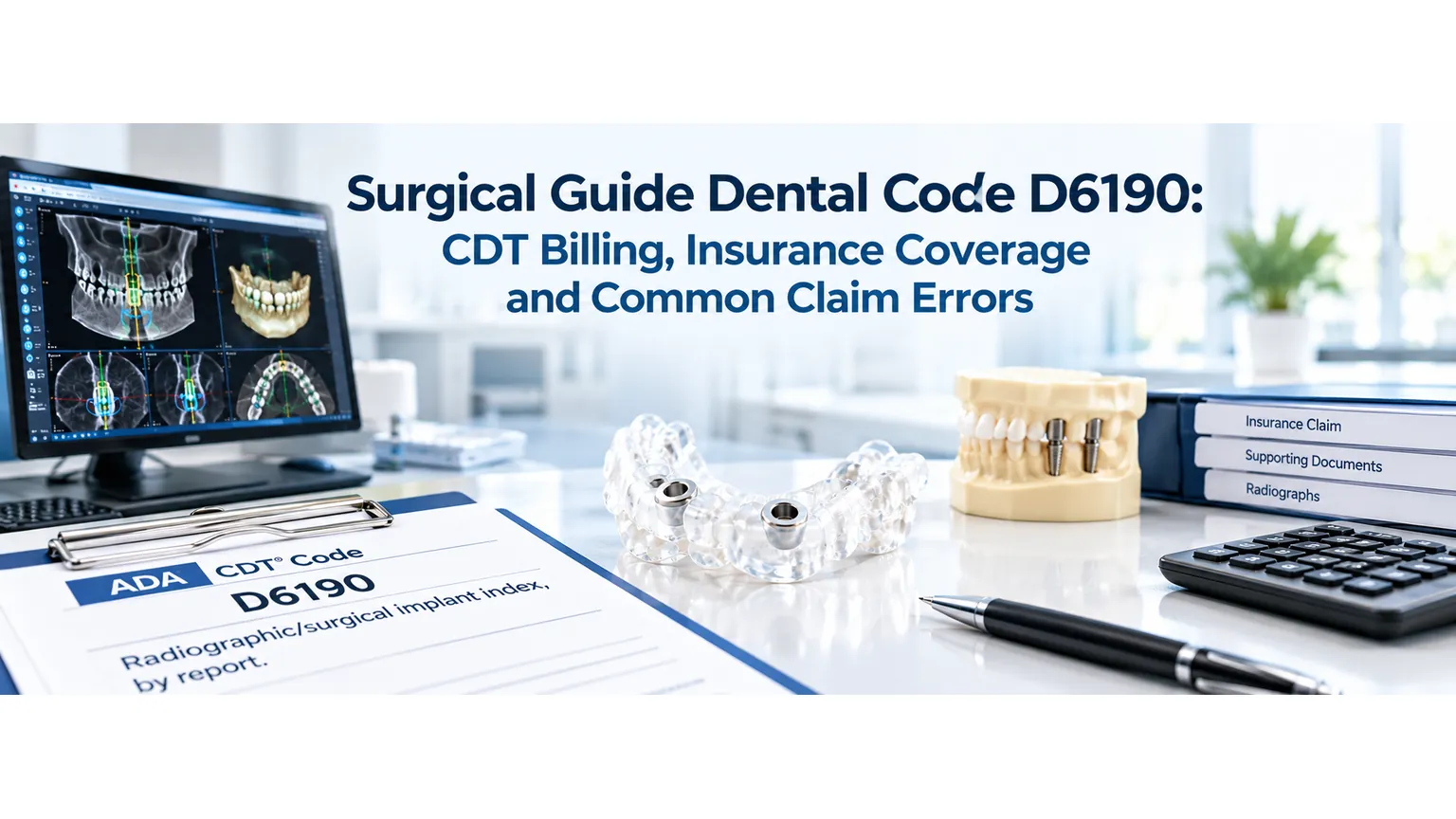
CDT code D6190 is defined by the American Dental Association as: Radiographic/surgical implant index, by report. The phrase "by report" is significant. It means the code does not have a fixed fee schedule entry at most payers. Instead, reimbursement is determined by what the provider reports in the attached narrative. Without that narrative, the claim is almost always denied or returned for additional information.
The code covers the fabrication and clinical use of a device, whether a radiographic stent, a surgical guide, or a combined index, that assists in the precise positioning of one or more dental implants. The guide is considered a separate service from the implant placement itself and should not be bundled into other implant codes.
What Qualifies as a Surgical Index Under D6190
The guide covered by D6190 must serve a clinical purpose beyond basic treatment planning. Qualifying devices include tissue-supported surgical stents used during implant osteotomy, radiographic templates worn during cone beam computed tomography scanning for treatment planning, combined radiographic-surgical guides that serve both functions, and digitally designed and manufactured guides produced from cone beam computed tomography data.
A custom dental implant surgical guide produced by a dedicated remote lab qualifies under D6190 when the guide is fabricated as a separate service, incorporates sleeve positioning, and is documented as a distinct step in the treatment sequence. The guide must be specific to the patient and the planned implant sites, not a generic positioning aid.
When to Submit D6190 on an Implant Claim
Companion Codes and Claim Sequencing
D6190 is submitted alongside the implant body placement code, typically D6010 for an endosteal implant. The two codes should appear as separate line items on the same claim, not combined. Some practices submit D6190 on a separate claim date corresponding to the appointment at which the guide was delivered or tried in, which can also help demonstrate that fabrication preceded surgery.
D6190 can be billed once per surgical site grouping per surgical event. If a practice places four implants in a single arch using a single guide, one D6190 is appropriate for that surgical appointment. If two separate surgeries are performed on separate dates, each surgery may support a separate D6190 submission, but each claim must be supported by its own narrative and documentation.
Flapless and Guided Surgery Scenarios
Payers are more likely to consider D6190 reimbursable when the clinical case justifies a surgical guide rather than freehand placement. Situations that support medical necessity include flapless implant placement where the surgeon cannot directly visualize bone anatomy, cases with proximity to the inferior alveolar nerve, sinus, or adjacent root structures, multiple-implant cases requiring precise parallelism for a prosthetic outcome, and implant placements in edentulous spans where no adjacent teeth provide positional reference.
The stronger the clinical justification in the narrative, the stronger the claim. Practices that use a surgical guide design service with documented implant planning data already have most of the narrative components available before the claim is submitted.
Documentation Required for a D6190 Claim
The Narrative Requirement
Because D6190 is a "by report" code, a written narrative is not optional. It is the mechanism by which the payer determines what the code covers and whether the service meets the plan's coverage criteria. A compliant D6190 narrative should include: the reason a surgical guide was fabricated rather than proceeding freehand, the type of guide produced (radiographic, surgical, or combined), the anatomical structures that required careful navigation, the implant system and number of implants involved, and the date of guide delivery relative to the surgical appointment.
Narratives that say only "surgical guide fabricated for implant placement" are routinely returned for additional information. Payers want to understand why the guide was clinically necessary, not simply that it was used.
Supporting Radiographic Records
The claim should be supported by the cone beam computed tomography scan or panoramic radiograph used during treatment planning. The images serve two purposes: they document the clinical complexity that justified a surgical guide, and they provide the payer with evidence that the planned implant positions required careful navigation. Attach images as either printed radiographs or electronic attachments, depending on the payer's submission format. Ensure the images are clearly labeled with the patient name, date, and treating provider.
Insurance Coverage for D6190
Why Many Plans Exclude or Bundle This Code
Dental plan coverage for D6190 is not uniform. Some major carriers include the code as a covered benefit under implant-related services. Others explicitly exclude it, treating surgical guide fabrication as part of the overall implant placement fee. A third category of plans covers D6190 only under specific clinical circumstances, such as immediate load cases or full-arch implant procedures.
The most common coverage limitation is bundling. Payers who bundle D6190 argue that precise implant placement is expected as part of the D6010 service, and that the guide is simply a tool the dentist chooses to use rather than a separately billable procedure. Countering this argument requires the narrative to establish that the guide adds a specific clinical benefit beyond what freehand surgery provides, and that its fabrication involved a separate process with associated cost and time.
Medical Cross-Billing Considerations
In some cases, particularly for patients who have suffered tooth loss due to trauma, pathology, or certain systemic conditions, the surgical guide component of an implant procedure may be billable to medical insurance rather than or in addition to dental insurance. Medical billing for implant-related procedures typically uses Current Procedural Terminology codes rather than Current Dental Terminology codes, and the specific codes used vary by payer. Practices that explore medical cross-billing for implants should work with a billing specialist familiar with medical necessity documentation for surgical planning devices.
Five Common Claim Errors That Lead to D6190 Denials
Missing or Insufficient Narrative
The most frequent cause of D6190 denial is submitting the code without a narrative or with a narrative that does not meet the payer's "by report" standard. Every D6190 claim should include a written statement of at least three to five sentences explaining the clinical necessity of the guide, the type of device fabricated, and how it contributed to a safer or more precise surgical outcome.
Bundling D6190 with the Implant Placement Code
Payers that bundle D6190 into D6010 will deny the surgical guide charge when both codes appear on the same claim. If you receive a bundling denial, the appeal should demonstrate that the guide is a separately fabricated device with its own cost of production, and that its fabrication preceded the surgical appointment by a measurable period. A lab invoice or delivery date record is useful evidence for this appeal.
Incorrect Tooth Number or Site
D6190 must be submitted with the correct tooth number or edentulous site designation. Claims that list a tooth number that does not correspond to the implant site on the same claim, or that fail to list a tooth number at all, are frequently rejected for missing information. For multiple-implant cases, list the primary site or the arch designation, depending on the payer's preferred format.
Submitting Without Pre-Authorization
Many plans that do cover D6190 require pre-authorization before the guide is fabricated. Submitting a post-treatment claim without a prior authorization number often results in denial, even when the service would have been approved had the practice requested authorization in advance. Verify benefit eligibility and pre-authorization requirements before committing to guide fabrication for any patient with dental coverage.
No Proof That the Guide Was a Separate Service
Payers occasionally deny D6190 on the grounds that there is no evidence the guide was fabricated by a separate party or that its production involved a cost distinct from the surgical fee. A lab invoice from a dedicated implant surgical guide laboratory is the strongest counter-documentation available. It confirms the guide was manufactured externally, establishes a production cost, and provides a delivery date that predates the surgical appointment.
How a Professional Surgical Guide Lab Strengthens Your D6190 Documentation
The documentation that supports a D6190 claim is significantly stronger when the guide is produced by a dedicated remote lab rather than fabricated in-house. A lab order creates a paper trail that payers find persuasive: there is an order date, a fabrication period, a delivery date, and a separate line item cost. These elements address the most common denial arguments, that the guide was bundled into the surgical fee and that its fabrication was not a distinct service.
Guided Excellence provides a surgical guide fabrication process that generates case documentation at every stage, from initial cone beam computed tomography case submission through clinical review and guide delivery. That documentation can be referenced in your D6190 narrative and attached to claims when additional support is requested. Practices that outsource their guides to a professional lab are also better positioned to demonstrate that the guide involved expert design review rather than a simple in-office template.
Every guide produced by Guided Excellence undergoes a licensed dentist review before fabrication begins. That clinical review step, which verifies implant angulation, sleeve positioning, and depth settings, is exactly the kind of professional oversight that differentiates a billable surgical index from a routine planning aid. You can review our dental implant surgical guide pricing and submit a case for review directly from the Guided Excellence portal.
Documentation Comparison: What Payers Require vs. What the Lab Provides
| Documentation Element | What the Payer Requires | What the Lab Provides |
|---|---|---|
| Clinical narrative | Required: "by report" code | Fabrication report from lab included with every guide |
| Cone beam computed tomography or panoramic radiograph | Required: must show planned implant site | Lab uses scan files; originals stay in clinical record |
| Implant planning data | Strongly recommended | Planning parameters documented in case submission |
| Proof of separate fabrication | Required to avoid bundling denial | Invoice and fabrication record confirm separate service |
| Clinical review notation | Varies by payer | Licensed dentist review letter available on request |
| Pre-authorization | Recommended for most payers | Lab turnaround fits pre-auth timeline in most cases |
Key Documentation Points for a Clean D6190 Submission
Whether the guide comes from an in-house workflow or a dedicated remote surgical guide design and fabrication service, the following elements should appear in every D6190 claim package.
- Written narrative of at least three to five sentences explaining clinical necessity and guide type
- Cone beam computed tomography or panoramic radiograph from the planning phase attached to the claim
- Separate line items for D6190 and D6010, not combined on a single procedure entry
- Correct tooth number or arch designation matching the implant site on the same claim
- Lab invoice or fabrication record showing the guide was produced before the surgical date
- Pre-authorization number when required by the plan prior to treatment
Bill D6190 with Documentation That Supports Your Claim
Surgical guide dental code D6190 is a legitimate billing code for a legitimate clinical service. The challenge is not the code itself, it is the documentation required to support a "by report" submission in an insurance environment where many plans default to bundling or exclusion. A complete narrative, accurate radiographic support, a separate fabrication record, and proper sequencing on the claim form are what separate approved D6190 claims from denied ones.
Guided Excellence can help implant dentists build a stronger documentation foundation by producing guides through a process that generates case records at every stage. Whether you are placing one implant or twelve, our nationwide implant surgical guide service provides the fabrication documentation your billing team needs to support a D6190 submission.
To get started, explore our surgical guide process for implant dentists, review surgical guide pricing and turnaround options, or contact our surgical guide team with any questions before submitting your first case.